[ This article was originally published on the ISLAMiCommentary website, which is now only available via the Wayback Machine. Here is a direct link to this article: https://web.archive.org/web/20170214044804/https://islamicommentary.org/2014/05/soft-power-and-the-arab-spring/index.html ]
by TAYLOR JOHNSON for ISLAMiCommentary/ARAB SPRING CLASS at DUKE UNIVERSITY on MAY 2, 2014
curated and edited by Julie Poucher Harbin, Editor, ISLAMiCommentary
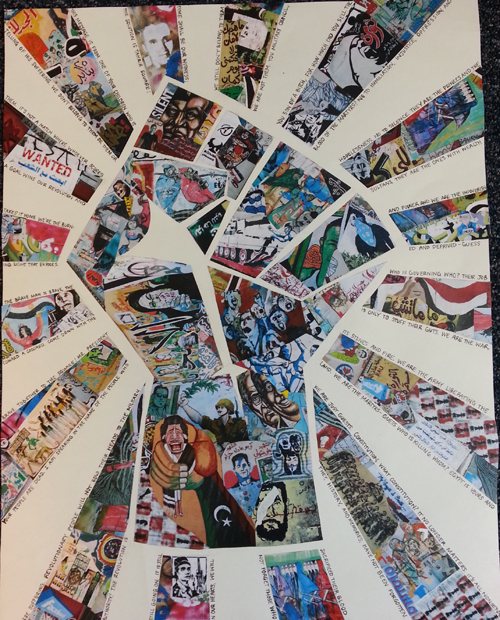
My creative work depicts a revolutionary fist made out of a collage of graffiti from the Arab Spring revolutions, outlined by lyrics and words from musicians like Ramy Essam and El General and from poets like Ahmed Fouad Negm.
The focus is the force of soft power, specifically graffiti, poetry, and music during and after the Arab Spring revolutions, amid an environment where hard power is controlled by a few political elites and difficult for the masses to access.
I really liked the concept of soft power and felt it needed exploring, because the mainstream scholarly trajectory tends to focus on the political and government aspects of revolutions and less on the capabilities of soft power to enact change where politics and government fall short. My thesis is that musicians like Essam, poets like Negm, and the many graffiti artists whose work lies throughout the streets of Egypt had the power to influence the revolution by inspiring others, specifically young people, to “go down to the square” with their messages of a powerful and angry revolutionary force, by providing powerful examples of opposition to authoritarian rule and corruption that couldn’t be killed by gunfire or tortured by a corrupt police force, and by creating a medium that could be understood by sympathizers abroad, who maybe couldn’t understand the lyrics or words but received and supported the message of human rights and freedoms.
I believe that the soft power of music, poetry, and graffiti helped to make the revolution what it was, and without it the revolutions could’ve fallen flat. Additionally, the art of the revolutions has the capacity to extend further and have more of an emotive effect than the names and dates of those who’ve died and the numbers of corrupt dollars spent. They not only propelled our understanding in the west of the events of the Arab Spring and why they were important – they recalled the power of art and of a single person’s words against the mighty enemy of an oppressive state.
Some resources on this topic:
Bohn, Lauren E. “Rapping the Revolution.” The Middle East Channel. ForeignPolicy.com. 22 Jul. 2011. Web. 21 Apr. 2014.
Colla, Elliot. “The Poetry of Revolt.” Jadaliyya. Arab Studies Institute. 31 Jan. 2011. Web. 21 Apr. 2014.
Kimball, Sam R. “Rapping the Arab Spring.” World Policy Journal 30.4 (2013): 79-86.
Levine, Mark. “Music and the Aura of Revolution.” International Journal of Middle East Studies 44.4 (2012): 794-797.
Omri, Mohamed-Salah. “A Revolution of Dignity and Poetry.” Boundary 2 39.1 (2012): 137-165.
Swedenburg, Ted. “Egypt’s Music of Protest.” Middle East Research 265. Middle East Research and Information Project. Web. 21 Apr. 2014.
Taylor Johnson is a sophomore at Duke University. This project and synopsis was part of Johnson’s final project for “The Arab Spring” class (PolySci 222) taught by Duke professors Abdeslam Maghraoui and Ellen McLarney.
—
This article was made possible (in part) by the Transcultural Islam Project, an initiative launched in 2011 by the Duke Islamic Studies Center — in partnership with the Carolina Center for the Study of the Middle East and Muslim Civilizations and the Oxford Centre for Islamic Studies — aimed at deepening understanding of Islam and Muslim communities. See www.islamicommentary.org/about and www.tirnscholars.org/about for more information. The Transcultural Islam Project is funded by a grant from the Carnegie Corporation of New York. The statements made and views expressed are solely the responsibility of the author(s).
Other web sites and print publications may re-publish this article as long as there is source attribution (author and ISLAMiCommentary) and a link back to ISLAMiCommentary.
Related Posts:
- Egypt on the Third Anniversary of the Uprising: Discussion with WSJ’s Matt Bradley, Profs. Maghraoui and McLarney
- The Art(s) of Revolution in the Middle East
- Duke Students Create Their Own “Arab Spring” Graffiti on Campus as Part of Class
- Technology and the Sacred: Voices and Faces of the Adhan in Cairo
- Egypt on the Third Anniversary of the Uprising: Moving Toward a Thug State?
Tags: Abdeslam Maghraoui, Arab Spring, Duke University, Egypt, Ellen McLarney, Taylor Johnson
Category: Human Rights & Gender, i-Comment, Middle East and North Africa, Politics & Current Events, Security & Civil Liberties