Special to the Diplomatic Pouch by Julie Poucher Harbin
"Ladies and gentlemen, this is a very good forum because I can see that women got power," said Ambassador of the Republic of Congo Serge Mombouli, as he addressed a crowd of mostly women in the chandelier and sunshine-lit room overlooking the Potomac on March 2. The women cheered.
One could be forgiven for thinking the guests were there for an early celebration of International Women's Day. But the luncheon was actually a forum on Africa organized by the Capital Speakers Club. Five African ambassadors gave an overview of their countries and spoke about the role of women in the development process. Colorfully arranged tables beside the dining room were laid out with handicrafts, books and other items from Africa, while salads, aromatic rice, flavorful bean and beef dishes and fish were laid out in a tasteful buffet.
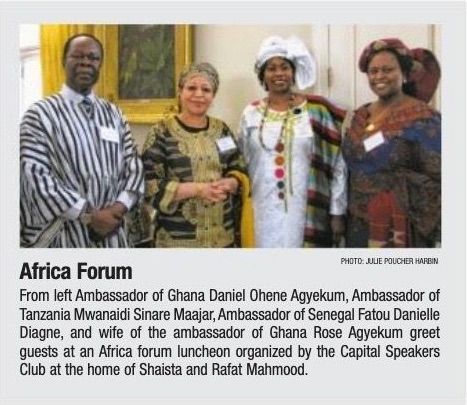
The official hostess of the program, prominent D.C. fundraiser Shaista Mahmood, wife of Pakistani Ambassador-at-Large Rafat Mahmood, had welcomed guests to the couples' Mount Vernon area home in a receiving line that included Ambassador of Ghana Daniel Ohene Agyekum and his wife Rose Ohene Agyekum, Ambassador of Tanzania Mwanaidi Maajar, Ambassador of Morocco Aziz Mekouar, Ambassador of Senegal Fatou Danielle Diagne, and Ambassador Mombouli.
Ambassadors' wives from Peru, Egypt, Tunisia, Indonesia, Ecuador and other countries also mingled with professionals from the World Bank and U.S. State Department, as well as business executives in hotel development, upscale furniture retail, multi-national management, and catering — just to name a few of the 100 or so guests at the late winter event.
Mombouli, who's been with the Congolese Embassy since 1997 and became ambassador in 2001, is an expert in corporate law and business negotiations by training. Once the cheering had died down, he proudly explained that women are "a key element of society in Congo" and that they are deeply involved in the country's economic and political life; working in the government, parliament, and the military. They also play a predominant role in agricultural production, generating 80 percent of the food crops for consumption, as well as tending to the domestic roles of water fetching, firewood gathering, food processing and preparation.
He also remarked that the Congo enjoys one of the highest literacy rates in Africa, including for women, and that women, as the sole educators, are largely responsible for this success.
One of two female ambassadors in attendance at the forum, Fatou Danielle Diagne served as minister advisor to the Senegalese president on competitiveness and good governance, before taking up her post as Senegal's ambassador to the United States. She focused most of her talk on Senegalese culture; specifically the tradition of glass painting and the ceremonial dancing of the saaba (a.k.a. sabar).
Though glass painting is not typical Senegalese (it dates back to the Romans and was popular well into the 18th century in Europe), it is an art practiced today in Senegal by young boys working on the riverside. The paintings depict woman dancing, or a house or village scene, or even a political leader.
"They are very colorful to bring joy and ... they play an important part in our tradition and art," she said.
The wives of the ambassadors of Egypt and Indonesia, Suzy Shoukry and Rosa Rai Djalal, admired one such painting that was being passed around the room.
With a nod to West African master drummer and dancer Kwame Ansah-Brew of Ghana who peformed after lunch, Diagne said, "As you know, in Africa we like to dance to express our feelings and everything. And we are so proud of our saaba."
Saaba, a dance performed to drumming rhythms on special occasions like weddings, births, and funerals, can be heard from a distance of 15 kilometers away.
Ambassador of Morocco Aziz Mekouar lamented that he hadn't come prepared to talk about Morocco's many cultural traditions, but had politics in mind instead. Specifically, he noted the work of the government and women's organizations over the past two decades to address women's rights by making landmark changes to what was an "unbalanced family law."
"We had a strange situation in that we had women all over the place in the ministries, as ambassadors, doctors, and as entrepreneurs leading thousands of people — mainly men...but at the same time they were not really considered as adults within the family," he explained. Divorce was unilateral and custody of children was always in favor of the father. Now, he said, spouses are treated equally under the law.
Ambassador of Tanzania Mwanaidi Sinare Maajar, a corporate attorney by profession and active member of an NGO that advocates for women's rights and access to the justice system, recounted the touching and personal experience of being a mother in her talk about the kanga, a traditional scarf-like garment worn as a dress in central and eastern Africa.
She held up a kanga, given to her by her son when he was 11. He and another boy had pooled their money and bought it during a school field trip for their respective mothers. "Mama, Mother is a mother eternal" was printed on the kanga. The two mothers shared the kanga until Maajar's son died at the age of 18. "Now I carry it all the time. And it is my connection to him," she said.
Maajar, who became ambassador just last fall, also noted that husbands or boyfriends often give kangas to wives or girlfriends to express their affection. A woman will also wear certain kangas to give messages to other women. "It's usually a sarcastic message," said Maajar, displaying a kanga that a woman might wear to the market when she thinks another woman has been talking about her behind her back, and knows she will see her there. The message on this particular kanga, loosely translated, said "Oh God, please protect me from hypocritical people."
At that moment, Mary Feierstein, wife of the U.S. Ambassador to Yemen Gerald Feierstein, laughed, "Oh that would sell a lot."
Ambassador of Ghana Daniel Ohene Agyekum, the final speaker, turned the conversation back to serious matters, talking about women's "leading role" in Ghana, which has a female speaker of the Parliament, chief justice and minister of justice. He noted that women constitute 80% of those engaged in agricultural production (like in Republic of Congo), and that girls, like boys, can go to school and become engineers, doctors, politicians or whatever they want to achieve.
"There's absolutely no distinction between women and men," Agyekum said.
He proudly pointed out that Ghana was the first to achieve independence from the British "for good reasons" and it was the first African country to be visited by President Obama. And he closed by taking the long view on Africa's development and evolution, which isn't always accurately portrayed in the West.
"As a continent we have been faced with very serious challenges; challenges of poverty, hunger; but there's so much positive things going on in Africa today, that would cloud the negative developments in countries like Tunisia, Egypt, Cote d'Ivoire, Somalia, and Sudan. The point I'm making is that Africa has so many things to offer to the world," he said. "We have attained a large measure of relative stability and we are trying to pursue the path of true democratic governance."
To cap off the celebatory conclusion, Agyekum and his wife Rose took a turn on the dance floor, joined by other ambassadors who let down their diplomatic guard to enjoy the moment.
This article is included in The Washington Diplomat XXX Diplomatic Pouch e-newsletter. (Original: )
UPDATE: Below is a screenshot of an image taken by Julie Poucher Harbin for The Washington Diplomat (newspaper) Diplomatic Spotlight section.