[This article is included in The Washington Diplomat Diplomatic Pouch e-newsletter, April 2011, and was preserved by Julie Poucher Harbin]

Special to the Diplomatic Pouch by Julie Poucher Harbin
Top women media executives and journalists from Canada, Britain, Uganda, Peru, Germany, Norway and the United States were among the guest speakers at an International Conference of Women Media leaders that drew around 60 delegates — "the international hall of fame of journalists" — and other invited guests from the far corners of the globe.
Organized by the International Women's Media Foundation (IWMF) and the George Washington University Global Media Institute, the March 22-25 conference was set up as a forum "to discuss gender barriers in the news business and craft a plan for the future," according to conference materials.
The first-ever comprehensive Global Report on the Status of Women in the News Media, a two-year study commissioned the IWMF and unveiled at the conference, revealed that women now represent about a third of the full-time journalism workforce in the world. The study was based on research data drawn from 522 print and broadcast media companies, 59 countries, and about 170,000 people.
It found that glass ceilings for women in the media business in about one-third of the nations studied still exist; most commonly, according to the study, at the middle and senior management levels. And while men continue to occupy the vast majority of top management jobs, with women holding only 27 percent of those positions, this did represent an increase over a 1995 Margaret Gallagher study that showed women occupying an average of only 12 percent of top management positions.
Women hold only 36 percent of the reporter jobs, but the study found that they occupy 41 percent of the newsgathering, editing and writing jobs worldwide, so they are nearing parity with men.
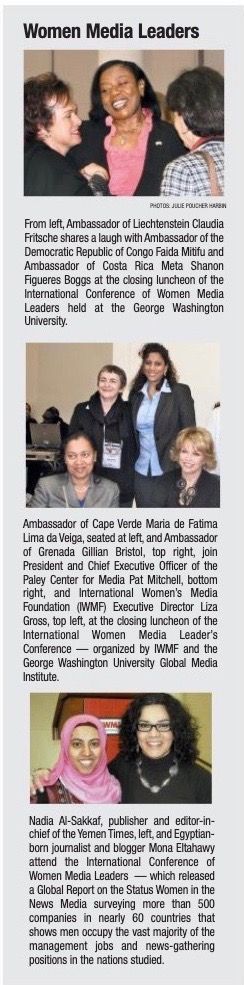
President and CEO of the Paley Center for Media and veteran broadcast network journalist Pat Mitchell spoke at the conference's closing luncheon about the direct correlation between women's empowerment and a country's prosperity and security.
Praising and encouraging a room full of journalist delegates from all over the world, Mitchell said, "There are so many examples of stories that you have written, blogged, tweeted or read that have changed your communities in your countries."
"I do not accept that advocating for women's stories, insisting that women are present in the news, in every forum, on very panel, at every table where discussions and decisions are made, is a loss of objectivity. Advocacy for gender sensitive issues in the place we work, enforcing them in the organizations we support, the companies we lead, is our responsibility, as individuals, as journalists and as women leaders."
Newly appointed Ambassador to Botswana Tebelelo Seretse agreed. In a lunchtime chat with the Diplomatic Pouch, Seretse said she wished female journalists in her country would do more to cover the women running for political office and show them in a positive light, arguing that if there was more coverage of women, more of them would seek and attain political office for the betterment of their communities.
Why the apparent resistance of women journalists to cover women?
"It's cultural. They are not seeing other women as leaders. They don't speak up. They don't have a woman bold enough," Seretse said. "They have to be trained."
Seretse, who from 1999 to 2004 served in two government ministries and the Office of the President and was chairperson of the women's wing of the ruling party in Botswana, said she spent time training female politicians, in the absence of press coverage, on how to get support for their candidacies, such as understanding local issues and how to do a house-to-house campaigning.
"Very, very, very few stood in the last parliamentary elections in 2009. Of 57 in parliament, only four women were elected," she said, attributing this also to a lack of training, access to good financial resources and an unwillingness of the government to change the constitution to mandate more equitable female representation.
The Global Report on the Status of Women said that slightly more than half of the media companies surveyed had established company-wide policies on gender equity. Western Europe and Sub-Saharan Africa were even higher at 69 percent of companies.
Conference delegate Nadia Al-Sakkaf, publisher and editor-in-chief of the Yemen Times and an 11-year veteran of the media business in Yemen, told the Diplomatic Pouch that while there are female Yemeni reporters, it's difficult for them to rise up in the ranks and become editors and publishers — admitting that she herself was lucky to rise because the paper is a family business. She took over for her father as publisher and editor-in-chief when he passed away, and her brother and sister are also involved with the company.
Al-Sakkaf, who has a strong reporting background, is frustrated with the lack of coverage she sees from female reporters, but for the opposite reason cited by Ambassador Seretse. "The stereotype is that women must only cover women and children's issues. It's difficult for them to get other things published," she said.
Mitchell expressed her deep appreciation at the luncheon for the kind of contribution that Al-Sakkaf, who was only in D.C. for four days and was due to fly back to Sanaa at its close, and other journalists have made to global media.
"Independent media is absolutely critical in a place like Yemen to have," she said. "Nadia is running a newspaper that is free of government influence and restrictions, and many of the women in this room are either working for independent sources or are an independent source of news and information themselves."
As the delegates and invited guests, including 10 female ambassadors to the United States, were finishing up their coconut cake and coffee, they turned their attention to Mitchell, who had invited Egyptian-born journalist and blogger Mona Eltahawy to the stage to speak about "Women's Voices in the Revolution."
Ambassador of Botswana Seretse, Ambassador of Bahrain Houda Nonoo, Ambassador of Cape Verde Maria de Fatima Lima da Veiga, Ambassador of Costa Rica Meta Shanon Figueres Boggs, Ambassador of the Democratic Republic of Congo Faida Mitifu, Ambassador of Grenada Gillian M.S. Bristol, Ambassador of Liechtenstein Claudia Fritsche, were all seated near the front and listened attentively.
Eltahawy said the best way to look at social media's role in the revolutions and uprisings in the Middle East and North Africa was to consider social media "the latest tool" that has enabled young people especially to get their voice across. She mentioned a young brave Egyptian woman, interviewed by Al-Jazeera English, who was determined to stay in Tahrir Square even when things got violent. Eltahawy, like so many others, followed her Tweets and worried if there was too long a gap in updates.
"I'd say that social networking especially, be it on blogs or on Facebook or Twitter, has created this seismic shift in consciousness, and has allowed young people, men and women to say I count, and once you say I count, in an autocratic state, you are essentially telling the regime ... that you will not be silenced anymore," said Eltahawy, while stressing that courage and activism have long existed in the region.
Eltahawy herself, with 43,000 Twitter followers, not only followed the tweets of protesters on the ground in Tunisia, Egypt, Bahrain, Syria, Libya, and Yemen, to better understand what is going on, but she re-tweeted and has continued to re-tweet information in their posts to her followers.
"I'm trying to use my Twitter feed as a conveyer belt ... to get their voices out," she said.
She pointed out that while some high profile so-called western journalists were interviewing Egyptian President Hosni Mubarak and Libyan leader Moammar Gadhafi, they weren't getting access to Libyan people on the ground.
"If you can't get on the ground, you can find citizen journalists who can get on the ground for you and connect you to people who someone like Gadhafi is preventing you from reaching," she said.
IWMF's Executive Director Liza Gross told the delegates how the idea for creating the IWMF had grown out of a conference two decades earlier but similar to the one held this March.
"The Berlin Wall had fallen, Eastern Europen countries were becoming free, the Soviet Union was becoming free and there was a great growth in free press all over the world. We started an organization that believes very deeply that no press can be truly free unless it includes women. Now we find ourselves 21 years later and we have another area where freedom and free speech and free press are breaking out and again, we want to make sure that women are included in that very important struggle for freedom."
As United States Ambassador-at-Large for Global Women's Issues Melanne Verveer said in her keynote luncheon speech at the start of the conference, "The fact is that there is nothing that is not about us. As we fare so goes the world, as we prosper so goes the world."
Note: The original images are missing from the Diplomatic Pouch piece. Here below are some images taken by Julie Poucher Harbin at the event that were featured in The Washington Diplomat Diplomatic Spotlight section in May 2011.