[ This article was originally published on the ISLAMiCommentary website, which is now only available via the Wayback Machine. Here is a direct link to this article: https://web.archive.org/web/20170214052700/https://islamicommentary.org/2013/08/zalmai-afghan-migrants-in-limbo-in-greece-stuck-in-the-quicksand/]
by JULIE POUCHER HARBIN, EDITOR, ISLAMiCommentary on AUGUST 5, 2013
Since the early 2000s, Greece has become the major gateway into the EU for undocumented migrants and asylum seekers from Asia and Africa. According to the latest numbers available (2010 OECD figures), irregular migrants made up almost 10 percent of the southern European country’s population.
Greece is not the preferred end-destination, however, for a variety of reasons — not least xenophobia-motivated hate crimes, a lack of economic opportunities made worse by the financial crisis, and mismanaged migration and asylum policies (which are only this year beginning to show signs of reform).
Afghan-Swiss photographer Zalmaï, traveled to Greece over a period of two-and-a-half years, going back and forth several times, each time for about three weeks, from 2010 until the middle of 2012, in order to expose the deteriorating condition of Afghan migrants trapped in its dysfunctional asylum system. Greece receives the largest number of Afghan migrants and asylum seekers in all of Europe. (In 2010, 3 out of 10 refugees worldwide originated in Afghanistan).
What resulted is his traveling photographic exhibition – Walking in Quicksand. Zalmaï, a world reknowned photographer who’s worked across 83 countries for two decades on many different issues, said it was difficult initially to find funding for the project— “It’s a little bit taboo, what is happening with immigration in Europe right now” — but in 2011 he was grateful to receive support from the Magnum Foundation’s Emergency Fund.
Then, in 2012, he collaborated with Human Rights Watch, which published a report — Hate on the Streets: Xenophobic Violence in Greece — calling on Greek authorities to protect victims, prevent attacks, and punish the perpetrators of hate crimes against migrants. The report was accompanied by a multi-media release that included Zalmaï’s work — illustrating some of the stories of these victims.
Zalmaï came to Duke last Fall 2012 as part of a Duke International Studies Center (DUCIS) one-month residency to share his experiences with students, and exhibit some of the photographs from his Walking in Quicksand collection — which was at that time touring the U.S. and receiving major media attention.
During a reception for the exhibit I had the chance to take a personal tour of the images on display that tell this story that is especially dear to Zalmaï’s heart — the hardships faced by Afghan migrants and asylum seekers.
An Afghan refugee himself, Zalmaï comes from a big family that all departed Afghanistan following the 1980 Soviet invasion. They left with only the proverbial clothes on their backs, and didn’t even take childhood photos with them. (The family was lucky in that Zalmaï’s Swiss-born aunt, who’d lived 29 years in Afghanistan with his Afghan uncle, was able to use her connections to help them get out).
Zalmaï said his experiences as a refugee helped him to connect with the migrants he encountered in Greece.
“Whether I am with an Afghan or an African, as soon as they know that I know what they are going through, all their ideas (about me) change,” he explained.
Most Afghan refugees who do manage to enter Greece, he explained, have come via Iran and Turkey, and from Greece their target destination is further north in Europe — where they have “a better chance” of getting asylum — such as Germany, Switzerland, the UK, and France. That is, if they can transit to Italy from Greece.
“Often,” he said, “they get stuck inside of Greece.”
In the mind of the photographer/activist, Greece is “quicksand” for migrants.
“When I started working on this, and I see the situation of Afghans in Greece, the image came by itself, like the more you try to move, the more you are getting inside and… as you move, you go down, and that was the image of quicksand for me,” Zalmaï told me. “Five percent, 10 percent,” he said, make it out of Greece. “90 percent get stuck in the quicksand.”
The first photo he shows me is of a man standing in the shadows of a doorway of an abandoned hospital in Thiva in central Greece (July 2011) north of Athens.
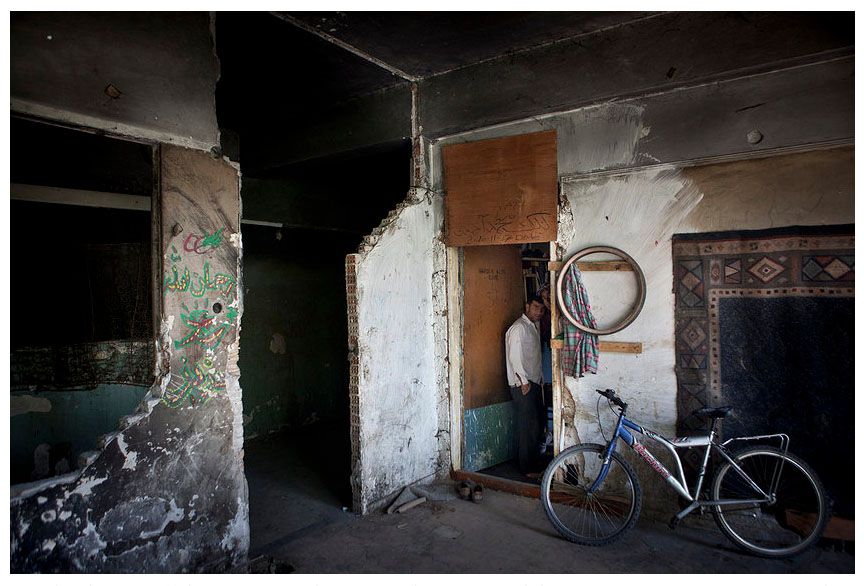
Hundreds of Afghans have taken up residence in this abandoned hospital. They are squatters in search of day-laborer jobs picking onions and tomatoes in the surrounding fields.
“It’s illegal and I think the Greek farmers make profits from the situation and they are paid probably 4-7 euros per day,” Zalmaï explains.
"Do many of them come from an agricultural background?" I ask.
“Not at all. The people, they don’t have money. The smugglers are expensive and when they reach here, they get stuck, they’re running out of money,” he responds.
He says that Afghans have been coming to Greece for the past 10 years or so. Many remain in limbo. Migrants he interviewed were stuck for “3,6, or 8 years or more.”
They don’t get support from social services, and very few are accorded asylum.
“Especially in Greece, they don’t understand the difference between asylum seekers and economic immigrant. They say – you are coming here just for having a better life,” Zalmaï says. “But you can see that in Afghanistan, in many places it’s a war zone. They (Greek authorities) don’t see that they are saving their lives.”
That fundamental misunderstanding of the problem is a major obstacle to gaining asylum. Added to this, Zalmaï notes that unlike in other countries, there are no special offices where refugees can seek asylum. Asylum seekers are directed to go to the police to make the request, he says, but the police either “don’t even know what asylum is,” and/or they put them in jail based on their illegal immigration status. (Since this interivew was conducted the government has established a special asylum service office, but only in Athens).
The second photo Zalmaï shows me is the cover photo for Walking in Quicksand.
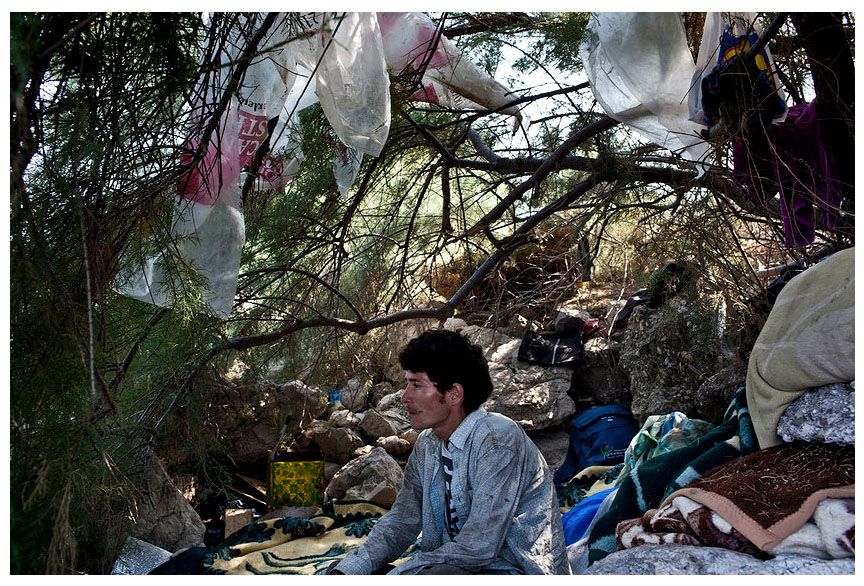
This was taken in the international port of Patras, Greece, also in July 2011. Located in western Greece, the port of Patras is the main gateway to Greece from Italy and Western Europe. Southern Italy is within reach for migrants trying to get out, with multiple daily ferry services.
This is where they wait — often weeks or months — to find stowaway passage in one of the trucks headed by boat to central and northern Europe via Italy. They can’t buy tickets because they don’t have papers.
“They are there along the port, but most of the time the police push them from the city and they have to go to the olive trees under the bridges,” Zalmaï says, and they hide out in the countryside surrounding the city. “They don’t want these people to be visible.”
"What is his story?" I ask, pointing to the man in the photo.
“He was there with a friend,” Zalmaï replies. “Probably over 3 years he’s been in Greece and has tried to leave from there. He was with a few friends. You can see he’s not alone. You have a few different bags here. This is really as close as he can be to the port. And they are waiting to go.”
With no access to running water or electricity, people like him live on whatever they can find from the city’s garbage.
Zalmaï, as he mentioned before, estimates that probably only about 10% of those who try and stow away to Italy, make it.
"So it’s a real gamble," I say.
“Absolutely.”
The next photo Zalmaï shows me is a picture of demonstrators.
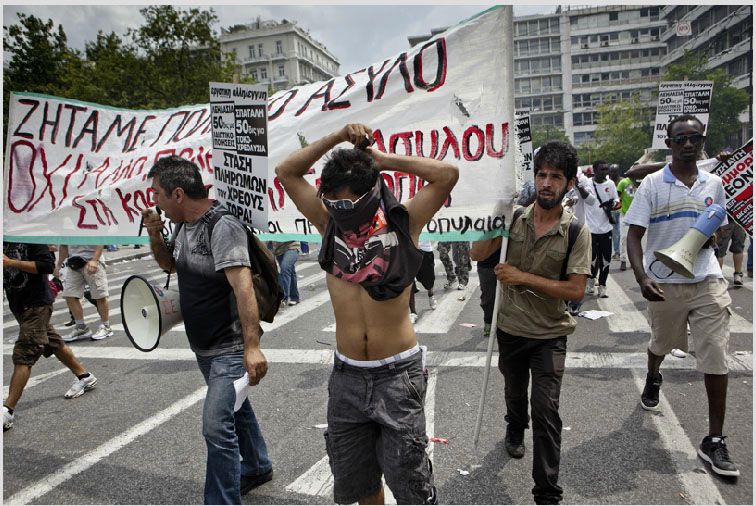
“They have requested asylum and as they cannot get it they go for a demonstration in the street —any occasion to show their existence and that they have rights,” Zalmaï explains. “They are supported by some kind of “left” groups…who demonstrate with them in the streets.”
Then we come to a photo of a wilted sunflower standing alone in the scorching heat. As it turns out it’s marking a mass grave for migrants near the town of Sidiro, Evros; the northernmost part of Greece close to the Turkish border. The graves are unmarked, unidentified, and unnumbered. (Aug. 2011)
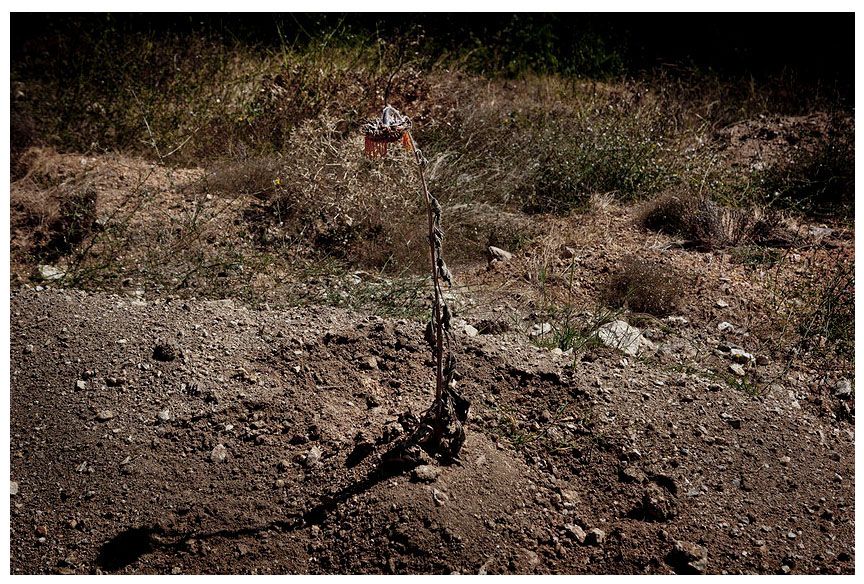
“This picture is very very sad,” Zalmaï pauses. “All those people tried to cross the river (into Greece). If they cannot make it then they’re dying. This is in one of a few small Muslim villages in northern Greece, and the local people have given them (space to bury their dead).”
“I asked around and I heard a lot of people were dying crossing the border and I was asking what they do with their bodies because they don’t have identification, they cannot send them back to Afghanistan or to North Africa or to Syria or to another place, and so they end up here, and there are like 300, 400 people buried there.”
"How many migrants in total in Greece do you estimate have died," I ask?
“A few thousand people,” Zalmaï speculates. “Most of the people we don’t know (about) because no one can record anything. The police, they don’t record.”
I am curious about the Greek Muslim village. "Who are these Muslims ?" I ask.
“About 6-7% of Greeks are Muslim,” Zalmaï says, adding that getting Greek citizenship is very difficult. Thus the “official” Muslim community (not including migrants) in Greece are mainly ethnically Greek and don’t “come from other communities as much.”
“Greek society is a very closed society and they are looking out for themselves and they are very racist and don’t like any foreigners, not only Afghans but even their neighbors in Albania and Turkey,” he adds.
Next Zalmaï takes me to Orestiada, Greece. Four men are stretched out in the grass, resting after a night crossing of the border between Greece and Turkey in the area of Evros, not far from where he found the mass grave. (Aug. 2011).
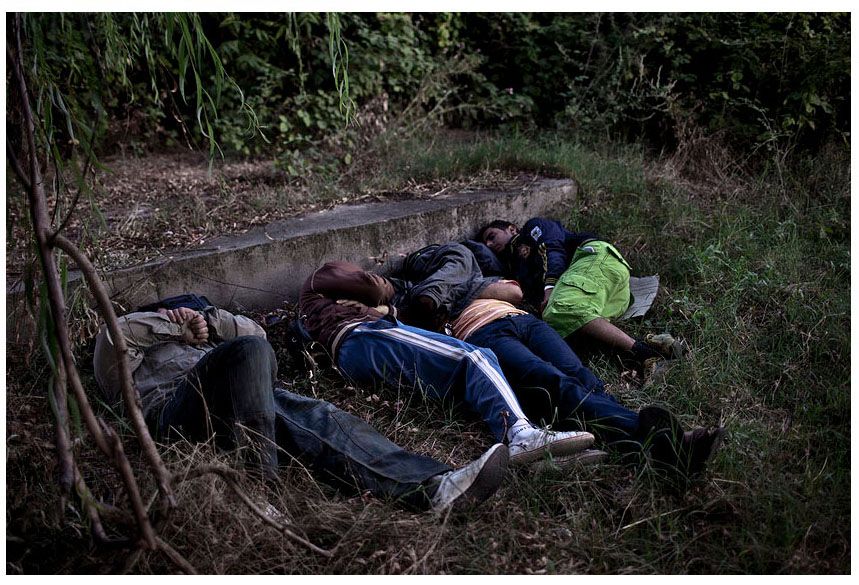
“I found them in the morning; they were sleeping and they planned to continue their journey to Athens,” Zalmaï says.
He was with a Greek friend when he came upon the group: “They were really surprised and at first they thought that… we were the police. And I said, no,no,no we are not police, we are just journalists and they were a little more relaxed. I spoke in Dari but they asked me what they should they do, should they go to the police? This kind of advice you cannot give them, because the consequences are huge.”
“Once they get fingerprinted in Greece, if they ever did make it to Italy, and authorities caught them in Italy, they would be sent back to Greece.”
We are drawn to a photo Zalmaï shot in a room at a group house in an area of Athens that’s popular with migrants. A woman, who lives with her two children and other migrants in that house is looking out the window. You can see the worry on her face.
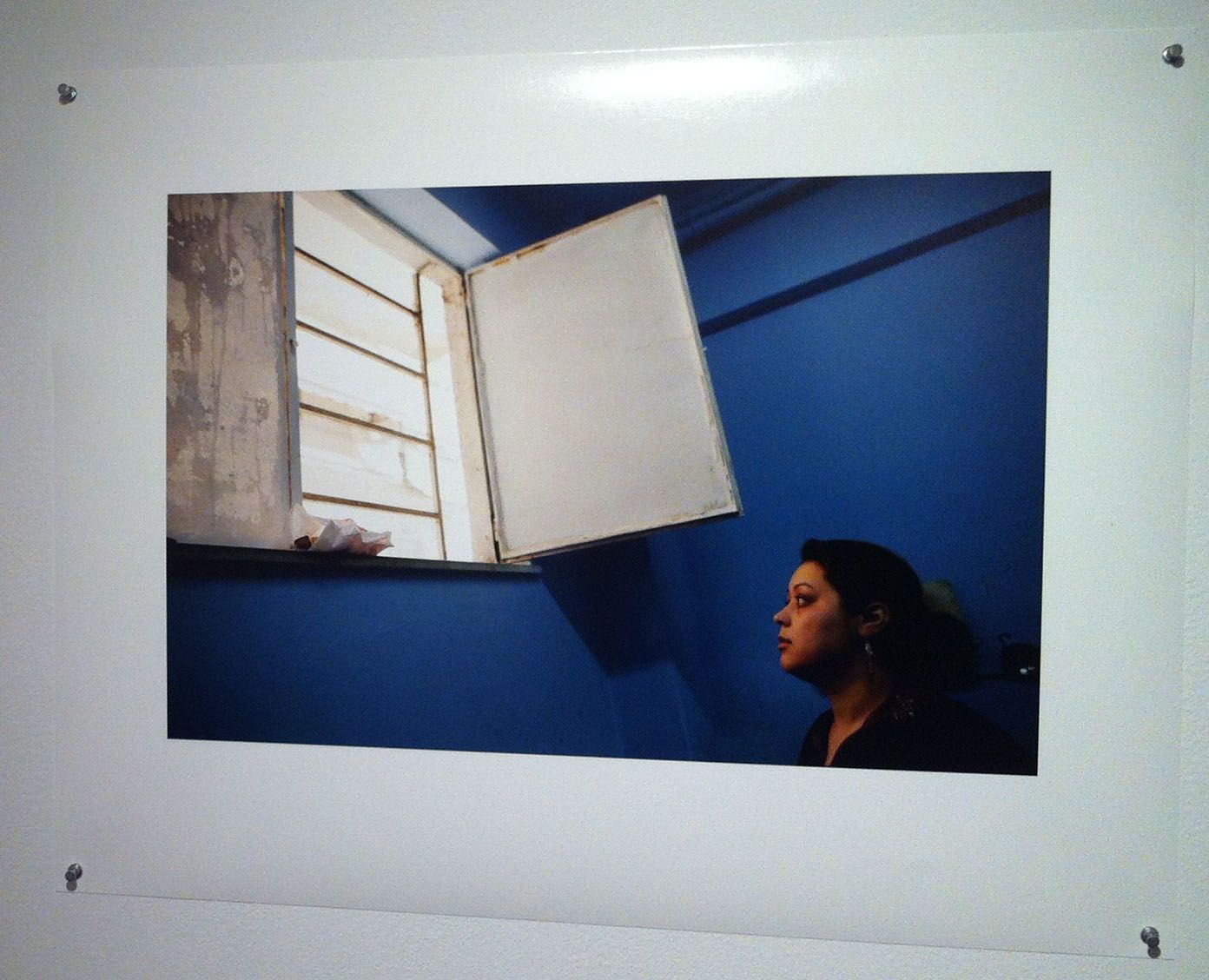
“The light is coming in and the house is like a basement; a place that not many people want to live,” Zalmaï remembers. “She was just crying and crying and crying and saying what can I do…Her house was attacked 4 times in one year by a group of 10-15 people. She has been here for 6 years. She is still waiting to leave the country. She was very worried about her kids, because the kids are without education and haven’t gone to school in a few years. And they are young kids.”
A few years ago the migrants were mainly young and middle-aged men, he explains, but now with “the situation in Afghanistan getting very bad,” there has been an increase in families and children.
“It’s very difficult and the war is spreading everywhere especially in the south of Afghanistan. And mostly they don’t really have opportunity to have some life in Afghanistan and they prefer to take the journey of exile.”
"They are not getting arrested for being squatters?" I ask.
“There are a lot, a lot of (arrests),” he says, “but all the prisons are full.” “They (Greek authorities) don’t know what to do. You can put them in a detention center but then you have to release them, but that is a game of cat and mouse, and it’s going on for years.”
Next we examine a photo in Zalmaï’s traveling collection that is not of an Afghan. This photo is of a 26-year-old man from Somalia, taken shortly after an attack on him and his friend by a Greek neo-Nazi in May 2012 at a park in Athens. The attackers used a beer bottle as a weapon.
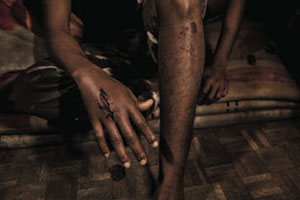
“As he didn’t have any kind of ID papers he could not go to the police to report the attack. He didn’t even want to even go to the hospital because he didn’t have money for the hospital. And I tried to help him get care, because as you can see you could lose your hand if not treated.”
Medical care is a big issue of concern for migrants.
"Who is taking care of their medical care?" I ask.
“No one," he says.
The next photo, also depicts a victim of a hate crime.
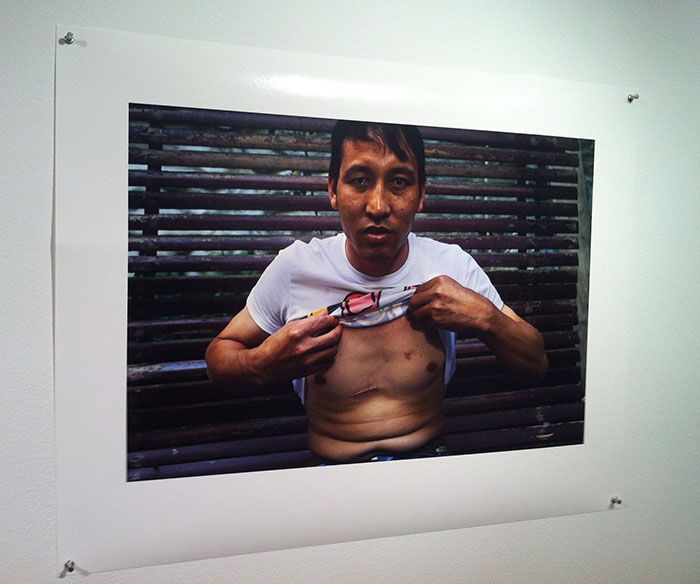
“It is of a man attacked by a group of neo-Nazis south of Athens and he was almost dead. He received 4 stab wounds — in the front and in the back,” Zalmaï says, noting that this was the first (known) case to go to the court, though “two years have gone by and we don’t have any result.”
"Isn’t it risky for a migrant to go to court?" I enquire.
“It’s risky but he was in the hospital, he was dying, he couldn’t even breathe. You couldn’t close your eyes and say it doesn’t exist. They didn’t arrest him, no.”
A woman in a hijab has her palms outstretched. "Is she at a mosque?" I wonder aloud.
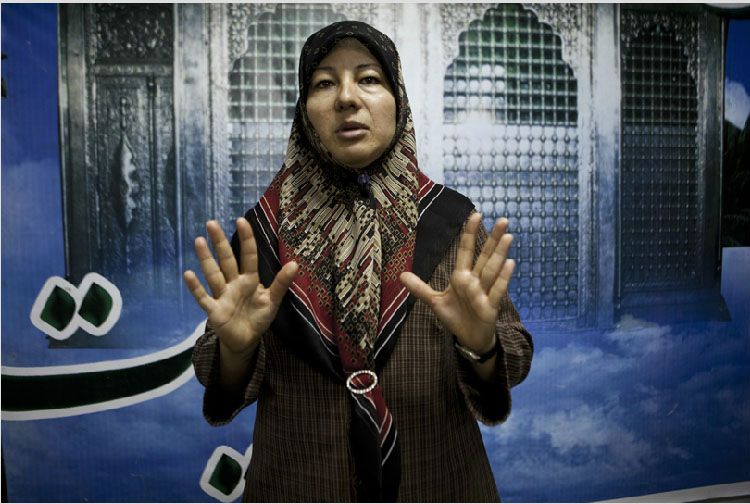
“This is a small center for Afghans to try to have some kind of support from the Afghan community… It’s in a basement, but this," Zalmaï says (pointing to the “mosque” on the wall) "is a painting. It was during Ramadan and they did something to be able to do their prayer.”
Back to the port of Patras (June 2011), Zalmaï shows me an Afghan man looking down at the sea; resting his head in his hand. Migrants have a rough existence. What is their future?
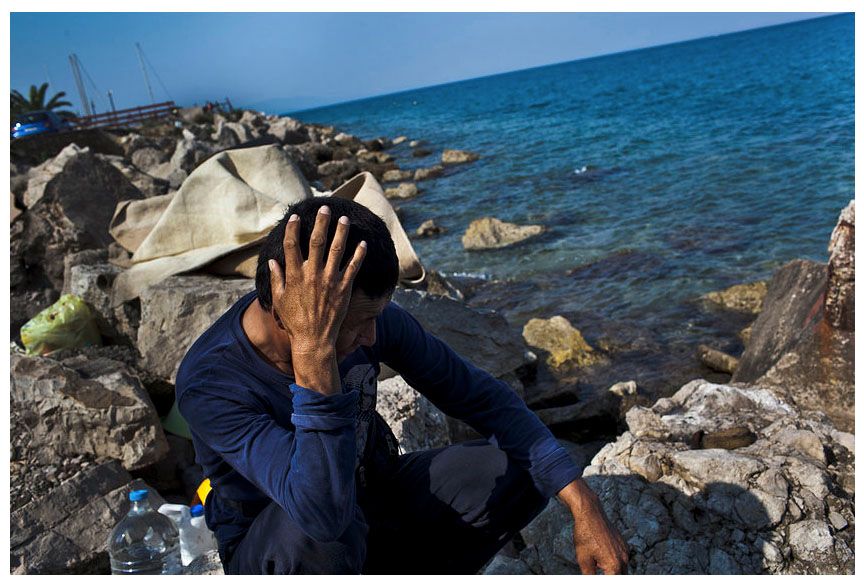
"There must be something that keeps them going," I say.
“Most of them, they don’t have any hope. Because it’s getting even worse and worse and worse. This is the first time after World War 2 that a Neo-Nazi group is in a parliament…Seven percent of the population supports these people,” he says.
The group he is referring to is Golden Dawn, which, according to a recent article in The Washington Post, “has campaigned aggressively against illegal immigration and Greece’s international economic bailout.” The group saw “a surge in support during the financial crisis and the dramatic rise in poverty and unemployment” in Greece, and “popular support is continuing to rise.”
In the Greek general elections in June 2012, Golden Dawn received 6.9 percent of the vote and won 18 seats.
"Are the attacks motivated by Islamophobia or Xenophobia ?" I ask.
“Xenophobia. Mostly,” Zalmaï explains. “I think that any kind of foreigners, they are not very welcome in this country. But they (the migrants) are ordinary people.”
Zalmaï feels strongly that while many in Greece blame immigrants/ migrants for their economic crisis, corruption is the real cause. “Their country was mismanaged for 20 or 30 years and all the money they received from the European Union … went to corruption, all the money disappeared…Probably like 20 -25 percent of the population get everything, but 80% get nothing.”
Migrants are among those victims.
“Nobody really understands them," he continues. "Nobody considers them. Nobody takes responsibility. Nobody recognizes their problem. Which is why I am here today and why I’m doing this work.”
"And yet, they still keep coming" I observe.
“There’s not enough information. People don’t know really what’s going to happen once they reach Greece," explains Zalmaï.
He also describes how some Afghan women are subjected to sex trafficking along the way, once in Greece, or when they make it to Italy. They simply “disappear with the smuggler.”
“When nobody looks for you, you can disappear and nobody knows,” he says, noting that this is true for male and female migrants. “They have families in Afghanistan, and then suddenly no news, no news, and they (the families) are just praying oh it’s going to be ok.”
He pauses, and has me riveted, with another story — the kind that really brings home the value of his work.
“In the movie I interviewed one guy in the middle of Patras. I went back to Afghanistan and I was interviewed on Tolo TV. They broadcast my work (the video), and then a week later someone called me and said thank you very much, I was looking for my brother for six years and I saw him in the movie and thank you very much, I know he’s alive. That was very nice for me and my work. At least one person found his brother again. He was disappeared for years. He saw him on the TV. He was alive. He was talking.”
Postscript
… Human Rights Watch reports that their 2012 report, which included Zalmaï’s work, “was vital in leading the Greek government to announce the establishment of a special police unit to deal specifically with xenophobic violence and promise serious prosecution of the offenders,” though “draft legislation to curb hate crimes was delayed by political infighting.”

The organization also notes that “a new asylum service has begun operating in Athens, but access to asylum in the rest of the country and in detention remains a concern.”
HRW’s latest report (published June 2013) — Unwelcome Guests: Greek Police Abuses of Migrants in Athens — “documents frequent stops of people who appear to be foreigners, unjustified searches of their belongings, insults, and, in some cases, physical abuse.”
“Many are detained for hours in police stations pending verification of their legal status,” according to the report. “Asylum seekers can be detained for up to 18 months, often in unacceptable conditions. Tens of thousands of people have been subject to abusive police stops based on little more than appearance, as part of a crackdown on immigration. Regulations allow detention for forced HIV testing and of migrants and asylum seekers on broad public health grounds.”
Related Posts
- Manslaughter in the Mediterranean: Who are the Migrant Victims?
- Is All Morality Gone? Condemning ISIS, and Beyond, in a World of Suffering (by Omid Safi)
- PEW REPORT: Rising Tide of Restrictions on Religion
- Walking on Quicksand: Afghan Refugees in Greece
- “No Matter How Bad it Gets, Don’t Come Back”
Tags: Afghanistan, asylum seekers, Greece, Greek police, hate crimes, human rights, Human Rights Watch, immigrant health, immigrants, Italy, Julie Poucher Harbin, migrant healthcare, migrants, neo-Nazis, Patras, photography, refugees, Somalia, Switzerland, Syria, Turkey, UK, Zalmaï
Category: Asia, Europe, Human Rights & Gender, i-Comment, Politics & Current Events, Security & Civil Liberties