[ This article was originally published on the ISLAMiCommentary website, which is now only available via the Wayback Machine. Here is a direct link to this article: https://web.archive.org/web/20170213221044/https://islamicommentary.org/2015/07/pakistani-graphic-novel-combats-extremism-via-comics-app/index.html ]
Column » Comics & Dialogue: Islam in Graphic Novels by A. DAVID LEWIS for ISLAMiCommentary on JULY 8, 2015
edited by Julie Poucher Harbin, Editor, ISLAMiCommentary
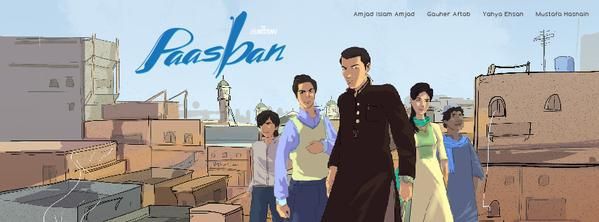
“The challenge in Pakistan is to reach the target audience with our message before the extremist groups can push them towards a hard conversion to their ideology. With most recruits, this happens somewhere between age 12-18, while subtle indoctrination begins much earlier. We think showing the true face of terrorists and the end results of their machinations will rob extremist groups of much of their moral high ground and revolutionary positioning, and will create enough innate resistance to cause major issues with their recruitment and tacit support from local population.” – Gauher Aftab, co-creator and writer of “Paasban” (“The Guardian”), a Pakistani graphic novel.
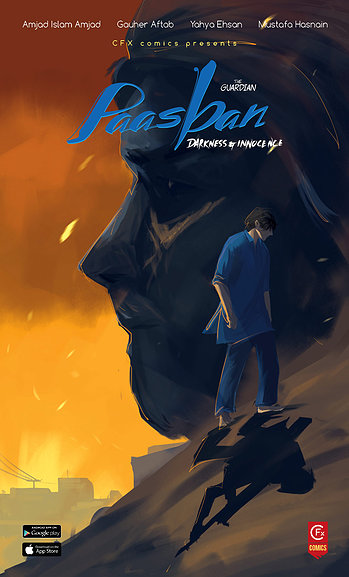
Today Creative Frontiers in Lahore, Pakistan released its second volume of Paasban (The Guardian) on its CFxComics app for both Android and iPhone devices (in English and in the local language). The first volume of Paasban, entitled Darkness and Innocence, released last month on the app, recounted the dilemmas faced by Asim, a Pakistani youth split between his friends at school and the alluring charitable organization promising to give him a greater sense of direction.
It becomes clear that this group, fronted by the charismatic Saleh, is a militant extremist group plotting violence in the name of Islam. Like Asim’s friends Saad, Zara, and Irfa, the real-life creators of Paasban – Amjad Islam Amjad, Gauher Aftab, Yahya Ehsan, and Mustafa Hasnain – feel that they must intervene in order to help save Pakistani youth from the call of groups like al Qaeda, the Taliban, and ISIS.
Previous to the release of the second volume, “Comics and Dialogue” had the opportunity to speak to Aftab about the origins of Paasban, its immediate effects on Pakistani readers, and what’s coming with the release of volume 2, entitled Redemption, and beyond.

C&D: What real-world material and research informs your depiction of Saleh’s mysterious group? How much comes from personal experience, from news reports, from extremist accounts?
GA: As a writer, I drew from my own personal experience with radicalism as a young boy in the late ‘90s which is very similar to what Asim and Munir go through at the hands of Saleh. When I grew older, I started working in PR and Communications for the development sector. I worked with journalists in the Swat Valley after an army operation that ‘cleansed’ the area of Pakistani Taliban militants in 2010-11, and saw and heard many similar stories of children being used as spotters, informants, and suicide bombers. In 2010-12, I also worked on investigating and countering extremist narratives in various rural districts of AJK (Azad Jammu & Kashmir) — a region with a history of indigenous antagonism against India as an occupier of a portion of Kashmir.
There has also been a lot of research done by Pakistani authors such as Ahmad Rashid on the rise of the Taliban, their ideology, and also how they propagate their message for different audiences in mainstream media, social media, or using localized networks of the mosque, madrasa, etc. As it turns out, the script hasn’t changed much since the ‘80s; the examples of Muslim persecution just change over the decades. In the ‘80s it was Afghanistan and Palestine and Kashmir, in the ’90s Bosnia, Kosovo and Chechnya were also added as flashpoints, and in the 2000s Iraq and Afghanistan were back on the agenda. Nowadays we’ve got Libya, Iraq, Afghanistan, Kashmir, Palestine, Syria, a whole lot of flashpoints where Muslims are fighting regimes backed by Western nations or directly in conflict with foreign troops. So the extremist narrative presented in the comics are quite prevalent, but the good news is that being ubiquitous is their only strength. Even among illiterate audiences, knowledge of basic Qur’anic injunctions against violence is widespread, and the extremist groups’ rationalization of violence falls way beyond any Islamic teachings or ‘proof’. The arguments are all politically motivated, and thus are not particularly sophisticated when you try and take them down. A basic knowledge of Islam is all you need to prove them false and expose them for the religious heretics they are.
C&D: What creators or creations do you see as your predecessors and/or inspirations? Who laid the groundwork for Paasban, in your minds?
GA: Pakistan has never had a comic book industry, and while there have been a few projects over the decades these never really created an impact. In terms of the art style, Yahya and his team wanted to create a look and feel that was indigenous and easily relatable for people anywhere in the country. They drew from the work of Alphonse Mucha as well as the famous Pakistani artist Abdur Rahman Chughtai, while the action sequences are inspired by Japanese Manga. Another cultural reference we used was to make Saad’s likeness and body structure, one of the main protagonists of the series, very similar to a young Muhammad Ali Jinnah (the founder of Pakistan).
C&D: When envisioning Paasban for the CfX app, how did you weigh the benefits of the tools available to you (e.g. animating the characters, background music, etc.) against its static, native medium of print comics?
GA: We were trying to adapt our outreach to address two problems that are native to Pakistan and perhaps other developing countries, the first being the lack of access to reading materials for a vast majority of the population, and second being the almost non-existent reading culture due to literacy levels. Pakistan has a small publishing industry and almost no distribution network for books, journals and the like. You can imagine how few people read when the largest local language newspaper, Jang, has a circulation of merely 1 million copies in a country of almost 200 million people. So rather than pump funds into printed copies, which the world over is a standard medium for this kind of content with an established audience, we decided to make the content available in a way that could be packaged as entertainment, not just for reading but with a whole curated experience that included background music and animated effects. This is designed to improve the virality of the content among vulnerable audiences who may have low literacy but at least have access to a smartphone in their family network, as well as make it an experience that has value for audiences with little experience or interest in reading.
C&D: Why is CFxComics the first digital comics app from Pakistan? That is, what led Creative Frontiers to stake out this virtual territory?GA: Pakistan is 12 months into a major internet revolution. About a year ago, the first 3G licenses were authorized, and now we have 15 million 3G subscribers growing at an exponential rate. At about the same time, cheap smartphones from China flooded the local market, so now you buy a 3G enabled handset preloaded with Facebook and Whatsapp that costs about $50 – $80. So the internet economy boom that has been experienced the world over in the past decade is just arriving in Pakistan, where there are already close to 100 million cellphone subscribers, all of whom are a potential audience for the CFx Comics app. Essentially, before this time there would have been no purpose or market for a localized digital publishing platform, and we are one of the first movers who want to use this trend to give our content and message the most outreach possible, while sowing the seeds of sustainability that can help us develop more issues of the Paasban series and keep it free in Pakistan.
C&D: What early response has Paasban received from readers, especially your target audience of those who might be lured in by extremist messages?
GA: The local audience loved the content, most hadn’t seen something like this before, and frankly even the audience in the larger cities like Lahore couldn’t afford comic books (priced between $6-$8 an issue). This is a free app with background music, animated effects and with a ‘Lite’ version that can run even on really low-end phones. As far as the message is concerned, that’s where our research has shown really promising results. We ran a survey and focus group exercise with 100 9th grade students in both rural and urban public schools, asking them questions both before and after they had read all three issues. Prior to reading our content, a majority believed that religious leaders and authority figures only spoke the truth, while after reading two-thirds of this group switched their views to neutral, which is exactly the kind of critical thinking we hope to foster amongst the target audience.
The challenge in Pakistan is to reach the target audience with our message before the extremist groups can push them towards a hard conversion to their ideology. With most recruits, this happens somewhere between age 12-18, while subtle indoctrination begins much earlier. We think showing the true face of terrorists and the end results of their machinations will rob extremist groups of much of their moral high ground and revolutionary positioning, and will create enough innate resistance to cause major issues with their recruitment and tacit support from local population.
C&D: Conversely, how do you hope Paasban will be received by further-out audiences, those either outside of Pakistan or those personally unfamiliar with extremist groups?
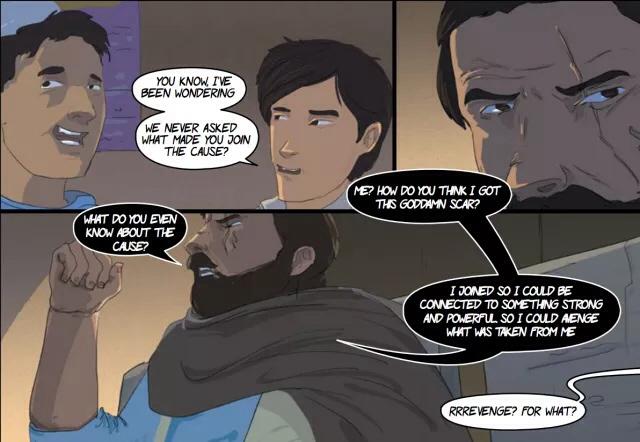
GA: For audiences abroad, recurring questions are Why do they hate us so much? or How can you kill people for religion? We blame the western media for this confusion and conflation of terrorists’ political motives with Islam, a religion that has very little to do with supporting violence in any form. Our series will be a belated eye-opener to Western audiences, who are now gravitating towards Islamophobia which is itself a form of extremism and bigotry. Through our story they can see exactly what kinds of Muslims are perpetrating these acts of terror, how they brainwash young people using fear and coercion, as well as understand who those recruits are and why they are so willing to give their life away for a cause they barely understand.
Also, we should remember that international terror groups like al Qaeda, ISIS and Hizb ul Tahrir have been very successful at recruiting from marginalized communities in the West, many of them being new converts to Islam. The Paasban series in English, The Guardian, can be useful in much the same way as in Pakistan, as an immediate counter to the kind of terrorist propaganda these kids are likely exposed to, and as an in-built cultural resistance to violent extremism.
C&D: With volume 2 out shortly, could you give some sense of the creative process for your team? Is there a general story worked out first, does the script come before the art drafts, when does character design take place, etc.?

GA: The storyline comes first, which is a process led by Mustafa Hasnain, CEO & Founder of CFx Comics and Creator of the Paasban series. The first three volumes of the graphic novel were conceived as part of one storyline, and I wrote the script for all three in one-go. This helps the Art team know where we’re going with the overall narrative and story for each character, and develops backgrounds, mood boards and characters designs during this phase. Right now, we’ve made all three volumes ready in time for the Urdu print run that was distributed to 5,000 public school students for free. For the CFx Comics app audience, we’re releasing new content every two weeks starting July 8th, as we wanted to build up our engagement with each new issue. Also, there is a lot of work to be done when converting each frame of the printed comic to the hundreds of different versions and sizes required for compatibility with Android devices worldwide, especially lower end phones.
C&D: Why the alternate, dark lettering for the menacing character of Khurram in Saleh’s group — but not for Saleh?
GA: Khurram’s character is a very key element to the story, one that will resonate with audiences at home and abroad. The one main difference in terrorist recruitment in the ’80s, ’90s and 2000s to what it is now has been the impact of the War on Terror, especially drone warfare. Drone strikes and air strikes are carried out in Pakistan and several other Muslim countries with dodgy intelligence and have very high collateral damage, mostly misrepresented as ‘enemy combatants’ to keep the media misinformed.
This has led to the en-masse recruitment of people like Khurram, whose conversion has nothing to do with Islam, ideology, or anything other than sheer vengeance and anger at having lost loved ones to foreign forces and senseless violence. Essentially, these are fighters or suicide bombers that have been gift-wrapped for terrorist groups, and we can’t fight these people through guns or narratives as we would the more malicious elements like Saleh or the more innocent ones like Asim and Munir. The dark lettering means to call out this character for the audience, and we want them to follow his story with particular interest, as both Muslim and Western society must bear the blame for creating such people. When a person has nothing, no house to go back to and no living family members left, we need to figure out a way to empathize and bring them back into the fold of society before their anger consumes everything in their path.
###
A. David Lewis is the founding member of Sacred & Sequential, a collective of religious studies and comics studies scholars. He currently teaches at MCPHS University and has previously lectured at Northeastern University, Bentley University, Boston University, Tufts University, Merrimack College, and Georgetown University. He is the co-chair for the American Academy of Religion’s “Death, Dying, and Beyond” Group. His latest book is American Comics, Literary Theory, and Religion: The Superhero Afterlife (Palgrave Macmillan, 2014). He is also co-editor of Graven Images: Religion in Comic Books and Graphic Novels (Bloomsbury Academic, 2010), co-author of Some New Kind of Slaughter from Archaia Entertainment, and co-editor of Digital Death: Mortality and Beyond in the Online Age (Praeger, 2014), a winner of the Ray and Pat Brown Award for “Best Edited Collection.” You can follow him on Twitter @ADLewis.
Lewis is also one of six nominees for a Will Eisner Comic Industry Award in the Best Scholarly/Academic Work category for American Comics, Literary Theory, and Religion: The Superhero Afterlife (Palgrave Macmillan, 2014). The awards will be presented on July 10, 2015 in San Diego.
———-
ISLAMiCommentary is a public scholarship forum that engages scholars, journalists, policymakers, advocates and artists in their fields of expertise. It is a key component of the Transcultural Islam Project; an initiative managed out of the Duke Islamic Studies Center in partnership with the Carolina Center for the Study of the Middle East and Muslim Civilizations (UNC-Chapel Hill). This article was made possible (in part) by a grant from Carnegie Corporation of New York. The statements made and views expressed are solely the responsibility of the author(s).
Other web sites and print publications may re-publish this article as long as there is source attribution (author and ISLAMiCommentary) and a link back to ISLAMiCommentary.
Tags: A. David Lewis, Abdur Rahman Chughtai, Afghanistan, Ahmad Rashid, al Qaeda, Alphonse Mucha, CFxComics, Comics & Dialogue: Islam in Graphic Novels, Creative Frontiers, extremism, Facebook, Hizb ul Tahrir, ISIS, Islamophobia, Japanese Manga, Kashmir, madrasas, Muhammad Ali Jinnah, Mustafa Hasnain, Paasban, Pakistan, Quran, Taleban, Terrorism, terrorists, The Guardian, Whatsapp
Category: Asia, Comics & Dialogue: Islam in Graphic Novels, i-Comment, ISIS, Muslim Life & Culture, Politics & Current Events, Science, Tech, Media & Social Media, Security & Civil Liberties