Between Psychoanalysis as Practice and as Social Theory
[ This article was originally published on the ISLAMiCommentary website, which is now only available via the Wayback Machine. Here is a direct link to this article: https://web.archive.org/web/20170214024125/https://islamicommentary.org/2014/12/scholars-notebook-observations-on-doing-psychoanalysis-in-tehran/index.html ]
by TAMAR SHIRINIAN for ISLAMiCommentary on DECEMBER 29, 2014
curated and edited by Julie Poucher Harbin, Editor, ISLAMiCommentary
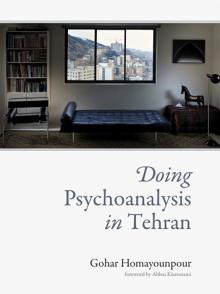
“Is psychoanalysis possible in the Islamic Republic of Iran?” This is the question that Gohar Homayounpour poses to herself, and to us, at the beginning of this memoir of displacement, nostalgia, love, and pain. Twenty years after leaving her country, Homayounpour, an Iranian, Western-trained psychoanalyst, returns to Tehran to establish a psychoanalytic practice. When an American colleague exclaims, “I do not think that Iranians can free-associate!” Homayounpour responds that in her opinion Iranians do nothing but. Iranian culture, she says, revolves around stories. Why wouldn’t Freud’s methods work, given Iranians’ need to talk? — Excerpt from the Overview of Gohar Homayounpour’s book Doing Psychoanalysis in Iran (MIT Press, 2012)

While many in the West think of Iran as an impossible site for the practice of psychoanalysis — where the patient is assumed to be far too repressed to be able to talk freely — Iranian psychoanalyst Gohar Homayounpour says in fact there are many ways in which the context of Iran is precisely the perfect place for a practice.
Homayounpour was invited to Duke University last month by the Women’s Studies department to participate in a series of talks on her work. One talk — “Doing Psychoanalysis in Tehran” — covered the clinical aspects of psychoanalysis in a doctor-patient setting and how the social and political context, including during the 2009 Iran elections protests, is of great importance.
Another covered the “Geographies of Psychoanalysis,” which shed light on the importance of an attunement to geographies outside of the West (the focus of the International Psychoanalysis Association until very recently) and its implications for psychoanalysis.
For her third talk — “Psychoanalysis and the Veil” — she was joined by Ranjana Khanna (Director of Women’s Studies at Duke and professor of English, women’s studies, and literature) and Duke literature professor Negar Mottahedeh.
I had the privilege to attend two of the three talks, “Doing Psychoanalysis in Tehran” and “Geographies of Psychoanalysis.” In this essay, I would like to explore the themes of these talks and implications for my own research.
Psychoanalysis in the Practice
For Homayounpour, who trains and supervises the psychoanalysts of the Freudian Group of Tehran and is a professor of psychology at Shahid Besheti University there, Freud’s theories of psychoanalysis are particularly desirable because they came straight out of the clinic.
Freud’s work, in other words, is based primarily on what he found through his practice (although even this has been contested by many, including feminists who argue that seeing things through the lens of patriarchy obstructed his vision.)
Homayounpour mirrors Freud’s approach to the clinic, forming her theories through her own practice, where she understands clinical processes of transference, desire and the ways in which the Other takes particular formations in local contexts. The Other, in psychoanalysis, designates the Symbolic Order, sometimes language itself — that which the person is born into, but also cuts the person off from their unconscious. (The unconscious was Freud’s term for his uncovering of the psychic processes occurring without the patient’s direct knowledge, thus unconscious rather than conscious processes). Thus, for Homayounpour, to understand what blocks her patients from their unconscious, one must not look toward universal conceptions of this Other and the desire for the Other, but the particularities of the social, cultural and political world of her patients — namely, Tehran. In other words, her clinical practice of psychoanalysis doesn’t exist in a vacuum. A practicing psychoanalyst, as she explained, must constantly be in dialogue with the world around her.
Homayounpour is particularly interested in how her patients confront the objects of fear in their daily lives — how they can move closer to these feared objects rather than move away from them. Following French Feminist theorists like Luce Irigaray, she is looking for ways of allowing her patients to be in touch with their fears. This often happens through transference – where Homayounpour herself, as the analyst, becomes the object of fear — the mother, father, police, the government, etc.

During her “Doing Psychoanalysis in Tehran” talk Homayounpour offered a few case studies. As she explained, during the 2009 post-election movement, many of her patient’s various fears, anxieties and associations came to light as they walked into her office. With conscious and unconscious fears awakened in the streets, many of these patients related their feelings about the protests, the government, and their own memories and associations reaching back to the 1979 revolution. One patient, who had been in analysis with Homayounpour for months, began discussing her relationship with her father for the first time. The patient’s experience in the streets in 2009 brought to light her fears and anxieties concerning her father, who had participated in the 1979 movements.
What was happening outside of the clinic couldn’t help but seep into the clinic, Homayounpour explained, and it brought her, the analyst with them. Her subjects were grappling with certain “real” fears — such as the government — but there were “unseen” fears in the unconscious.
Homayounpour points out that much of what people think psychoanalysis does — such as “help” patients or “cure” them — is far from what the analyst should be interested in doing. She is not interested in a project of psychoanalysis that is “humanitarian” — helping by “giving,” which is never a selfless giving, but helps sustain the ego of the analyst herself. Rather, she aims to bring her patients close to that which they fear — by allowing them, through the analysis, to name and confront these objects of fear in order to make them less fearful objects. In such cases, the patient will begin to understand that what this Big Other — the police, the government, or even the Father — does is create fear, and instead approach these objects, through coming closer and closer to them, with love and hospitality. This very difficult process of analysis eventually enables the patient to have another kind of relationship with these objects of fear. No longer will they be feared, but they can be understood. And most importantly, the patient can understand how that object came to be feared in the first place.
“The social” is also crucial to Homayounpour’s work. “The social” in this context is a term many anthropologists use to describe the world of relations informed not only by contact with others, but mediated contact — through cultural, political and economic exchanges, which precede the person and into which the person becomes a subject.
The ways in which an object of fear like the father, the government, the unknown future, patriarchy, racism and so on, might become an object of love, are very particular to the experience of a person who has been impacted by the social context in which they live (or “the social”).
Psychoanalysis, as founded by Freud in the turn of the 20th century Vienna, was a clinical theory — coming out of and used for analysis of individual patients and their symptoms. But the social and political world surrounding Freud, as well as his relationships to his patients, cannot be forgotten. All of this is essential to understanding both how and why psychoanalysis was founded and the way in which it can be used today.
Psychoanalysis Beyond the Couch
While the clinical aspects of the work of Freud and other practicing psychoanalysts like Jacques Lacan, Carl Jung, Donald Winnocott and others, are the most well-known, psychoanalysis is increasingly also being employed “beyond the couch” by social scientists and theorists who are applying psychoanalytic theories to larger scale problems.
Queer theory has long been making use of psychoanalytic concepts to make sense of desire and its sometimes not-so-“rational” orientations. For example the psychoanalytic concept of the ‘death drive’ in the work of Tim Dean and Leo Bersani on the phenomenon of ‘barebacking’ (condomless sex) in U.S. gay male urban subcultures has now become a classic example of this.
More recently, anthropologist Naisargi Dave has worked through psychoanalytic theory to understand the ways in which queer activists in India merge fantasy and politics.
On the way to lunch with some other graduate students at Duke, we discussed the way that I see this kind of “geographic” psychoanalysis fitting into my research on the clash between nationalist, feminist, and LGBT activists in Yerevan, Armenia.
In my research, for example, I have employed the Freudian and Lacanian concepts, respectively, of the “primal father” and the Name(s)-of-the-Father, to make sense of how Armenians understand nation as the legitimate project of mythological forefathers and the state as the illegitimate, and morally weak, father.
I situate these kinds of fathers in what is often called “perverse” where perversion is both homosexuality — as that which strays away from the moral path of Armenia — but also the state and the oligarchy class, which strays away from the path of morality as well. My work looks at ultranationalists’ expressions of anxiety concerning the future of Armenia, where these two forms of perversion are often conflated with one another, and most often in unconscious ways.
It is not just in the realm of queer studies that psychoanalysis has become fruitful for social theory. John Borneman, a professor of anthropology at Princeton University, has applied Freud’s notion of the death of the father to understand the ends of authoritarian regimes. University of Wisconsin-Madison anthropologist Katherine Ewing uses psychoanalysis to understand the formation of self between conflicting ideologies and interests in contemporary Pakistan. And University of California Berkeley literature professor Judith Butler has theorized power itself as having a “psychic life” formed through conscious and unconscious processes.
I asked Homayounpour, as a clinician, what she thinks of this use of psychoanalytic theory and she responded, “Psychoanalysis is more successful as a social theory than it is in the clinic.” Of course, by this she did not mean that she was unsuccessful or that clinicians should no longer employ psychoanalysis. Rather, for her, it is important to take the social theory into consideration both in the clinic and outside.
For many of us at Duke who are not practitioners, but employ psychoanalytic theory to our literary, ethnographic, and archival work, Professor Homayounpour’s work offers a critical perspective.
More importantly, she taught us how a project like psychoanalysis, far from being apolitical, offers a glance into how one might make sense of, or analyze, the multi-faceted world that consumes us and help us create new or different relationships with this world.
How may we all use the theory of psychoanalysis to understand social, cultural and political phenomena? Although Homayounpour may say, casually, that psychoanalysis works better as a social theory than as a clinical one, maybe what this statement offers at its deepest level, for those of us who work in the humanities and social sciences, is that these two modes of analysis are not that far apart.
For more on Gohar Homayounpour’s work and research, you can read her book Doing Psychoanalysis in Tehran, published by MIT Press in 2012.
Tamar Shirinian is a 6th year Ph.D. candidate in Cultural Anthropology, also working toward a certificate in Feminist Studies, at Duke University. Her research explores the new rise of nationalism in post-Soviet Armenia. She contextualizes the Armenian experience both in its shared history with other post-Soviet and post-socialist places, but also within the particularities of Armenia itself – in genocide, its history of governance by foreign sovereigns, and the large-scale emigration in the post-independence period. She is interested in how these new nationalists confront the “crisis” in population by orienting these anxieties onto the figure of the homosexual. Tamar is also the managing editor of the Journal of Middle East Women’s Studies.
—
ISLAMiCommentary is a public scholarship forum that engages scholars, journalists, policymakers, advocates and artists in their fields of expertise. It is a key component of the Transcultural Islam Project; an initiative managed out of the Duke Islamic Studies Center in partnership with the Carolina Center for the Study of the Middle East and Muslim Civilizations (UNC-Chapel Hill). This article was made possible (in part) by a grant from Carnegie Corporation of New York. The statements made and views expressed are solely the responsibility of the author(s).
Other web sites and print publications may re-publish this article as long as there is source attribution (author and ISLAMiCommentary) and a link back to ISLAMiCommentary.
Tags: 2009 Iran elections, Armenia, Carl Jung, death drive, Doing Psychoanalysis in Iran, Donald Winnocott, Duke University, Duke University Women's Studies, feminism, geographies of psychoanalysis, Gohar Homayounpour, International Psychoanalysis Association, Iran, Jacques Lacan, Judith Butler, Katherine Ewing, Leo Bersani, LGBT, Luce Irigaray, MIT Press, Naisargi Dave, nationalism, patriarchy, psychoanalysis, queer studies, racism, Ranjana Khanna, Shahid Besheti University, Sigmund Freud, Tamar Shirinian, Tim Dean, University of California Berkeley, University of Wisconsin-Madison, women's studies, Yerevan
Category: Books, History and Anthropology, Human Rights & Gender, i-Comment, Middle East and North Africa, Psychology & Sociology, Security & Civil Liberties, sexuality, Student