[ This article was originally published on the ISLAMiCommentary website, which is now only available via the Wayback Machine. Here is a direct link to this article: https://web.archive.org/web/20170214044106/https://islamicommentary.org/2014/06/global-expressions-of-classical-islam-on-display-at-duke/]
by AMBER WATSON for ISLAMiCommentary on JUNE 6, 2014
curated and edited by Julie Poucher Harbin, Editor, ISLAMiCommentary

At a time when events in the so-called “Islamic world” are most often portrayed through the lenses of political science and theory — often concentrating on government policies, war, civil strife, and socioeconomic development — Assistant Professor of Islamic Studies and History Mona Hassan re-directs the conversation with her class “Introduction to Islamic Civilization, Part 1.”
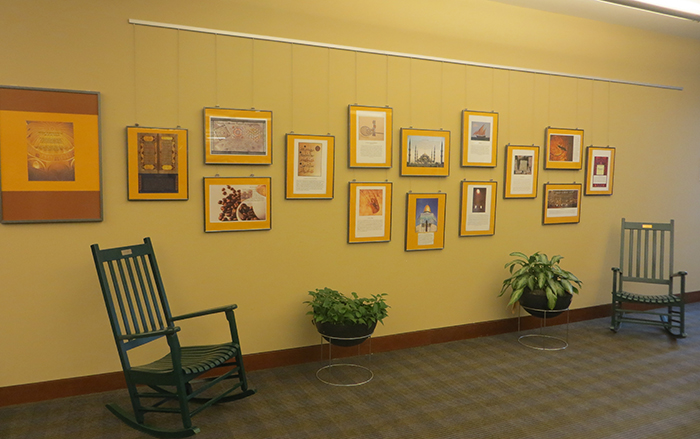
In this class she has given her students the opportunity to learn more about the practices, expressions, and values of global classical Islam. As part of the students’ research on “the fluorescence of Muslim culture and learning across Afro-Asia,” as Hassan explained, they constructed a 15-frame photographic exhibit on Islam’s contributions and impact on the world, on display at Duke University’s Perkins Library (near room 118) since graduation this May.
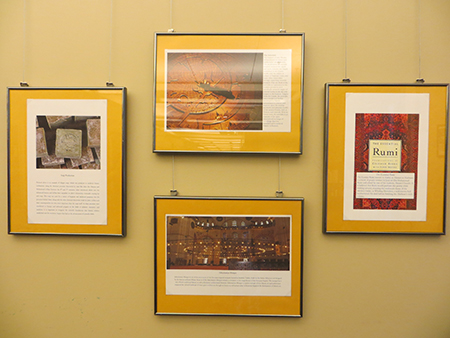
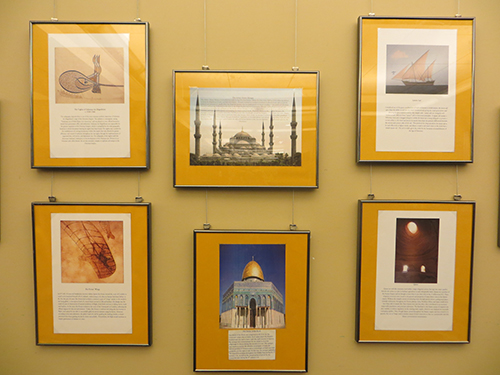
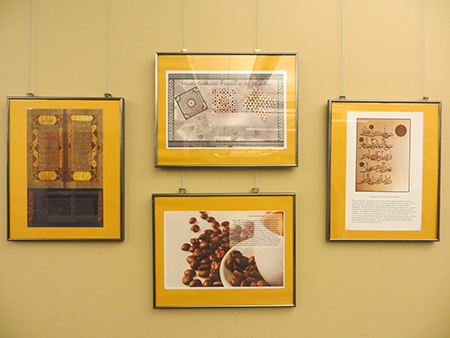
Dating all the way back to 875 A.D. in Islamic Spain, Abbas Qasim Ibn Firnas is declared the “first human in flight,” for his construction of hang glider-like wings made from wood, silk, and feather and a short attempted flight. There’s also a primer on Sufi mystic Jalal al-Din Rumi, one of the most influential poets in the world, who was able to “connect the mundane world to that of the Divine.” Another picture, titled “Dressing God’s Words in Fine Garments,” highlights calligraphy and the importance of reading and writing in Islamic society. “Read!” is in fact the first sentence written in the holy Qur’an. Also on display — examples of some of the greatest Islamic architectural masterpieces such as Istanbul’s Sultanahmet (or Blue) Mosque and Jerusalem’s Dome of the Rock.
Coffee, soap, and the triangular lateen sail, are also highlighted as important Islamic inventions and cultivations. Duke rising senior and Asian & Middle Eastern Studies major Mayyadda Major, who created the piece on soap for this exhibit and last summer recorded an Arabic/Sudanese rap video with other AMES students, said the class and the AMES program have expanded her horizons.
“I’ve come to realize that there is a lot about Islam and the Islamic world that has gotten distorted in the West, resulting in a monolithic, overwhelmingly negative image of a very diverse group of people. This class gave me a deeper understanding of a counter-narrative that portrays the peoples of Islamic civilizations as diverse, innovative and complicated.”
Amber Watson is a junior at Duke University majoring in International Comparative Studies and Asian & Middle Eastern Studies, with a minor in French.
This article was made possible (in part) by the Transcultural Islam Project, an initiative launched in 2011 by the Duke Islamic Studies Center — in partnership with the Carolina Center for the Study of the Middle East and Muslim Civilizations and the Oxford Centre for Islamic Studies — aimed at deepening understanding of Islam and Muslim communities. See www.islamicommentary.org/about and www.tirnscholars.org/about for more information. The Transcultural Islam Project is funded by a grant from the Carnegie Corporation of New York. The statements made and views expressed are solely the responsibility of the author(s).
Other web sites and print publications may re-publish this article as long as there is source attribution (author and ISLAMiCommentary) and a link back to ISLAMiCommentary.