[ This article was originally published on the ISLAMiCommentary website, which is now only available via the Wayback Machine. Here is a direct link to this article: https://web.archive.org/web/20140729174558/https://islamicommentary.org/2014/06/no-good-men-among-the-living-america-the-taliban-and-the-war-through-afghan-eyes-book-q-a/]
Column » By the Book with JOSEPH RICHARD PREVILLE for ISLAMiCommentary on JUNE 24, 2014
curated and edited by Julie Poucher Harbin, Editor, ISLAMiCommentary
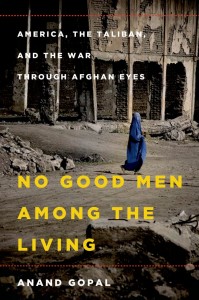
How often do we hear from Afghans on their experience in America’s long and exhausting war in Afghanistan? Anand Gopal gives them a voice in his moving book, No Good Men Among the Living: America, the Taliban, and the War Through Afghan Eyes (Metropolitan Books, Henry Holt and Company, 2014).
Gopal, currently a Bernard L. Schwartz Fellow at the New America Foundation, covered the War in Afghanistan from 2008-2012 primarily for The Wall Street Journal and The Christian Science Monitor. He was living in Manhattan on 9/11, and the shocking experience jolted him to investigate America’s response to the terrorist attack “on a strange and distant battlefield.”
As he travelled throughout Afghanistan, Gopal witnessed the chaos and the wreckage wrought by the “War on Terror,” which became a war of survival for the Afghan people trapped in it.
Gopal takes the title of his book from a Pashtun proverb: “There are no good men among the living, and no bad ones among the dead.” He learned this proverb from a war-weary Afghan man he interviewed.
Gopal writes that for this man, the proverb meant that “there were no heroes, no saviors, in his world. Neither side in the conflict offered much hope for a better future. The categories of the American war on terror – terrorists and non-terrorists, fundamentalists and democrats – mattered little, not when his abiding goal, like that of so many caught in the conflict, was simply to finish each day alive.”
Anand Gopal discusses his book in this interview.

What major challenges did you face in writing your book?
The biggest challenge was winning the trust of the Afghans I profiled, and earning their cooperation so that I could verify their stories. With the Taliban fighter Akbar Gul, for instance, I would spend weeks tracking down those who knew him or were present for particular scenes he described. At first, Akbar Gul, who was not familiar with Western journalistic norms, was very suspicious of this endeavor. He would say: “You’ve heard the story from me—why do you need to ask anyone else?” But in time, he began to come around. Once, I was able to track down an Afghan pro-government commander who had fought on the opposite side of him in a battle. Akbar Gul was fascinated by this, and for a short period, he became the interviewer as I recounted the battle from his adversary’s perspective. Through such a process, he came to slowly, grudgingly, cooperate with my efforts. In time, I was able to learn things that he had forgotten, or in some cases, purposefully omitted.
How did you come to focus on the stories of these particular Afghans in your book – a Taliban commander, a pro-government warlord, and a housewife?
I spent many months traveling the Afghan countryside and meeting people whose views of the war were very different than my preconceived notions. For instance, I stayed for a time in a village in Kandahar with a noted tribal elder. He was something of a local don, and every day villagers would come to his house for tea or a meal. In the course of one day, an Afghan army officer, a U.S. military patrol, and a Taliban commander all visited him to pay him respect. To survive so many years of conflict, he’d worked to maintain ties with all sides. It struck me how irrelevant, under such circumstances, the American notions of friend and foe actually were. From the Afghan villager’s point of view, life was about navigating the various forces and power structures that towered over their lives.
With this in mind, I decided to follow the lives of Afghans who seem, on the surface, to conform to our notions of the enemy, the ally, and the civilian—and to interrogate whether this indeed was an accurate way to understand the conflict. So I followed: Akbar Gul, a Taliban commander who quit after 2001, only to rejoin the movement and become an insurgent commander fighting against the U.S.; Jan Muhammad, who rose from humble origins to become a major warlord who worked closely with American forces; and Heela, a housewife from Kabul who fled to the countryside to escape the civil war.
How was America’s war in Afghanistan based on an “Us-Versus-Them” ideology?
After 2001, the U.S. divided the world—and Afghans—into two categories: you were either with us or against us. This artificially ordered a complex and messy battlefield, one that, over the years, has been the scene of shifting alliances and sudden turnarounds. After the Soviets left in 1989, for instance, many Afghans who had been Communists switched allegiances to the mujahedeen, grew out their beards, and began praying regularly. After 2001, the Taliban similarly shifted sides, giving up their weapons and surrendering to the U.S.-backed Afghan government. Yet because of the ideological disposition latent in U.S. policy at the time, Washington policymakers did not accept this reality. Instead, they allied with anti-Taliban warlords, who became their main source of intelligence, and by doing so killed and arrested many innocent people. And they refused to accept the Taliban surrender, forcing many Talibs to regroup in Pakistan and launch an insurgency. In this way, the U.S. war on terror became a self-fulfilling prophecy, as it created the very enemies it insisted were there all along.
Do you think Afghans are nervous or pessimistic about the future of their country?
I think many Afghans are concerned about the future. The Taliban insurgency has not been defeated, and the pro-government warlords and strongmen of the countryside are as strong as ever. With international troops leaving, foreign funds are drying up. Housing prices in Kabul have crashed, and petty street crime has soared. Allegations of widespread fraud have marred the presidential elections, and supporters of the two major candidates appear to be buckling down for a protracted political struggle, which many fear could turn deadly. Most of my Afghan friends who have the means are looking to leave the country. The hope that pervaded Afghan society in the early years after 2001 has been thoroughly eradicated by a war that seems to have no end in sight.
What kind of legacy will America leave behind in Afghanistan?
On the one hand, America will leave behind a revitalized urban Afghanistan, one that has witnessed a boom in education, basic infrastructure, health, and other services. The American intervention has spawned a new generation of Afghan entrepreneurs, journalists, and teachers. It has brought the internet and television to a country that had almost no access to the outside world before 2001. It has improved the lives of millions of girls, particularly in cities like Kabul.
On the other hand, America will leave behind a countryside of unending suffering. It has empowered a new generation of warlords and contractor strongmen—powerbrokers whose authority derives from American guns and money, usually in the form of private security contracts. It has fostered a culture of impunity and lawlessness, where individuals with close ties to the U.S. military run rampant over human rights and the rule of law. It will have left behind an Afghan state that is designed not to meet the needs of its people, but the short-term needs of American national security. It has caused such instability that, in some areas of the rural south, villagers prefer the dark ages of the Taliban to the current period, if only because people are desperate for security for their families.
So in a sense, America’s legacy is very mixed. The gains seen in the urban area might be ephemeral, because they are contingent on the war staying in the rural areas. So, even the gains are not genuinely sustainable: the Afghan state exists only because of foreign aid, and that foreign aid exists only because of the war. If there were no war in the countryside, there would be no state in the city. This, more than anything, is the lasting legacy of America’s intervention: a war without an end.
How has Afghanistan changed you?
It’s impossible to travel through or live in Afghanistan and not come away forever changed. Afghans are among the most generous and hospitable people I’ve ever known, and I’ve made friendships there that will endure. I’ve also lost many friends, and continue to lose them, making it impossible to ignore the country for very long. I know I’ll be returning to the country regularly, which I believe is especially important in the coming years, as Western attention dwindles but the war continues.
Joseph Richard Preville is an American writer living in Nizwa, Oman. His work has appeared in The Christian Science Monitor, San Francisco Chronicle, Harvard Divinity Bulletin, Tikkun, The Jerusalem Post, Muscat Daily, Turkey Agenda and Saudi Gazette. He is also a regular contributor to ISLAMiCommentary.
—
This article was made possible by the Transcultural Islam Project, an initiative launched in 2011 by the Duke Islamic Studies Center — in partnership with the Carolina Center for the Study of the Middle East and Muslim Civilizations and the Oxford Centre for Islamic Studies — aimed at deepening understanding of Islam and Muslim communities. See www.islamicommentary.org/about and www.tirnscholars.org/about for more information. The Transcultural Islam Project is funded by a grant from the Carnegie Corporation of New York.
Other web sites and print publications may re-publish this article as long as there is source attribution (author and ISLAMiCommentary) and a link back to ISLAMiCommentary.
Tags: 9/11, Afghan warlords, Afghanistan, Anand Gopal, Joseph Preville, New America Foundation, Taliban, War in Afghanistan, war on terror
Category: Americas, Asia, Books, By the Book, History and Anthropology, i-Comment, Politics & Current Events, Security & Civil Liberties