WITH his first 100 days behind him, Mayor Cory Booker of Newark is already immersed in the difficult task of administering a city that Harper’s Magazine once called the worst in America. Mayor Booker is young, smart and likable, but restoring his city to prosperity is not going to be easy. Soon after he took office, after a campaign in which he announced that public safety would be his top priority, both homicides and shootings in the city spiked. In effect, Newark welcomed its new mayor with a mini crime wave.
To borrow a favorite Booker word, the fundamental challenges facing Newark are “daunting.” The city is a living laboratory for nearly every bad planning idea of the 20th century. Urban renewal destroyed whole neighborhoods, replacing low-rise, vernacular residences with public housing projects. Built on superblocks, the projects wiped out the original grid as well as commercial and retail activity. Interstate highways cut the city into pieces, dividing and isolating neighborhoods. And crime, of course, made sport of the general civic unraveling.
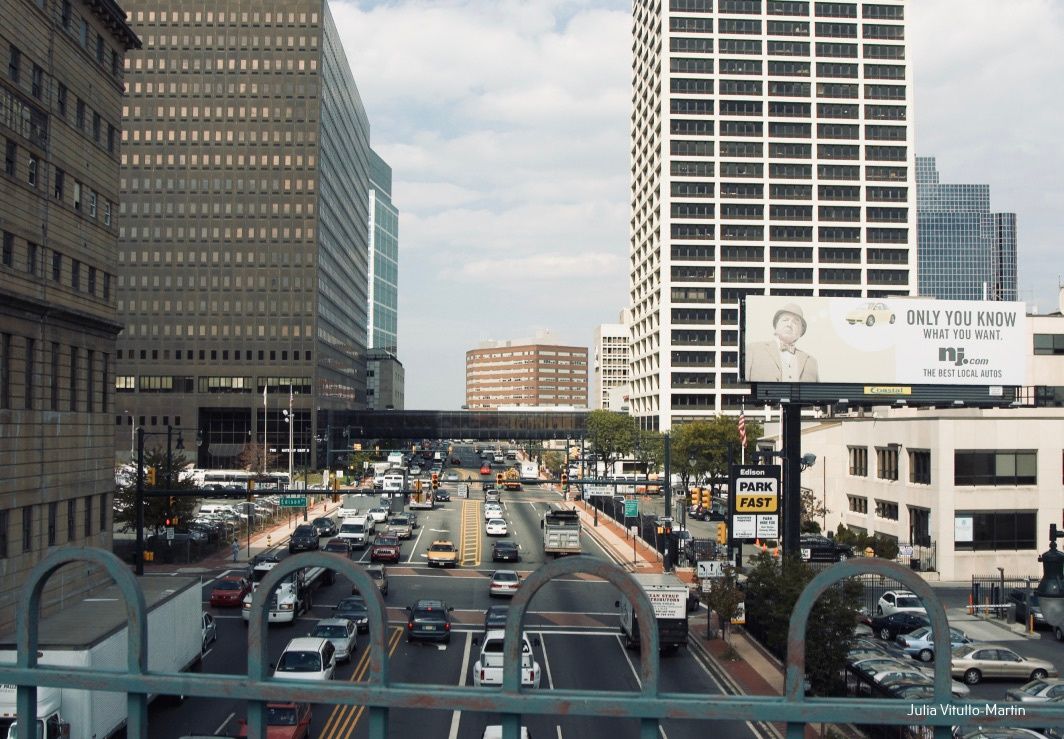
Corporations, most prominently Prudential Insurance, tried to help. But to protect employees from the deteriorating environment, they built fortress-like towers, connected to the train station and to one another by skywalks, bypassing the streets below and walling off the waterfront with parking garages and hostile architecture. Meanwhile, surface roads were widened to facilitate traffic, making escape to the suburbs more efficient. Gradually, shops and restaurants closed, leaving a few dejected discount stores behind.
Despite this bleak history, there is cause for hope. Newark rightly calls itself a “gateway” — in transportation the city has it all: a major international airport 10 minutes away; an international container port on the waterfront; passenger and freight railroads; light rail; and major highways. Newark is more accessible than almost any city of its size in America.
Moreover, unlike St. Louis, Detroit or Buffalo, Newark is situated in the heart of the most dynamic and economically powerful metropolitan region in the country. If the value of real estate is indeed derived from location, there is no reason for Newark to remain a crime-ridden, failing city of vacant lots and underused property bordered by a forlorn waterfront.
That’s why the Booker administration must emphasize a second priority right behind public safety— development. To return people to the city’s streets, parks and public spaces — and to increase the tax base — Newark needs intense, mixed-use development on vacant land as well as conversion of its many abandoned industrial buildings.
The goal is to drive out harmful uses of space, like drug dealing, and replace them with positive uses — people working, walking, shopping and playing in the parks. This can happen only if the administration accelerates the pace of redevelopment that has already begun, including the renovation of two magnificent downtown Art Deco buildings, one for offices, the other for residences.
To capitalize on its latent strengths, Newark should pursue three strategies:
• First, promote market-rate housing in the downtown core and publicize Newark’s bargain prices. Though Newark is only 15 minutes by PATH train from Midtown Manhattan, luxury apartments in Newark rent for about half the price of those in Manhattan. In a bargain-scarce metropolitan region, a $1,500 per month luxury one-bedroom can attract urban pioneers to transitional neighborhoods, just as similar bargains attracted residents to Jersey City a decade ago.
• Second, invigorate the empty, largely inaccessible waterfront and reconnect it to downtown. The informal waterfront evenings organized last summer by the New Jersey Performing Arts Center proved that people will flock to Newark’s waterfront if given access and a reason. The once decrepit waterfronts of diverse cities like Milwaukee, San Antonio, and Miami now teem with people, life, and revenue — and so can Newark’s.
• Third, clean up the city with business improvement districts. Newark’s dejected appearance is in part due to its abundance of vacant property. But it’s also a result of outdated and inappropriate signs and facades, says Linda Epps, president of the New Jersey Historical Society. “We need a plan for the kind of image the city wants to project,” Ms. Epps said, “one that applauds the wonderful old architecture that hasn’t been taken advantage of.”
One proven mechanism is the creation of business improvement districts, in which successful property owners join those who need help. All parties contribute, with the wealthiest paying the largest share, to clean up and improve business areas for all.
There is no denying the challenges Newark faces. But with energetic new leadership and the right development strategies, the city can come back. Of the many post-industrial cities still devastated by the effects of job loss, urban renewal, federal redlining, highway construction, riots, flight to the suburbs, corruption and mismanagement, Newark has the best chance of returning to the ranks of the successful.
The right development will capitalize on Newark’s strategic location, realizing a long-desired “gateway” not only to New York City, but to a prosperous future.
Ms. Vitullo-Martin is a senior fellow at the Manhattan Institute