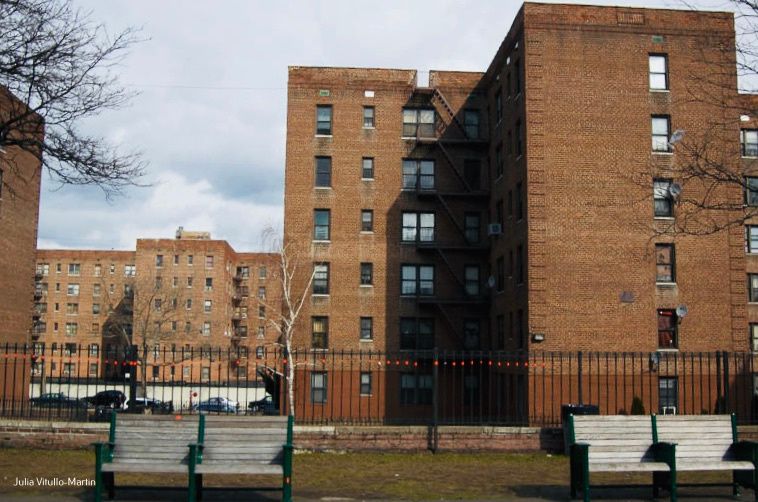
ic housing was born during the Great Depression, a time of despair and hope. It was viewed then as young, innovative, forward-thinking, attracting the country's best architects and thinkers. Today, public housing is seen by many as dismal, tired, corrupt. Huge projects have deteriorated beyond habitability in many cities and are being torn down in Newark, St. Louis, Providence, R.I., and elsewhere.
Now several energetic, even charismatic local leaders are trying to bring about a renaissance in public housing. In Chicago, for example, Vince Lane, who has led the nation's second-largest housing authority since 1988, has won national attention for his efforts to revive the projects he oversees: rehabilitation programs that train and employ tenants, conversion of abandoned lakefront apartments into mixed-income housing, establishment of a private school headed by the pioneer educator Marva Collins, and aggressive police searches for illegal tenants, weapons and drugs.
But public housing leaders must contend with a web of Federal laws and regulations that constrain their efforts to improve the way their projects are run. Here are a few:
* A Federal law intended to keep public housing affordable requires tenants to pay 30 percent of their income as rent. This creates two perverse incentives: tenants on welfare are discouraged from working, since they would automatically forfeit 30 percent of their wages, and those who do work have every reason to move out as their earnings increase and their rents rise.
* The Government's "minimum design standards" are, for all practical purposes, maximum standards that effectively mandate the dreary character of much public housing. The Department of Housing and Urban Development refuses to pay construction costs for work that exceeds the minimum standards, so if a local authority wants to builds attractive housing that fits inconspicuously into its neighborhoods, it must somehow find local funds.
* Urged on by advocacy groups, HUD pressed the New York City Housing Authority to reserve half its vacant apartments for homeless families, pre-empting its waiting list of 282,900 poor people.
* Since 1979, to reduce the concentration of public housing in poor neighborhoods, HUD rules have forbidden new construction in "impacted" areas. As a result, housing authorities are forced to hold on to grossly deteriorated buildings. They cannot simply replace them on the same site, since HUD regulations forbid new construction. "Non-impacted" -- that is, middle-class -- communities are seldom willing to accept public housing.
* By Federal regulation, public housing for the elderly must be open to disabled tenants; this includes the mentally ill, including many people damaged by drug and alcohol abuse. Many housing authorities now have large numbers of young disabled single males in buildings intended for elderly people. "The life styles just clash here," Mr. Lane says. "Both groups are unhappy. If the priorities emphasize housing the hard-to-house in existing projects, you'll risk making the whole project, and the surrounding neighborhood, fall apart. Why are we doing this? Because HUD tells us we must."
Public housing innovators like Mr. Lane face a rigid antagonist in the HUD bureaucracy, which bars most deviations from the rules. Yet HUD has been known to recognize the local character of public housing. When Boston's housing authority went into receivership, HUD, cooperating with the court, granted the receiver extraordinary powers to revive the projects, enabling a return to local control.
But a housing authority should not have to hit bottom before being granted the flexibility to reinvent itself. Authorities should have this freedom under normal circumstances as well. Modest revisions in the regulations are not enough.
Thus, HUD needs a drastic overhaul: throw out all regulations (making exceptions for housing authorities with records of incompetence and corruption) and then discuss which rules should be restored.
Public housing has some things going for it that it didn't have a few years ago. Housing Secretary Henry Cisneros cares about public housing and wants reform. In Assistant Secretary Joseph Shuldiner, former general manager of housing authorities in New York City and Los Angeles, he has an executive with extensive on-the-ground experience.
On Capitol Hill, Senator Barbara Mikulski of Maryland, chairwoman of the appropriations subcommittee that oversees HUD, is also a champion of public housing. Congress has responded favorably to an Administration proposal to delay rent increases for newly employed tenants.
But real reforms will only come at the local level. The best thing the Federal Government could do is to free innovators from regulations that have all too often been counterproductive.
Ms. Vitullo-Martin is a senior fellow at the Manhattan Institute.