In 1995, a city planner in Berlin showed me the plans for rebuilding huge sections of the city, including Checkpoint Charlie at the former entrance to East Berlin. Berlin had an unparalleled opportunity for great thinking, so I was dismayed as I stared at models of incredibly prosaic buildings, mostly third-rate knockoffs of Philip Johnson. They were similar to what New York had built in the 1960s and early 1970s and then came to loathe.
Trying to say something that wasn't too rude, I murmured that they were a little ordinary. "Yes! Precisely," the planner beamed. "Very ordinary. Very normal."
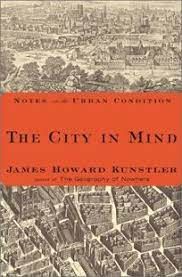
I could never make sense of the episode until, in "The City in Mind" (Free Press, 272 pages, $25), I read James Howard Kunstler's musings on the paradoxes of Berlin: how the vicissitudes of the 20th century -- among them, "political mania, moral suicide, and mass murder" -- had caused Berliners, at the end of the century, to "search for nothing grander than normality." And normality, for better and worse, is what Berlin got. Eventually, he notes, Berlin attempted a "critical reconstruction," which was meant to overturn the modernists' "disdain for the street." But it was mostly an intellectual attempt, and the city itself ended up with the same kind of dreary, hostile modernist buildings that had been built there since the war.
You would think this would be a strike against Berlin, and so it is, in Mr. Kunstler's view. But he acknowledges such faults only to dwell on our greater ones. Mr. Kunstler argues that, along with other European cities, Berlin is in far better shape today than, as he puts it, the "cities of its chief destroyer" -- i.e., better than Cleveland, Baltimore, Detroit and "other cities of the victorious United States, leader of the Free World." These places "look like the enemy bombers flew over them yesterday."
Mr. Kunstler's complaint is that the U.S. devoted much of the 20th century to trying to become a "drive-in utopia." The nation spent huge amounts of money to permit Americans to flee their cities for the synthetic countryside of suburbia. The result, he believes, has been disastrous both for the abandoned cities, which lost the "prospering classes" and a tax base, and the countryside, which is now mangled by car-driven overdevelopment. In short, we precipitated a cultural destruction whose chief artifact has been the loss of the art of city-making.
Mr. Kunstler sees almost nothing of value in American cities. He looks at Atlanta and finds a vacuous, "giant misbegotten organism" of isolated glass towers. He surveys Las Vegas and encounters waste, degradation, bad planning and ugliness. He finds a measure of hope only in Boston, which after nearly destroying itself with corruption and class warfare is now building livable neighborhoods and defying the tyranny of the automobile.
By contrast, he looks at European cities and pronounces them beautiful, civil, urbane and healthy in large part because they heed their heritage. Thus Rome's classicism and London's romantically landscaped core make those cities gorgeous and livable, offering residents and visitors alike a civility and beauty that can indeed show the best of what cities can be.
The novelist Frank Norris once said that the U.S. has only three "story cities -- New York, of course, New Orleans, and the best of the lot, San Francisco." The problem with Mr. Kunstler's approach is that in setting U.S. cities against the rest of the world, he declines to compare our story cities with theirs. In his account the only American urban center that comes off well is Boston -- a story city if ever there was one.
And what is a story city? A city that projects a conception of itself, that casts spells and encourages its residents to dream beyond themselves. One with a rich history, a splendid setting and a sense of uniqueness that inspires writers, poets and artists the way Balzac was inspired by Paris, Dickens by London, Dreiser by Chicago and Chandler by Los Angeles. New York, of course, has long thrilled or infuriated just about everyone who passes through it. The novelist Willa Cather called such cities "cities of feeling."
No one would call Cleveland, Louisville or Las Vegas cities of feeling, whatever their merits. Las Vegas was simply invented by gangsters -- a tale Mr. Kunstler tells well but irrelevantly. Cleveland has had a long decline from a never glorious past, though it continues to shelter some excellent medical and cultural institutions. If Mr. Kunstler were being fair, he would compare Cleveland to Hamburg or Louisville to Limoges, and neither American city would come off badly.
Mr. Kunstler greatly admires Paris (who doesn't?) and uses it as proof "that city-making is an art rather than a product of statistical analysis or social service casework." Baron Haussmann's 19th-century renovation of Paris was indeed extraordinary, and every American city given a vaguely similar chance via urban renewal in the 20th century muffed it badly. Haussmann, Mr. Kunstler notes, was willing to wreak destruction on Paris, including its "rat-maze of slums," to create the "epitome of everything we value about city life." True. But the Parisian -- in fact, the basic non-American -- solution for the problem of poor people is to house them in outlying neighborhoods, far from transportation and other city services.
The causes of American urban failure are many, beginning with an agrarian heritage that mythologized the countryside. To this day, the federal tax system obeys this ideology by subsidizing farms while redistributing billions of dollars away from cities.
But a self-imposed cause of urban decline is also the one noted recently by Robert Fogelson in his book "Downtown." The American planning ideal separated businesses and residences, while European cities spread them over the same territory. When work and home are side by side, streets stay lively. When they are apart, one is deserted when the other is busy.
Of course, the city that is seldom deserted is New York, which is barely mentioned in Mr. Kunstler's book. How can you call a book "The City in Mind" and not talk about New York -- the city that is not only the dominant urban model in our own minds but also, as we have seen, in the minds of our enemies? New York is the emblem of the urban imagination matched by human will -- and in the end it is human will, not buildings, that make a city.