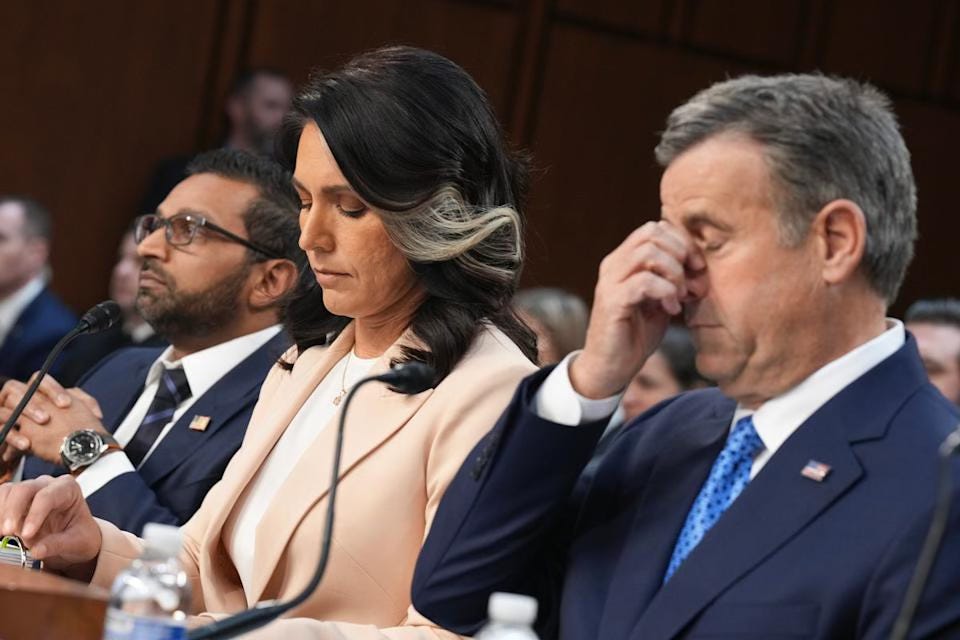
Poor Pete Hegseth. He got run over Tuesday by the clown car packed with Trump’s comical national security team, which would be funny, as they say, if it weren’t so serious.
Two of the Trump administration’s top intelligence officials threw the new defense secretary under the bus at a Senate Intelligence Committee hearing on Tuesday. That’s when outraged Democrats used a fortuitously timed hearing on global threats to demand answers to how and why they had included Jeffrey Goldberg, editor-in-chief of The Atlantic, in their discussion of classified plans for a U.S. attack on Yemen—on Signal, no less, a supposedly encrypted commercial messaging app that the Pentagon had warned employees in 2023 was not suitable for discussing classified information. Not only that, a few days after the Yemen discussion—but before Goldberg disclosed it—the Pentagon warned employees in an agency-wide bulletin that Signal users were being targeted by Russian hackers.
At first, Director of National Intelligence Tulsi Gabbard and CIA Director John Ratcliffe, both of whom were on the Signal chat with Hegseth, Vice President J.D. Vance, Secretary of State Marco Rubio, other senior officials and National Security Advisor Michael Waltz, who led the targeting discussion, parroted the White House’s claim that “no classified information” was discussed.
Well then, why not make it all public, committee Vice Chairman Mark Warner (D-Va.) and others asked. “You can’t have it both ways.” (Goldberg reported that some of the discussion he was allowed to monitor was so sensitive he wouldn’t release it himself.)
When several Democratic senators reminded the two “spymasters” that the White House earlier had vouched for the authenticity of the conversation, which Goldberg described in his article on Monday as including “precise information about weapons packages, targets, and timing” of the attack, Gabbard and Ratcliffe quickly covered their own hind quarters and hung Hegseth out to dry.
How? Ratcliffe stressed that his own comments during the group chat had not disclosed any classified information. Under questioning by former Navy warplane pilot and astronaut Sen. Mark Kelly, D-Ariz., the CIA chief also agreed that any discussions among top national security officials about possible military targets “should be conducted through classified channels.” Then, in a classic Washington maneuver, he employed some bureaucratic legerdemain to drop the dime on Hegseth.
It’s the defense secretary, Ratcliffe said, who has the authority to declassify such details, while conceding that he had no idea if Hesgeth had done so. Gabbard, who initially had refused to even confirm she participated in the group chat, later said she too had not personally shared any classified intelligence during the group chat, likewise fingering Hegseth as responsible for any declassification of operational details.
Since the Signal scandal story broke, Vance also has been scrambling for cover, apparently worried that his remarks during the group chat could put his loyalty to Trump in question. Goldberg quoted texts from Vance calling Trump’s demand for a Yemen strike “a mistake” and wondering aloud whether the president understood its consequences, namely that such an attack might cause a spike in oil prices and help Europe. Goldberg’s article quoted the vice president’s spokesman William Martin as saying Vance “unequivocally supports this administration’s foreign policy.”
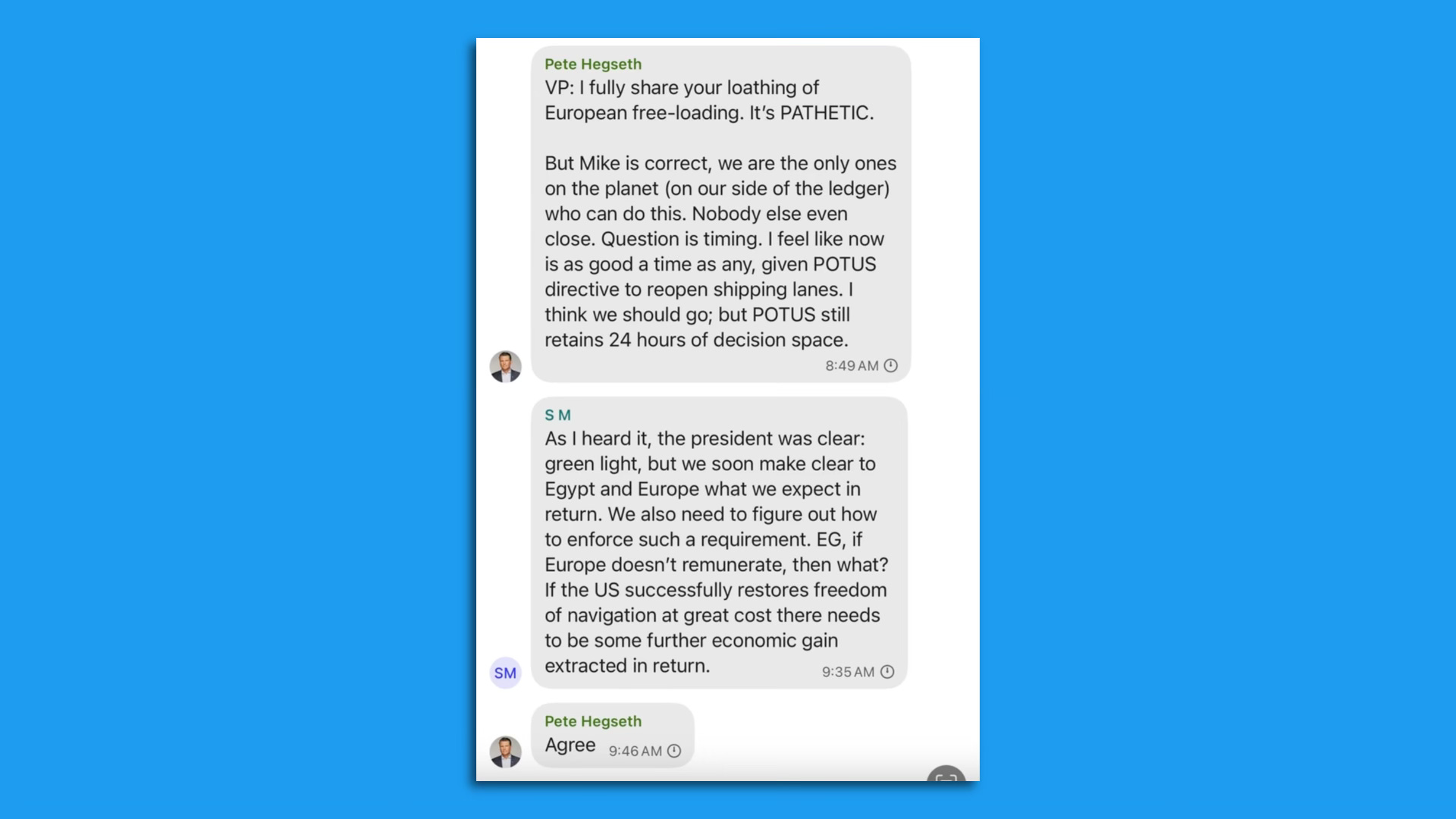
But they’ve all got to be worried about arrows in the back. Politico ran a story Monday calling Michael Waltz‘s ”future in doubt.” Of course that’s just “water cooler talk,” or, as they say at the CIA, “the corridor file.” But such speculation can take on a life of its own, especially with Trump, who famously values appearances over reality in his choice of TV-ready officials.
Waltz, who initiated the Signal chat, may have to be sacrificed. “A senior administration official told POLITICO on Monday afternoon that they are involved in multiple text threads with other administration staffers on what to do with Waltz,” the news outlet said. “Half of them [are] saying he’s never going to survive or shouldn’t survive,” the story said, citing using anonymous sources, because Waltz’s handling of the Signal chat was “reckless.”
After the Politico story moved, though, Trump defended Waltz, telling reporters that attacks on him were “very unfair” and repeating the lie that “it wasn’t classified information.” He also slammed Goldberg as a “sleazebag,” which amounts to an open invitation to MAGA extremists to mount personal attacks on him.
No words of praise for the beleagured Pete Hegseth. With mounting disgust over the security breach, Trump will soon enough come to a boil. Look for somebody’s head to eventually roll down the White House driveway.
Fake News
Out in Hawaii yesterday, en route to an Indo-Pacific tour meant to calm allied jitters, Hegseth followed the Trump response playbook, suggesting in an impromptu press conference on the tarmac that the leak was a “hoax.” Then he attacked Goldberg personally, branding him a “deceitful and highly discredited so-called journalist.” In a brazen gaslighting performance, he added, “Nobody was texting war plans, and that’s all I have to say about that.”
But of course that’s exactly what was discussed, reported Goldberg, who reproduced in his piece screen shots of the Signal chat thread about the impending Yemen strikes. He hardly needed to say on CNN, in response to Hegseth’s smear, “That’s a lie.” He had the receipts.
Likewise, Ratcliffe also claimed that such communications between top officials on Signal was”entirely permissible and lawful.”
Another whopper. The rules on handling classified information are clear and spelled out in the Espionage Act and other regulations. Any discussion of war plans must take place in a highly secure room or “bubble” engineered to rebuff enemy electronic probes. Moreover, by law, such discussions are considered part of presidential papers and must be preserved in writing, The Signal chat was set to disappear in a week.
Not only that, Gabbard later confirmed she had and was out of the country at the time of the char. When asked if she used an official phone or her personal cell phone for the texting, she said she couldn’t remember.
Worse, it turned out that Trump envoy Steve Wikoff was in Moscow, where Russian electronic surveillance is intense, when he joined the group chat. At the hearing, Democrats vowed to learn if Trump’s national security team had held other classified conversations on their personal phones over Signal. In other words, the scandal was not over, it had hardly begun.
Retired Army General Mark Hertling called the whole affair, ”Arrogant. Amateurish. Lacking in situational awareness. A huge security breach that opens operations to foreign actors and puts our military at risk.”
The Editor
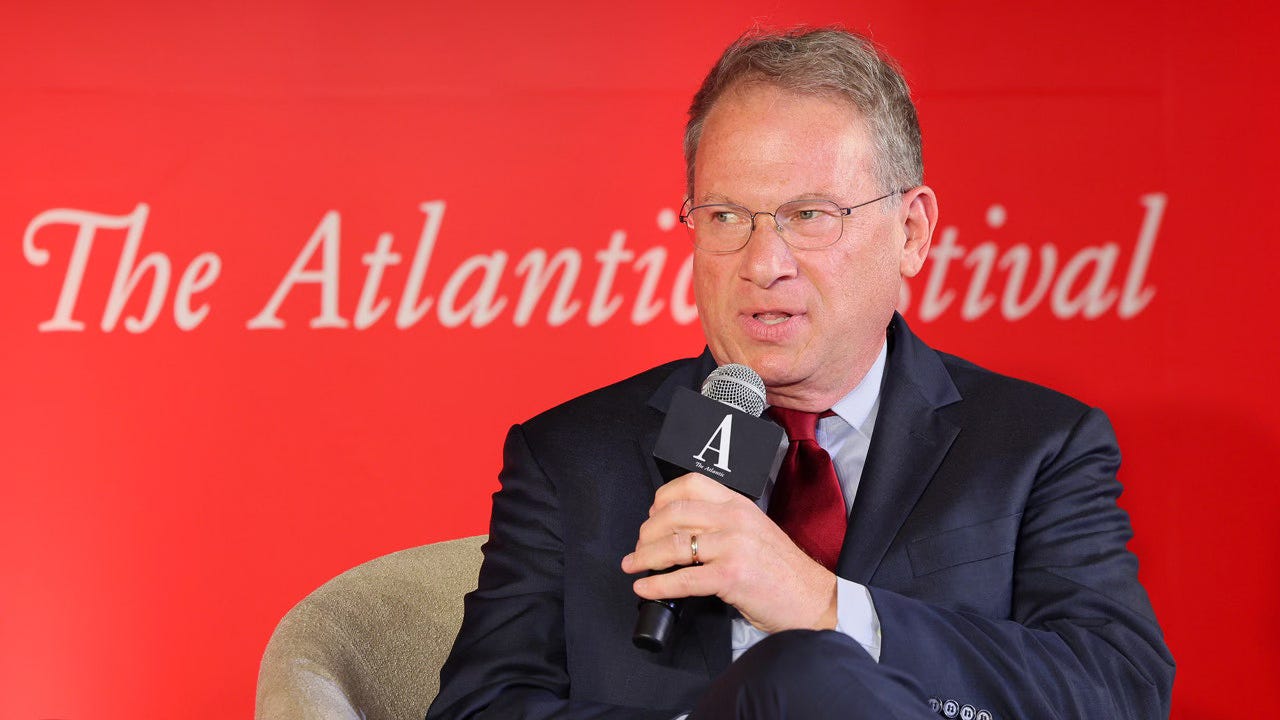
Goldberg’s rise to editorial eminence in Washington was not by accident. His foreign affairs journalism over the years for The Washington Post, The New York Times Magazine, The New Yorker, and now The Atlantic, has been marked by seriousness of purpose and meticulous reporting. His militant defense of Israel, which included service as a young man at an IDF prison guard a stint at The Forward, and his cheerleading for the George W. Bush administration’s 2003 invasion of Iraq, has drawn criticism from the left.
Ironically, the pro-Trump New York Post tried to use Goldberg’s support for the Iraq invasion to discredit him, charging in the headline of a 2020 column now getting new life that Goldberg “helped misreport America’s way into Iraq war.” The column accused Goldberg, in a piece he wrote for the New Yorker, of giving credence to the Bush administration's lie that Saddam Hussein and Al Qaeda were secret allies.
Goldberg was hardly alone in accepting the administration’s misrepresentations and propaganda. Remember the nonexistent Iraqi WMDs served up by The New York Times? But the subversive habit of Trump & Co. to indulge in the most patently untrue statements, whatever the subject, was on full display Tuesday under the high ceiling and klieg lights of Room 216 of the Hart Senate Office Building on Capitol Hill.
“I can’t recall,” Gabbard and Ratcliffe said again and again, in response to the most basic questions.
Such as this one when Sen. Jon Ossoff (D-Ga.) asked simply whether they remembered the group chat on Signal.
“I can’t recall,” they each responded.
“Yes, you can,” Ossoff shot back.
Now that was unforgettable.
SpyTalk is a reader-supported publication. To receive new posts and support my work, consider becoming a free or paid subscriber.