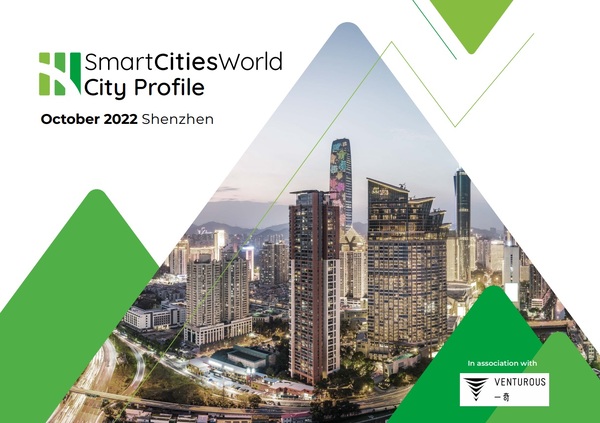
Shenzhen is acknowledged as “China’s Silicon Valley”, having evolved into a science, technology and urban innovation hub. High-tech is the lifeblood of the city’s economy, accounting for about 60 per cent of industrial output. In this edition of City Profiles, we explore how this late adopter in smart city development has wasted no time in moving up the digital learning curve and is admired as a leader in planning and implementing urban solutions and technologies.
According to the Shenzhen government, the city intends to become a benchmark digital city by 2025. In Shenzhen’s smart city plan, a key objective is to improve public services and urban governance capacity. City leaders stress the importance of digital infrastructure, strengths in data and analytics, and cooperation with international partners – with an underlying goal of improving and sustaining urban quality of life.
Among its smart city objectives are:
- Enhancing e-government, data sharing and governance
- Ensuring availability of next-generation connectivity
- Establishing big data platforms and building upon strengths in artificial intelligence, cloud computing and IoT
- Supporting the application of open government data
- Introducing data privacy and protection regulations.
Among the highlights in this report are:
- Insight into its three-layer smart city architecture
- Shenzhen’s plans to integrate e-gov administration with the local digital economy and tech-oriented residents
- How the city intends to become a model city for transportation by 2025
- Why the city turned to a “sponge city” model, which relies on green infrastructure
- How its environmental and biodiversity strategy has seen it become a leader in green growth.
Find out more about Shenzhen’s smart city strategy in this 18-page report.
WEBINAR: If you are interested in hearing more about Shenzhen and Public-Private Partnerships, then you might be interested in a webinar planned for 26 October (11am CET, 5pm SG/HK). Find out more here