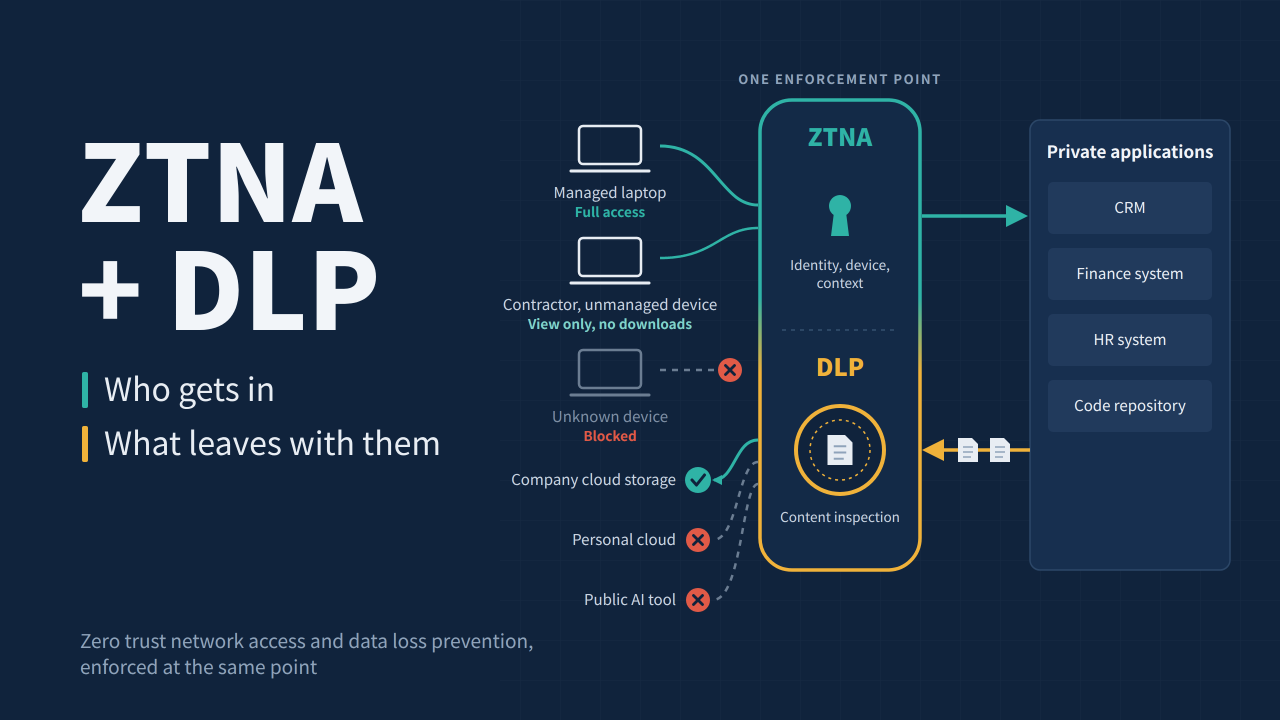
Zero trust network access (ZTNA) and data loss prevention (DLP) come from different parts of the security stack and are often owned by different teams. Most security service edge (SSE) platforms now sell them together, with a shared DLP engine running inside the same service that brokers user access. That raises a fair question for buyers: what does an access control product gain from a data protection engine, and is the pairing worth evaluating as one purchase?
ZTNA brokers user connections to specific applications, typically at the application layer (Layer 7). It's built on least-privilege access, continuous verification of users and devices, and, in many implementations, user and entity behavior analytics (UEBA). It's usually owned by the network or security team. DLP has historically lived elsewhere: on endpoints, in email gateways, in network appliances, and later in cloud access security brokers (CASBs). It's usually owned by a compliance or data governance team.
In an SSE platform, ZTNA handles private applications, a secure web gateway (SWG) handles internet traffic, a CASB handles SaaS, and a shared DLP engine inspects content across all three. This post looks at what the combination solves, what's driving it, and where it falls short.
The gap ZTNA alone can't close
ZTNA answers one question well: should this user, on this device, in this context, be allowed to reach this application? Once the answer is yes, most ZTNA solutions keep rechecking identity and device posture during the session. They don't inspect the data moving through the session, and that's where the risk is.
For example, a contractor with legitimate CRM access can export the full customer list. An employee on a personal laptop can download a sensitive financial report to local storage. A developer can paste proprietary source code into a public generative AI tool. None of these violates an access policy. Each one is a data loss event.
DLP answers the next question: what is this user doing with the data once they have access? Together, the two give security teams one place to make decisions based on both who the user is and what data they're handling.
What problems does this combination solve?
Bases access decisions on data sensitivity: With DLP context, access policy can do more than allow or deny. For example, a user on a managed device gets full access to a file share. On a personal device, the same user gets view-only access through browser isolation or app-level controls, and downloads of files containing regulated data are blocked.
Mitigates third-party and contractor risk: Organizations routinely give outside parties access to specific applications, often from devices the organization does not manage. ZTNA limits which apps they reach. DLP limits what content leaves those apps. Together they give security teams a stronger position in audits and vendor contract reviews.
Reduces alert noise: Traditional DLP is known for high alert volume, and detection accuracy still depends on classification methods such as exact data match and document fingerprinting. Pairing DLP with ZTNA adds context. Shared identity, device posture, and UEBA baselines help show which matches need follow-up. For example, a user who suddenly downloads ten times their normal volume of content is worth investigating even if each download is allowed.
Addresses generative AI leakage: Prompts and file uploads to AI tools are outbound web traffic. In an SSE platform, the SWG already proxies that traffic, so the shared DLP engine can inspect it for source code, customer records, or credentials and then block, redact, or warn the user.
Replaces separate tools with a common policy: Separate access and DLP tools mean two consoles, overlapping policies, and often two data classification schemes. A combined approach reduces duplication, coverage gaps, and the staff time needed to run both.
What's driving it
The access point became the inspection point - Remote access VPNs put users on the network and, in most deployments, passed traffic without content inspection. Endpoint DLP saw files on the device but had little access context. Once ZTNA brokers began replacing VPNs and proxying traffic at Layer 7, the access point became a logical place to inspect content.
Vendors combined the capabilities - SASE and SSE platforms brought ZTNA, SWG, CASB, and DLP into a single cloud-delivered stack. Gartner defined SASE in 2019 and introduced SSE as its security component in 2021. Before that, buyers typically bought these capabilities separately from different vendors.
Data moved to SaaS - When sensitive data sat behind a perimeter, network DLP could catch it on the way out. Now that data is spread across SaaS applications and accessed from anywhere, the most consistent control point sits between the user and the application.
Unmanaged devices have become normal - Hybrid work and contractor-heavy staffing mean many sessions start on devices where endpoint DLP agents can't be installed. Enforcement has to happen inline or in the browser.
Generative AI added urgency - Employees began pasting sensitive data into AI tools faster than policies could adapt. That pushed security leaders to combine access controls with data controls.
Where it falls short
- Inline DLP only sees what the proxy can decrypt, so TLS inspection must be in place.
- Applications that use certificate pinning, and traffic excluded for privacy reasons, fall outside inline inspection.
- Non-web traffic tunneled through ZTNA at Layer 3 or 4 gets little or no content visibility.
- Endpoint DLP is still needed for USB, printing, and offline activity.
Because of these gaps, most vendors enforce DLP in three places: in network traffic, in SaaS apps, and on endpoints. Buyers should ask whether a single policy and a single set of data classifications apply across all three, or whether each is managed separately and can produce different results.
What it means for buyers and vendors
For security teams, the pairing extends least privilege from applications to data. ZTNA controls who can reach an application, and DLP controls what they can do with the data inside it. For business leaders, it means fewer vendors to manage and one place to show auditors who accessed regulated data and what they did with it.
For vendors, this reflects a change in how these products are bought. The sales motion: Buyers increasingly start with data protection goals and evaluate access control as part of the solution.