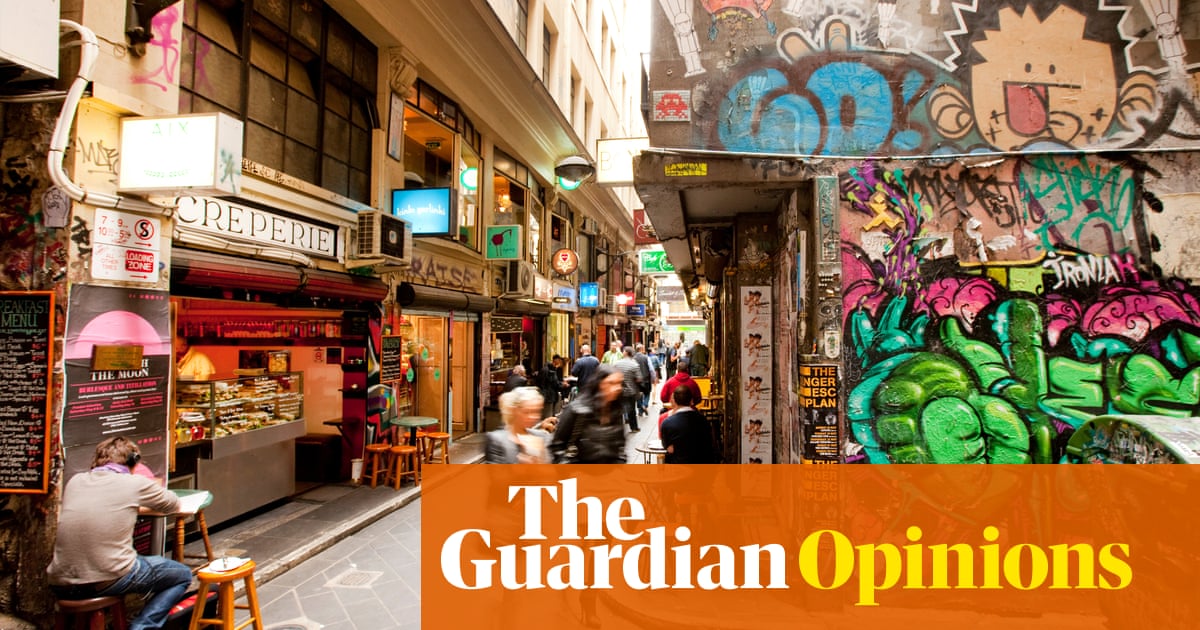
Break-ups are never easy, but some are harder than others.
During the dumpster fire that has been life in Melbourne’s lockdown 2.0, I’ve been forced to reflect on a relationship I took for granted, nitpicked at, maybe even gaslighted – until the unthinkable happened and they broke up with me.
I know I am not alone in mourning the end of this relationship. In fact, my connection to Melbourne cafes, my love of coffee so good it borders on a transcendental experience, is a wellspring of affection tapped by much of the city. Cafes get us through winter; heck, they get us through the day, and that is no small feat in Melbourne at the moment as residents battle stage-four restrictions and our anxiety over just how high that day’s case numbers and deaths will be. We need a modicum of relief.
Pre-pandemic I spent much of my life in cafes – I wrote in them, filed stories from them, met friends in them, and sought solitude in their far corners.
Yet I never fussed over them, never effused to others about how wonderful they were, because to acknowledge the appeal of Melbourne cafes (seriously, no other city’s cafe scene comes close) is akin to excessively flattering a gifted child who then turns into a narcissist with a superiority complex.
And you could argue evidence of this ego inflation was already on display – from the widespread apotheosis of chefs (“the chef recommends this”; “the chef won’t do that”) to menus that offered obscure produce and overly wordy descriptions of what was essentially a soft-boiled egg. I recoiled at the pretension, the tilt at coolness, the affected quality of my city’s cafes.
I tried but failed to get used to the uncomfortable cafe seating of milk crates or rusty metal chairs that caused patrons to limp out with lower back problems, and I never could see the point of food served on wooden slabs, adorned no less in those offensive micro-herbs.
Then there was the frustration of cafe doors left wide open throughout winter in obvious denial of how freezing converted shipping containers can be. One August outing, I relocated to the outside tables because it was warmer than inside – which felt as if I was brunching in the freezer aisle.
Now? What I wouldn’t give to hear about a cafe’s food philosophy (so interesting!). I miss cafe wait staff earnestly informing me of the provenance of the duck eggs on the menu, of the small farm that brought us today’s bacon, of the single-origin story of my espresso.
I would do anything to queue for a tiny slice of the communal table in Melbourne’s best cafes, to feel my toes harden into ice blocks and experience the intermittent rush of chilly air that whips through in winter.
I would love to devour the expensive deep-fried balls of zucchini, sorry fritters, and I would even tolerate the tapas-style share plates (OK, maybe not the share plates).
At this point, I would put up with a wide range of discomfort in blizzard-like conditions for good eggs. I would set my alarm at 5am on a Saturday; I would book ahead, several weeks in advance, if cafes would have me back.
Because, look, I wasn’t perfect either. For the most part I was a good patron, but there were times I failed to keep up my side of the bargain. Perhaps, if I am honest, I nursed that one coffee for too long without ordering food, and maybe that time I pretended not to see a party of four eyeing my large table. I actually did see them and maybe, just maybe, I could have moved to a smaller table.
Furthermore, I have tried to replicate a half-decent cafe experience during lockdown 2.0 and discovered this is not easy. While cocktail hour has proceeded without interruption in our home, my daily cup of coffee has been a succession of disasters, as I tested one alternative after the next: stove-top, plunger, injecting caffeine. I transported a takeaway coffee in a thermos back to my home office, but it seems ambience is a crucial ingredient in the ideal cafe experience. Where was the exposed brick, the bicycle mounted on the wall, the soundtrack of an unsigned band?
Which was how I arrived at two inevitable moments of clarity: there is no viable substitute for great Melbourne cafes, and when cafes do reopen, I owe them big time.
In the meantime, I will avoid the extreme behaviour that usually accompanies a break-up. I won’t get a tattoo or a piercing. I won’t dye my hair a radical hue nor pretend to prefer tea to inspire jealousy.
Most importantly, I won’t confuse the cheap imitations – hello coffee plungers – with Melbourne cafes, the real deal.
And when you all open again, I will enjoy you, however you come, with whatever level of pretension or queuing or elaborate food philosophy is on offer, and I won’t complain or try to change you again. I promise.
• Johanna Leggatt is a Melbourne-based journalist
America faces an epic choice ...
... in the coming months, and the results will define the country for a generation. These are perilous times. Over the last four years, much of what the Guardian holds dear has been threatened – democracy, civility, truth.
The country is at a crossroads. The Supreme Court hangs in the balance – and with it, the future of abortion and voting rights, healthcare, climate policy and much more. Science is in a battle with conjecture and instinct to determine policy in the middle of a pandemic. At the same time, the US is reckoning with centuries of racial injustice – as the White House stokes division along racial lines. At a time like this, an independent news organization that fights for truth and holds power to account is not just optional. It is essential.
Like many news organizations, the Guardian has been significantly impacted by the pandemic. We rely to an ever greater extent on our readers, both for the moral force to continue doing journalism at a time like this and for the financial strength to facilitate that reporting.
We believe every one of us deserves equal access to fact-based news and analysis. We’ve decided to keep Guardian journalism free for all readers, regardless of where they live or what they can afford to pay. This is made possible thanks to the support we receive from readers across America in all 50 states.
As our business model comes under even greater pressure, we’d love your help so that we can carry on our essential work. If you can, support the Guardian from as little as $1 – and it only takes a minute. Thank you.