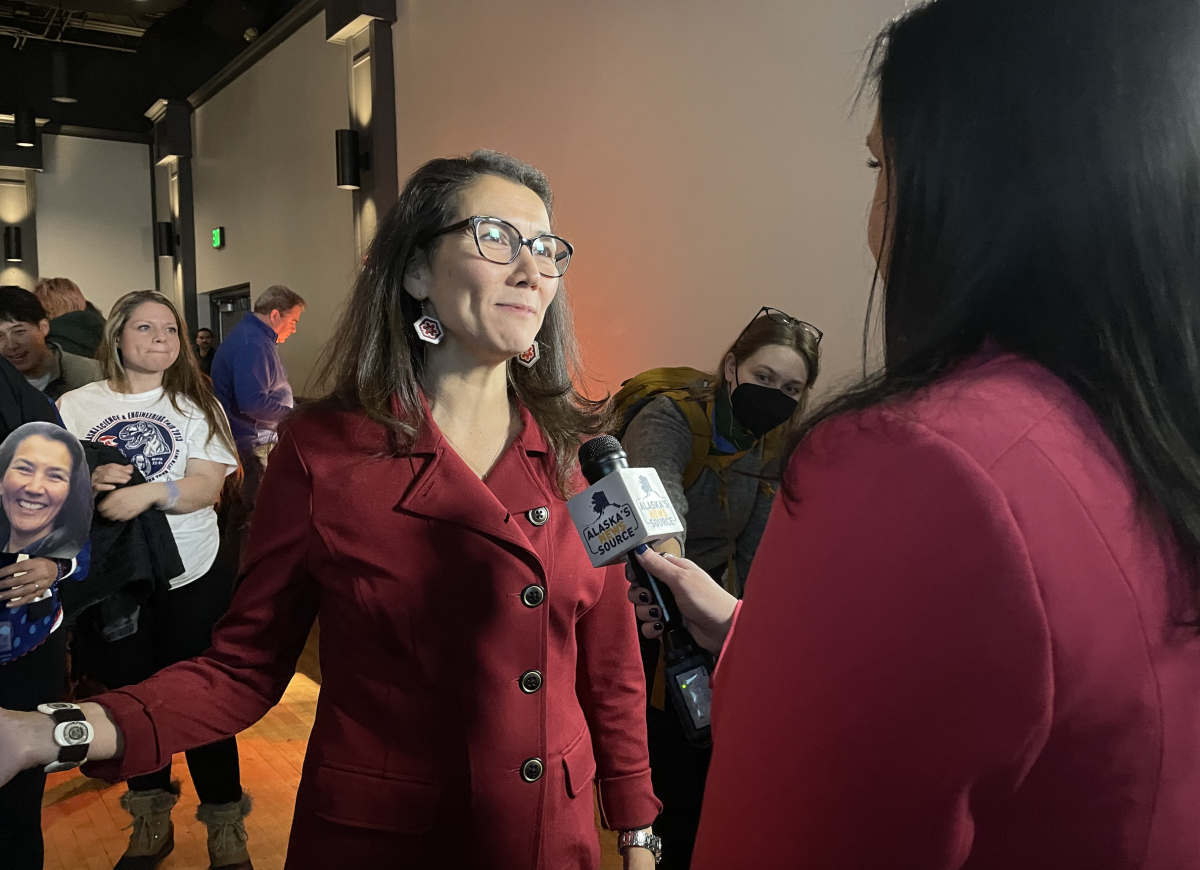
Fuel costs and food insecurity are two issues Rep. Mary Peltola, Yup’ik, D-Alaska, plans to take on as she begins her first full term as a U.S. Representative in 2023.
Peltola is the first Alaska Native person to be elected to the U.S. House of Representatives, and the first woman to hold that position for Alaska. The race was officially called over the Thanksgiving weekend, after Alaska’s lengthy, new ranked-choice voting process had completed.
Peltola was elected in August to fill the remaining months of Don Young’s term after he died in March. She campaigned on a “pro-fish, pro-family, pro-freedom” platform. The Alaska Federation of Natives endorsed her election to a two-year term, as did Young’s two daughters. Peltola has said she’ll follow in Young’s footsteps, working to build bipartisan support for Alaskan interests in Congress.
Alaska in 2021 opted for a new election process, with open primaries and ranked choice voting. A tally of first-choice ballots showed Peltola in the lead with almost 49 percent of the vote. It takes a majority, though, in the ranked-choice voting system, of 50 percent plus one to win an Alaska election.
Second-choice ballots were tabulated on Nov. 23, when Peltola won with nearly 55 percent of the vote over former governor Sarah Palin, who took 45 percent.
When asked what her win says about Alaskans, the Anchorage Daily News reports Peltola said, “I think it says that Alaskans are ready for an Alaskan to represent them who isn’t spouting the canned messages that we hear nationwide. I think it shows that Alaskans wholeheartedly embrace nonpartisanship and embrace working together and tackling issues that Alaskans face.”
She’s said repeatedly that she’ll represent all Alaskans in Congress. While Alaska will be at the forefront, she told ICT on election night that Alaskans share concerns common across Indian Country.
“So many things that Indian Country find as issues we see as issues across the state and across the nation. One of the things I'm really worried about are home heating costs,” Peltola said. “I know that a lot of people, now that we're in the cold season, are trying to balance out whether they can afford their heat or they can afford to eat, and we've got to drive down our stove oil prices or diesel.”
The cost of fuel affects transportation costs, which raise the cost of living everywhere but especially in rural communities that don’t have the economy of scale to help bring costs down.
“Petroleum is one of the most volatile of all of our commodities, and when we see that go up, every household in Alaska goes backwards. So we've gotta get a handle on that,” she said.
One of the ways rural Alaskans handle the high cost of living is to gather and share food from nature. Peltola, who previously worked for an intertribal fisheries management consortium, said abundance is low among many species, ranging from salmon to caribou to ptarmigan.
“A great concern to me is the low ocean productivity that we're seeing in the Bering sea right now. We saw the bottom fall out of the crab (fisheries) and halibut is in short supply, Chinook salmon, chum salmon, silver salmon. So we have a lot of things that we need to find out what is the cause, but in the meantime, we've got to be much more precautionary in the way that we manage our natural resources.”
Peltola will continue filling the last months of Young’s term until she is sworn in to her two-year term on Jan. 3, 2022.
Our stories are worth telling. Our stories are worth sharing. Our stories are worth your support. Contribute $5 or $10 today to help ICT carry out its critical mission. Sign up for ICT’s free newsletter.