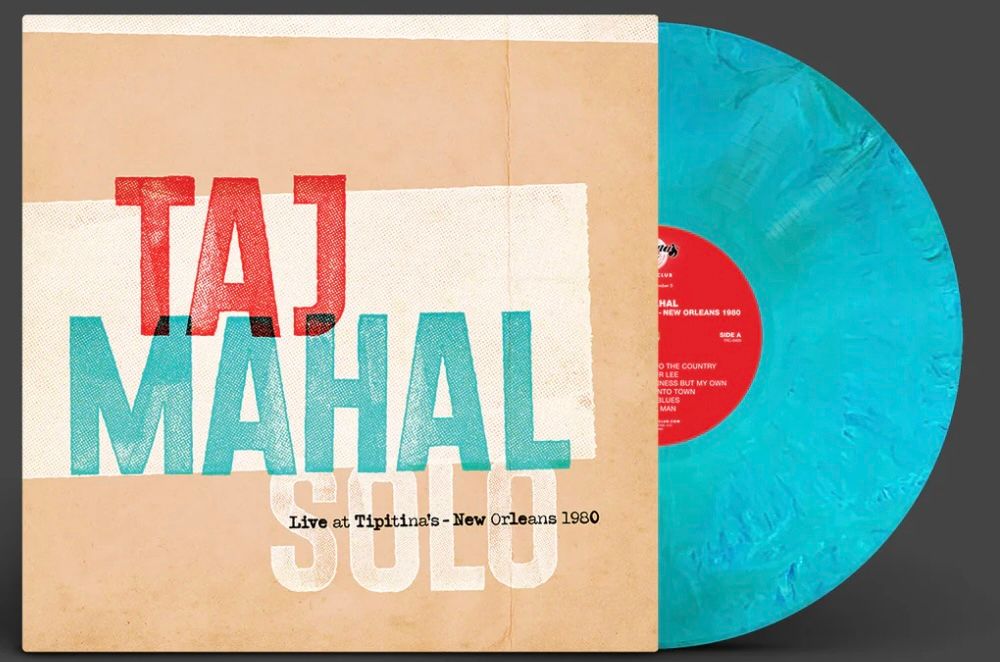
Taj Mahal stepped onto a small stage in a fledgling New Orleans club on Dec. 5, 1980, and asked the Friday night crowd, “How ya feelin’?” A chorus of cheers washed over the sound of his fingers settling on strings. “Gooooood,” he replied, his voice warm as an easy smile. He was feelin’ real good, too, he said, and as he dove into his first number, a country daydream for lovers, it showed.
With just his agile voice and bright-toned guitar, Mahal stripped down the classic 1968 tune to its prettiest parts, conjuring hand-painted flowers on a mailbox for two and a groove that ached in just the right way. He coaxed the ladies and the fellas to sing back-up and delivered a blues-bound scat over their unison “shoobeedoowees.” There were sing-alongs in the key of “liquor’s quicker” and love song side-joints full of wild characters. Classic blues narratives shifted shapes as the night continued, and world-traveled rhythms dug into their tales.
This recording captures all of that and more – the audience interactions, alternately funny, moving and sweet; echoes of Mahal’s musical elders and the influences of his travels; his New Orleans-specific comic asides. It also captures Mahal, then 38, at a pivotal point in his career. Between label deals, the acclaimed bluesman was playing more solo shows due to what he’d later call the “economics” of the time. He’d soon relocate to Hawaii, launching a quieter phase of his prolific career.
Tipitina’s, then barely three years old, was a marked departure from the bigger New Orleans venues Mahal had played in the ‘70s. A ground-floor-only, neighborhood club founded less than three years earlier, Tip’s had yet to be renovated and air conditioning remained a distant dream.
“Man, it is like a sauna in here,” Mahal noted from the stage according to Sonny Schneidau, who mixed and recorded the show. With its dropped ceiling and low-rise stage, Tip’s had little in the way of boundaries between artist and audience. But in Mahal’s eyes, New Orleans music audiences “had a high degree of musicality and were very sophisticated in their taste …,” he’d later recall, “so it was exciting for me to come there and play – anytime, for whatever reason.”
Besides, he’d never been much for boundaries.
Born Henry St. Claire Fredericks Jr., in New York City's Harlem section in 1942 and raised in Springfield, Mass., Mahal’s upbringing revolved around multiple musical cultures and traditions -- from the gospel his mother, a schoolteacher from South Carolina, sang in church, to the jazz his father, a classically trained pianist and arranger from St. Kitts and Nevis, played professionally. After launching his career alongside guitarist Ry Cooder in the Rising Sons, Mahal forged his own path, releasing three acclaimed albums – Taj Mahal, The Natch’l Blues and the electric/acoustic blues double-header Giant Step/De Ole Folks at Home – in 1968 and ‘69, as he collaborated with bandmates like guitarist Jesse Ed Davis and trombonist Howard Johnson, and other musicians like the Rolling Stones.
Mahal spent much of the ‘70s exploring a much wider musical palette and creating sonic pathways in his work from American blues traditions to other music forms, instrumentation and lineages around the globe, especially Africa and the Caribbean. Tours in the South Pacific in 1978 and Africa in1979 seemed to unlock even more creative power for the multi-instrumentalist and avid music scholar.
“By ‘80 … mostly, I wanted to know the music from a cultural standpoint,” says Mahal, speaking from his home in California. “That was my big vibe. Where's that culture?”
He uses a sourdough analogy to explain, positing the “mother” dough – “the batch you have to pull off of” for the next loaf – as the blues: “Because it came through in lots of different ways in the earlier music that I heard, but there's something something wholly -- [as in] ‘W-H-O’ and ‘H-O’ -- about the blues, you know? Something absolutely all-encompassing and basic at the depth of it. If you don’t feel them or understand them, you’re dead, no exceptions.”
Despite those universal qualities, Mahal admits his interpretation of the blues – “it’s not [about] putting it on you,” he says, it’s “a joyous thing that can lift a whole room” – hasn’t always been met with receptive ears. Some audiences keep themselves closed off, while others can be swayed to open up and feel what he’s doing.
Whatever that channel is, he says, “In New Orleans, it’s open already.”
That was certainly the case that December night in 1980 at Tipitina's – “you can hear by the response from the audience,” Mahal says. Some of that energy likely stemmed from Mahal’s relationship with the Crescent City, which he says “always had a big place in my heart for music.” It’s a love he traces to childhood dances, where the music of Huey “Piano” Smith was powerful enough to jolt him out of his “wallflower” tendencies. “That music would come on and … I don't know what it was. In the same vein that the Hawaiian music completely filled my spirit. It wasn’t playin’ at me, I was already there.”
He went on to work with drummer Earl Palmer on The Natch’l Blues and shared stages with the Meters. When he met Ernie K-Doe, “I said, ‘Man what I love about your music … you don't end down, you end up!’” he recalls, singing a few lines from “Mother-in-Law.”
New Orleans music surfaced in this Tip’s show, too, with the murder ballad “Stagger Lee.” Mahal’s fingerpicking hints at Mississippi John Hurt’s 1928 version of the song, while the swaggering theatricality of his guitar string gunshots and wild character voices suggest shades of Lloyd Price and Dr. John’s renditions.
Dig a little deeper and a lifetime of stories starts to emerge. By 1980, Mahal was married with children and had traveled the world. Hawaii was on the horizon, but his choice of tunes like the laid-back opener here spoke to something deeper and longer-simmering than a desire to ditch the West Coast.
“My life has all been about regaining the information and relaying it and reworking it and rearranging it and showing people just the value of the simple life. The city life. The blues life. The country life, you know? And I’ve lived with, in and out of that,” he explains, citing his college studies in animal husbandry and agronomy.
“Fishing Blues,” resonated more directly in 1980, when Mahal’s version of the song appeared in an ad for President Jimmy Carter’s re-election campaign: “I look through all these great nuggets and pieces of deep Africana, deep Americana … These songs hold true to a lot of people. So I knew that I was on the right track when he did that.”
That the tune would find its way into U.S. politics – in a former farmer’s campaign, no less – underscores Mahal’s long held belief in their value and power. The message becomes even more poignant when you consider the songs’ context, as Mahal often does, in a recording industry where commerce and commodification have historically reigned above all else.
Reflecting on “Dust My Broom,” Mahal says he’d “heard about” Elmore James’ popular 1965 version before actually hearing the song, since “so much of this great music wasn’t being played on the air” nationally. As for Robert Johnson’s original, “There's so many Black musicians that have never heard of Robert Johnson. In Africa, you don't have no record industry over the heads of an enslaved bunch of people. … It’s the people in the culture themselves that decides what [the culture] keeps or throws out.”
He takes a lighter swipe at the music industry later, teasing that his take on Eric von Schmidt’s alternative “good time” version of “Ain’t Nobody’s Business,” with its explicit cocaine references, “would have been a huge song but Columbia said it was promoting taking drugs.”
The recording also nods at some of Mahal’s greatest fingerpicking influences, including Reverend Gary Davis: “There are very few people who could actually play [‘Candyman’] like him. It’s one of the premier fingerpicking songs and its roots go all the way back to the 11th Century in Mali, to the kora and the ngoni players – the kamale ngoni – that three-finger-picking style, its ancestor is back there,” he explains.
“He grew up during the years that the piano was expanding in terms of blues and ragtime, and he transferred all that ragtime stuff to one thumb and one finger on six strings on a guitar,” he marvels. “So he played the guitar more like it was a piano than it was a guitar.”
When Mahal recorded “Candyman” with the Rising Sons, he “was trying to re-anchor people into the deep music of this country,” he says – but the originals showcased here feature his use of the style, too.
“That's just a natural way to touch strings and that's the sound that I want. I mean, guys play flurries of notes …But no, I love that rolling fingerpicking sound. I mean … you don't get ‘Queen Bee’ unless you can play that sound.”
“And if you can’t pick it?” I ask.
“Then you don't play it,” he says. “Look, you either got a real good gumbo or you got a pot of soup, OK?” Suddenly less animated, Mahal stops chatting and looks at me through sunglasses, as if to make sure his point has made it across our screens, West Coast to Gulf Coast. It’s a brief but disarming moment and I wonder what it felt like to sing and whistle and clap on cue with Taj Mahal and a roomful of sweaty, music-loving kindred spirits on a December evening in 1980.
Then Mahal breaks into song again, taking me right along with him.
“Listen to how that feels, man!, ‘Buy you a Chev-ro-layyy … You could walk down the road and see that everything's all right, you know?”
Jennifer Odell -- New Orleans, 2024