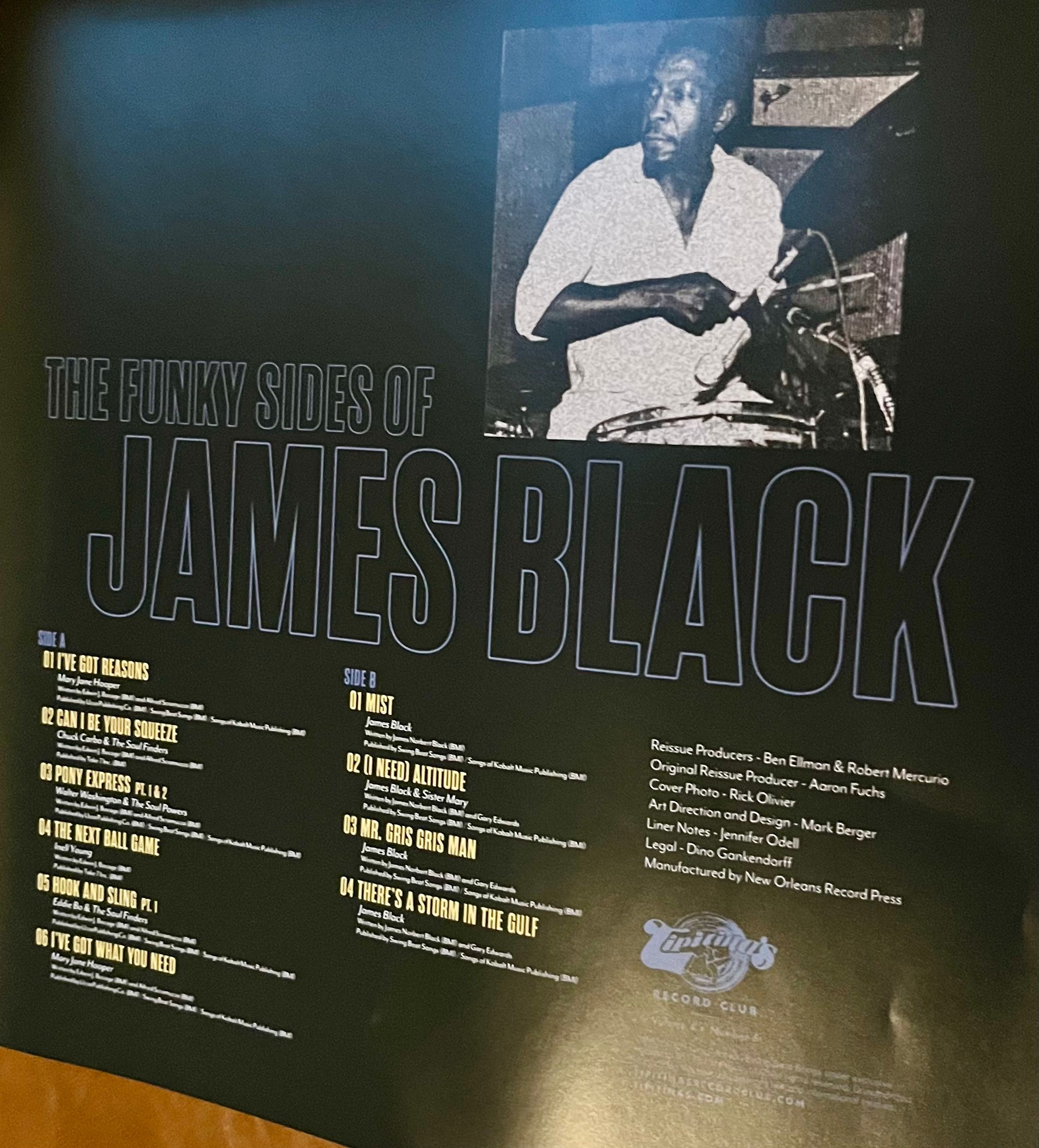
“I wanna work up to where James Black really is."
On April 9, 1983, the New Orleans-born musician of the same name was on the air at WWOZ-FM in his hometown, reflecting, occasionally in the third person, on his wide-ranging music career while playing selections of his music on DJ Pat Jolly’s show.
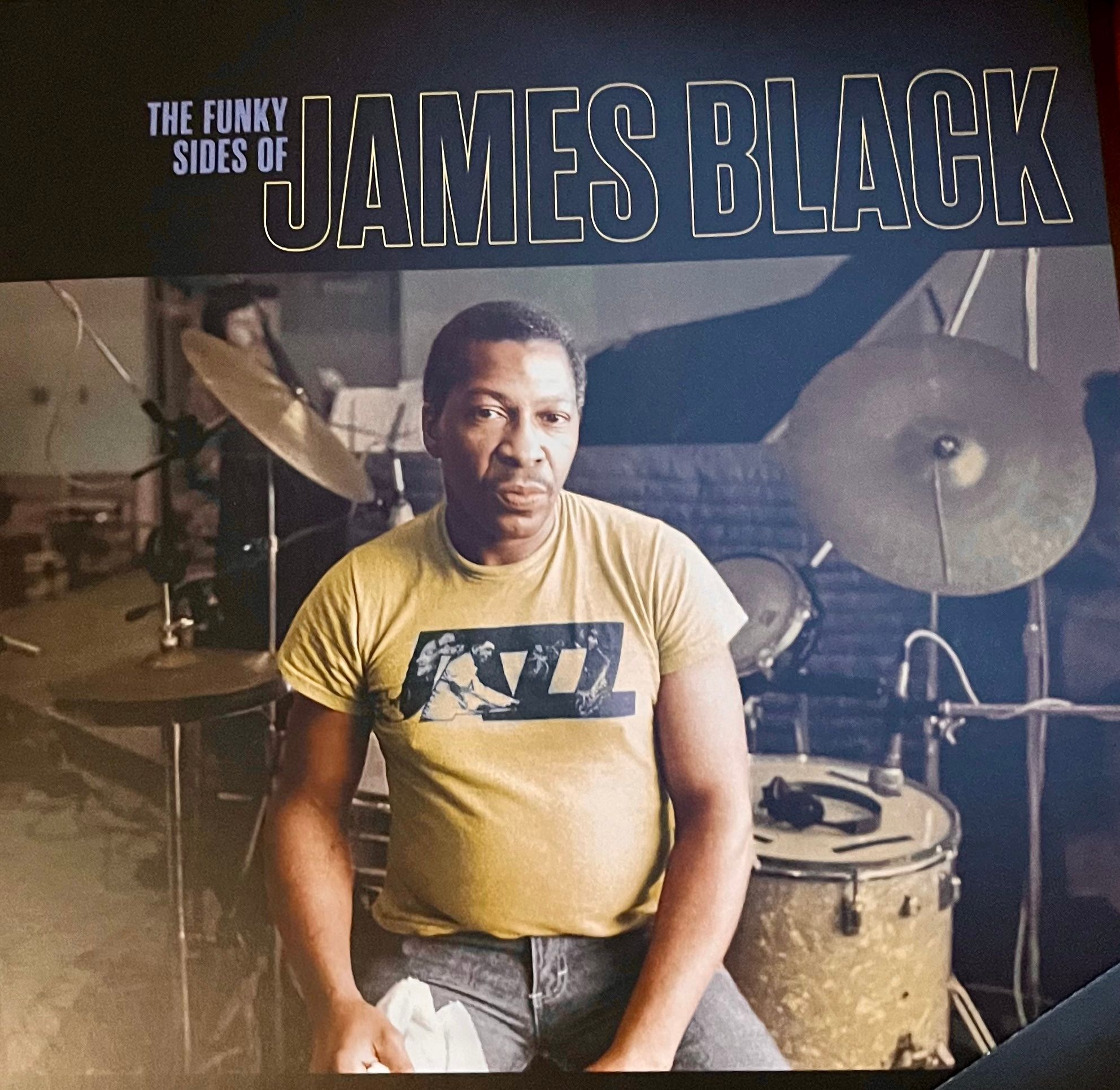
After opening with his composition “Monkey Puzzle,” the title cut from his acclaimed 1963 AFO Records album with the Ellis Marsalis Quartet, Black recapped the flurry of early-1960s work that launched him to a series of landmark recordings and performances with some of the biggest names in jazz, funk and rhythm and blues. There was the tour with singer Joe Jones that led him to New York City (and left him there after he and Jones had a falling-out). He recalled a run with Horace Silver at Birdland on the famed original venue’s final three nights. He cited years spent touring in Lionel Hampton’s band before the acclaimed vibraphonist fired him -- “I wouldn’t play four beats on the bass drum,” Black said, chuckling. “I was into jazz and bebop and I didn’t wanna be tied down!”
Black was set to return to New Orleans when a call from Yusef Lateef changed his plans. The multi-instrumentalist had heard Black on Nat and Cannonball Adderly’s 1962 album In the Bag and wondered if he wanted a gig. He accepted and the two forged a long-running creative relationship. All of that was just the start. An in-demand session player, Black teamed up with Eddie Bo in the late ‘60s to cut some of the deepest funk tracks of the era. He recorded for Allen Toussaint through the ‘60s and ‘70s, backing the likes of Irma Thomas, Dr. John and Lee Dorsey and more artists in a wide range of styles.
“I dug it, I like jazz and all that,” Black, then 43, recalled on Jolly's show. “But I still, deep down inside me, had my own James Black concept, my own kind of music. And I’d get fired off a lot of gigs because I had my own James Black concept.”
He cued up a version of his celebrated composition “Magnolia Triangle” from 1965’s Live at Pep’s with Yusef Lateef. A swirl of bass drum gongs gave way to Black’s trademark fire as the drums took hold of the tune, a groove in five cushioning thorny horn lines into a moment of unison, then bouncing them out into space like a slingshot.
“I’m sorta like the ‘mission impossible drummer,’” he told Jolly. “When nobody else can play it, they’ll call me.”
From the early 1960s until his death at 48 in 1988, James Black regularly shattered preconceptions about jazz and opened doors to new ways of thinking about music, in general. On drums, he balanced fire with technical precision and a holistic view of both his instrument and the music at hand. With his dizzying command of rhythm, innovative harmonic concepts and boundless hunger for creative adventure, Black took creative strides that routinely pushed whatever he was playing into new territory.
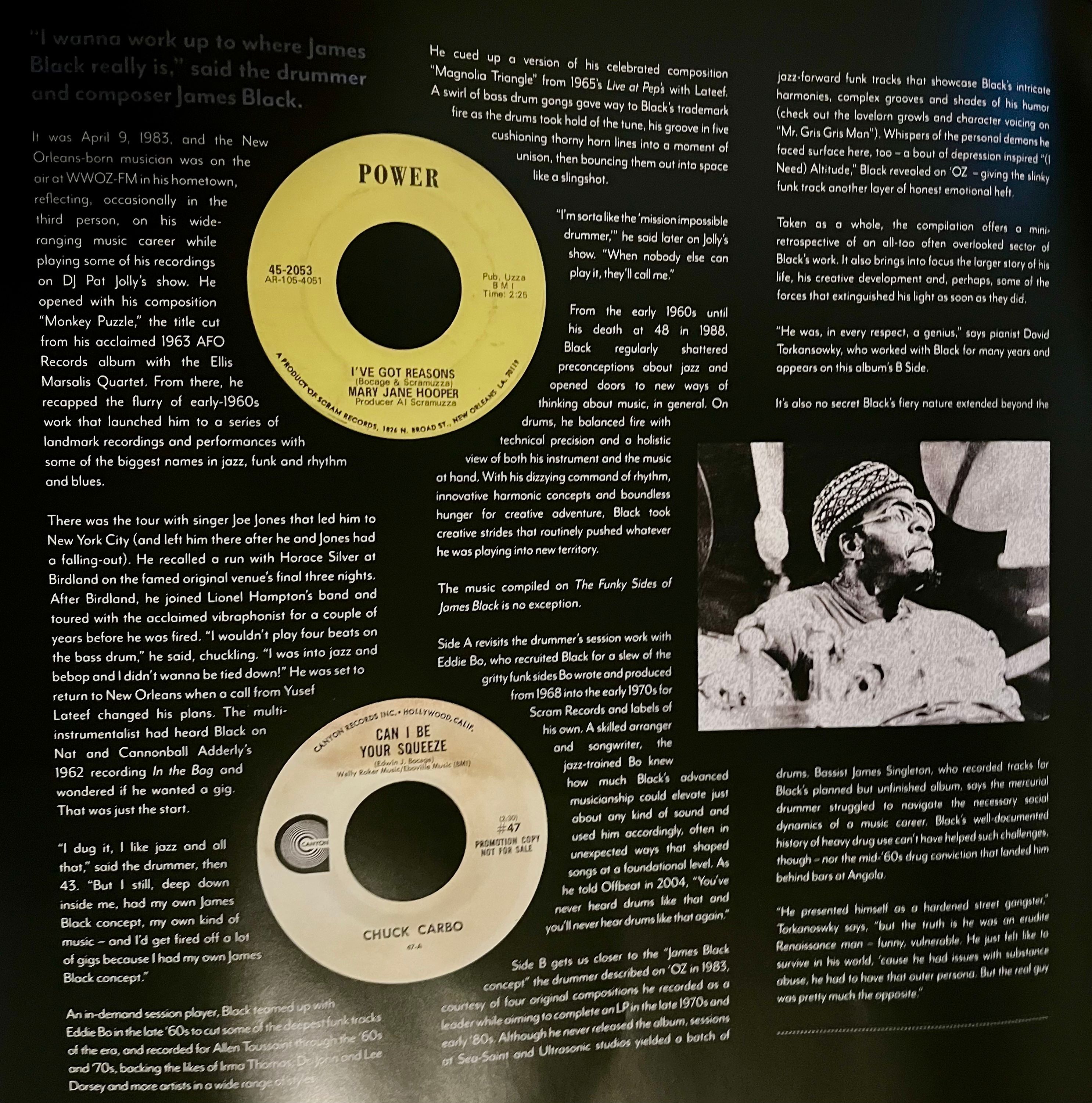
The music compiled on The Funky Sides of James Black is no exception. Side A revisits the drummer’s session work with Eddie Bo, who recruited Black for a slew of the gritty funk sides Bo wrote and produced from 1968 into the early 1970s for Scram Records and labels of his own. A skilled arranger and songwriter, the jazz-trained Bo knew how much Black’s advanced musicianship could elevate just about any kind of sound and used him accordingly, often in unexpected ways that shaped songs at a foundational level. “You’ve never heard drums like that and you’ll never hear drums like that again," Bo said in a 2004 interview with Offbeat writer Michael Hurtt.
Side B gets us closer to the “James Black concept” the drummer described on ‘OZ in 1983, courtesy of four original compositions he recorded as a leader while aiming to complete an LP in the late 1970s and early ‘80s. Although he never released the album, sessions at Sea-Saint and Ultrasonic studios yielded a batch of jazz-forward funk tracks that showcase Black’s intricate harmonies, complex grooves and shades of his humor (check out the lovelorn growls and character voicing on “Mr. Gris Gris Man”). Whispers of the personal demons he faced surface here, too -- a bout of depression inspired “(I Need) Altitude,” Black revealed on ‘OZ -- giving the slinky funk track another layer of honest emotional heft.
As a whole, the compilation offers a mini-retrospective of an all-too often overlooked sector of Black’s work. It also brings into focus the larger story of his life, his creative development and, perhaps, some of the forces that extinguished his light as soon as they did.
“He was, in every respect, a genius,” says pianist David Torkanowsky, who worked with Black for many years and appears on this album’s B Side.
With that genius, however, came a fiery and unpredictable temperament that sometimes caused problems for Black in his professional life.
“He presented himself as a hardened street gangster, but the truth is he was an erudite Renaissance man – funny, vulnerable," Torkanowsky muses. "He just felt like to survive in his world, ‘cause he had issues with substance abuse, he had to have that outer persona. But the real guy was pretty much the opposite.”
Bassist James Singleton, who recorded tracks for Black’s planned but unfinished album, says the mercurial drummer struggled to navigate the necessary social dynamics of a music career. Black’s well-documented history of heavy drug use presumably complicated those challenges -- as did the mid-’60s drug conviction that landed him behind bars at Angola.
*
“Rhythm and blues, rhythm and blues, basically rhythm and blues. Everybody calls me a ‘jazz drummer’ and all that, but I grew up with rhythm and blues.”
Born on Feb. 1, 1940, James Black grew up around the corner from the famed Caldonia Inn in the Crescent City’s Treme section at a time when rhythm and blues was king, a point he made in a fittingly rhythmic cadence in a 1982 interview for the Hogan Jazz Archive’s oral history series at Tulane University.
He’d studied piano at home and trumpet in school, he told interviewer Jason Berry, playing rhythm and blues in nearby country towns as a kid and listening to artists like Roy Brown, Big Joe Turner, Bo Diddley and Louis Jordan. By then, Black’s music sensibilities were deeply rooted in the sounds of his neighborhood. Detailing the New Orleans-specific feel for rhythm he shared with the city’s long line of stellar drummers, Black cited second line parades and Mardi Gras Indian chants and the rhumba Professor Longhair poured into his piano at the Caldonia.
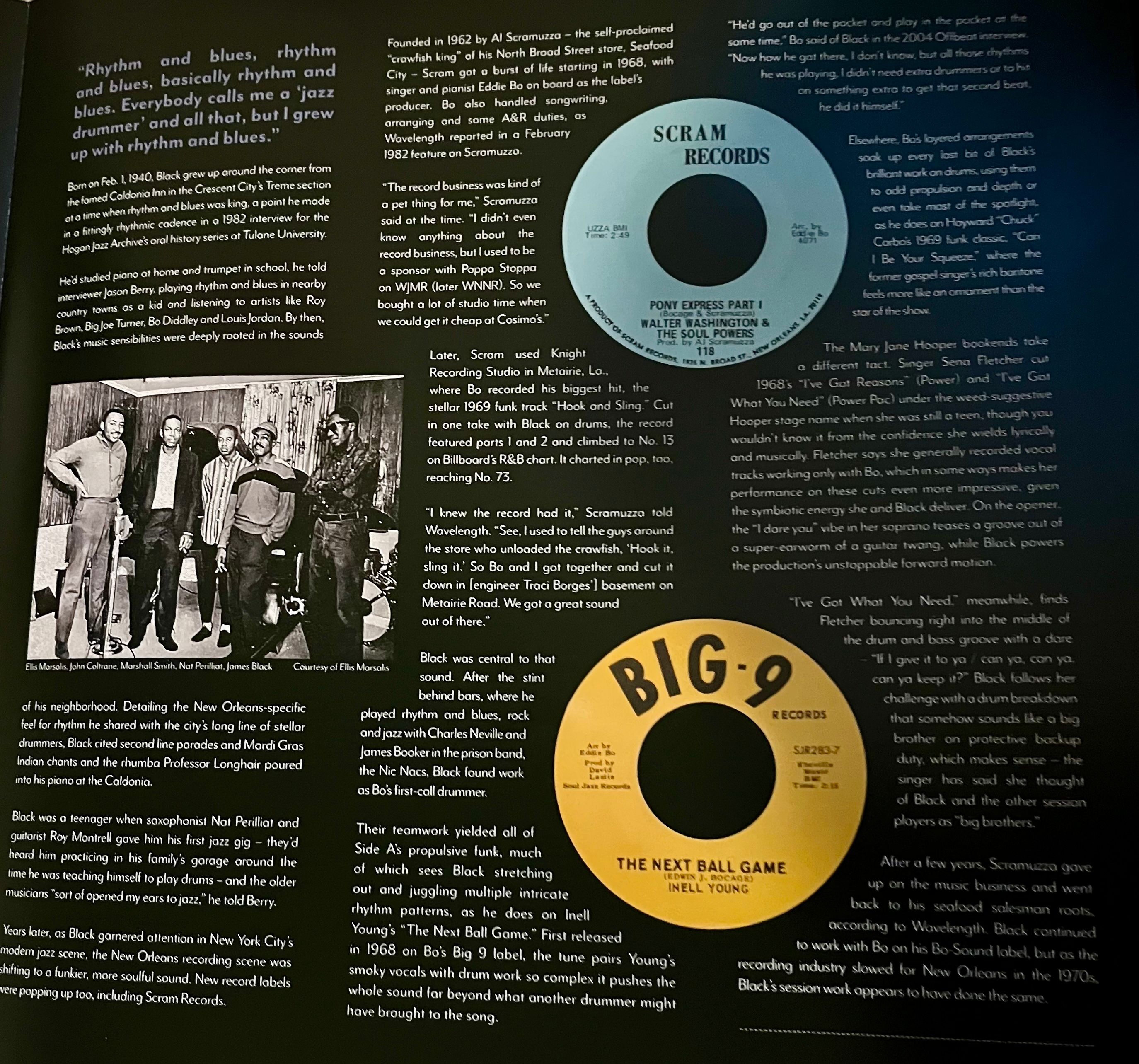
Black was a teenager when saxophonist Nat Perilliat and guitarist Roy Montrell gave him his first jazz gig – they’d heard him practicing in his family’s garage around the time he was teaching himself to play drums – and the older musicians “sort of opened my ears to jazz,” he told Berry.
Years later, as Black garnered attention in New York City’s modern jazz scene, the New Orleans recording scene was shifting to a funkier, more soulful sound. New record labels were popping up too, including Scram Records.
Founded in 1962 by Al Scramuzza – the self-proclaimed “crawfish king” of his North Broad Street store, Seafood City – Scram got a burst of life starting in 1968, with singer and pianist Eddie Bo on board as the label’s producer. Bo also handled songwriting, arranging and some A&R duties, as Wavelength reported in a February 1982 feature on Scramuzza.
“The record business was kind of a pet thing for me,” Scramuzza said at the time. “I didn't even know anything about the record business, but I used to be a sponsor with Poppa Stoppa on WJMR (later WNNR). So we bought a lot of studio time when we could get it cheap at Cosimo's.”
Later, Scram used Knight Recording Studio in Metairie, La., where Bo would cut his biggest hit, the stellar 1969 funk track “Hook and Sling.” Recorded in one take with Black on drums, the record featured parts 1 and 2 and climbed to No. 13 on Billboard’s R&B chart. It charted in pop, too, reaching No. 73.
"I knew the record had it,” Scramuzza said in the same Wavelength interview. “See, I used to tell the guys around the store who unloaded the crawfish, 'Hook it, sling it.' So Bo and I got together and cut it down in [engineer Traci Borges’] basement on Metairie Road. We got a great sound out of there.”
Black was central to that sound. After his stint behind bars – where he played rhythm and blues, rock and jazz with Charles Neville and James Booker in the prison band, the Nic Nacs – Black found work as Bo’s first-call drummer.
Their teamwork yielded all of Side A’s propulsive funk, much of which sees Black stretching out and juggling multiple intricate rhythm patterns, as he does on Inell Young’s “The Next Ball Game.” First released in 1968 on Bo’s Big 9 label, the tune pairs Young’s smoky vocals with drum work so complex it pushes the whole sound far beyond what another drummer might have brought to the song.
“He’d go out of the pocket and play in the pocket at the same time,” Bo said of Black, speaking to Offbeat. “Now how he got there, I don’t know, but all those rhythms he was playing, I didn’t need extra drummers or to hit on something extra to get that second beat, he did it himself.”
Elsewhere, Bo’s layered arrangements soak up every last bit of Black’s brilliant work on drums, using them to add propulsion and depth or, as even take most of the spotlight, as he does on Hayward “Chuck” Carbo’s 1969 funk classic, “Can I Be Your Squeeze,” where the former gospel singer’s rich baritone feels more like an ornament than the star of the show.
The Mary Jane Hooper bookends take a different tact. Singer Sena Fletcher cut 1968’s “I’ve Got Reasons” (Power) and “I've Got What You Need” (Power Pac) under the weed-suggestive Hooper stage name when she was still a teen, though you wouldn’t know it from the confidence she wields lyrically and musically. Fletcher says she generally recorded vocal tracks working only with Bo, which in some ways makes her performance on these cuts even more impressive, given the symbiotic energy she and Black deliver. On the opener, the “I dare you” vibe in her soprano teases a groove out of a super-earworm of a guitar twang, while Black powers the production’s unstoppable forward motion.
“I’ve Got What You Need,” meanwhile, finds Fletcher bouncing right into the middle of the drum and bass groove with a dare – “If I give it to ya / can ya, can ya, can ya keep it?” Black follows her challenge with a drum breakdown that somehow sounds like a big brother on protective backup duty, which makes sense – the singer has said she thought of Black and the other session players as “big brothers.”
Scramuzza soon gave up on the music business and went back to his seafood salesman roots, according to Wavelength. Black continued to work with Bo on his Bo-Sound label, but as the recording industry slowed for New Orleans in the 1970s, Black’s session work appears to have done the same.
*
James Black left New York City’s jazz scene in the mid-1960s, but he never really left modern jazz.
In the early ’70s, the drummer reunited with Ellis Marsalis in the pianist’s Elm Music Company ensemble, which played regularly at the French Quarter jazz haunt Lu & Charlie’s. He continued his affiliation with founding members of Harold Battiste’s progressive jazz-minded AFO Records group around that time, and experimented with pop, funk and soul with singer Deacon John in what he’d later call their “acid rock” outfit, Duckbutter. By the mid-’70s, Black was leading his own bands, including a series of eponymous modern jazz combos that performed his original work at Jazz Fest from 1976 until 1988.
The complex funk sound on this album’s Side B draws from that era of Black’s career. Armed with the creative freedom his work with Marsalis and his own bands allowed, the drummer and composer set out to record his own album in the late ‘70s and early ‘80s. He teamed up with producer and Sound of New Orleans label founder Gary Edwards, then with Allen Toussaint’s Sansu label, and recorded a batch of original music, much of it fueled by the funk-jazz fusion captured here.
“I like to play funk and rhythm and blues and all that, but I still like to play jazz too,” Black told Modern Drummer’s Scott K. Fish in a June 1982 interview. “Each style of music has its own limitations.”
At the time of the interview, Black was in pre-production for his planned album – “10 sides for Sansu Records with Allen Toussaint,” he said – and was excited to trade his long-running sideman role for bandleader in the studio. Music-wise, he envisioned a “floating sort of harmony but with a solid beat behind it and some floating vocals” by singer Mary Bonnet – a description that fits what we hear on this album’s version of “Altitude.” Mostly, though, Black seemed pleased he could finally express himself more completely than he’d been able to in sideman roles, musing at one point that “sooner or later, from maybe the third side, you’ll hear the real James Black come out!”
By April 1983, Black had made enough progress on the recording to play some of the unreleased music on Jolly’s ‘OZ show, including rough cuts of the lush and spacey fusion-funk track “Altitude” and the more cerebral “There’s a Storm in the Gulf,” which he dedicated to “people in the Gulf South” affected by recent flooding.
“‘Altitude,’ to me, is a very special song, because at the time I wrote this song I needed altitude because I was really down, low and depressed,” Black told the show host. “I heard this little voice in my head that said, ‘Man, you need you some altitude! You can’t just be down here wallowin’ in the mud like that!’ It said, ‘You need to pick yourself up!’ So I gave it a try and I sat down and I wrote it. And I sang – I’d never actually sang as such before but it seemed like such an ideal song for me to sing because it expressed exactly how I felt and exactly how I knew other people felt in the world.”
He also cited musicians he’d recruited for the project, including Torkanowsky, as well as trumpeter Clyde Kerr, Jr., and percussionist Mark Sanders. Since multiple versions of some tunes later surfaced, however, details including personnel and exact recording dates for each track are unavailable. (Side B’s version of “Altitude” is believed to stem from a late ‘70s session.)
While the recording sessions didn’t lead to a release during Black’s lifetime, they did yield the alternately brilliant, funny, honest and thought-provoking music on The Funky Sides of James Black’s second half.
“James was one of the great composers of this town,” says Singleton. “There’s no debate.”
Asked about Black’s vision for the recording project that now forms the basis of this album’s Side B, Torkanowsky says, “James lived on the margins,” and that gave him a different perspective on the process and, perhaps, the project as a whole.
“He was, as most misunderstood geniuses go, not embraced by the establishment and so any studio experience was an exception,” he continues. “I think James was just happy to be making his record.”
Black’s efforts to promote the project during interviews in the early 1980s also shed light on his state of mind in the final years of his short life. In his interview with Modern Drummer, Black referenced a long history of perceived limits on his ability to express himself completely through music. He made similar comments, albeit veiled in warmth and self-deprecating humor, the next year on ‘OZ.
Asked in 1982 how he navigated feeling discouraged, Black told Modern Drummer he looked to his spiritual side for balance. That balance seemingly eluded his grasp in the end – Black’s drug use caught up to him six years after the interview and he was pronounced dead on Aug. 31, 1988 – but his words suggest he sought an internal life as multi-faceted and complete as his music.
“We said rhythm, harmony and melody is like a trinity. You're physical, you're mental and you're spiritual. It's a trinity,” Black told the magazine. “It's like all things come in threes. You get your three things together so you can be a complete person. Instead of just being a drummer who doesn't know harmony and melody – just rhythm. That’s a machine.”
-- Jennifer Odell, New Orleans 2024