
Writing on living a deliberate life, focused on building businesses rather than cabins by ponds. Content about strategy, life, and philosophy all building to being more deliberate and living a more amazing life.
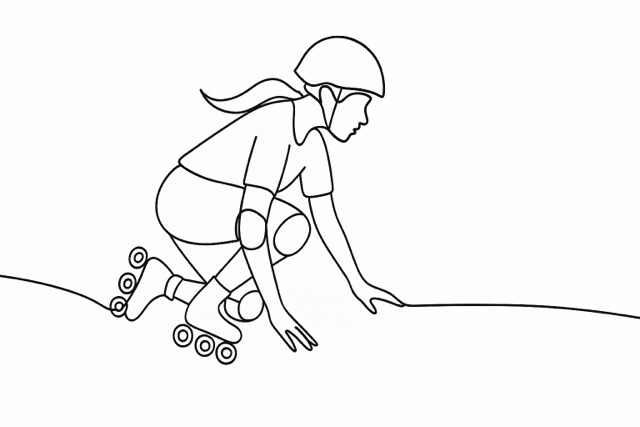
She fell, and won, not despite the fall, because of it.

I didn't fail 1,000 times. The light bulb was an invention with 1,000 steps
-Thomas Edison
The beauty and precision of the Tibetan Monk Mandalas make their destruction a non-attachment practice; otherwise, they’d call it cleaning up.
It’s all well and good to practice Zen non-attachment to success as you nonchalantly walk through the world, explaining to everyone who cares how unattached and Zen you are.
Flipflop-clad billionaires work very hard to demonstrate their non-attachment.
(This is neither non-attachment nor zen, but that’s another story).
I find letting go of failure to be harder.
Also: try this process to reframe failure…
Which brings me to the skater.
I saw a video the other day of a young girl in a speed skating race. She fell seconds after the start.
As she struggled to her feet, the other skaters marked half a lap. Still, she came back from behind and won the race.
All the comments celebrated her win despite falling.
That’s backwards: she won because she skated hard enough to fall. The fall demonstrates excellence.
I used to have a rule in skiing that I had to fall at least once every day. And I mean skis off, people asking if I was okay falling, not tripping over the skis getting off the lift.
Why? Not falling meant I wasn’t pushing myself; you don’t get to be a good skier playing it safe on the bunny slopes.
Those who excel fail.
Even if the skater hadn’t won that race, she was on the path to winning. She would have won the next one.
Failure isn’t a hurdle to overcome on the pathway to success. Failure is an indicator that we are doing what we need to do to succeed.
Somewhere along the way, though, we all get taught to fear failure.
Maybe it started with school, where “wrong” answers meant red pens and lowered GPAs.
Or maybe it was when we first embarrassed ourselves in front of a crowd, and the ego learned a lesson it would never let us forget about how NOT to embarrass ourselves.
Even hypothetical failure can hold us back. Honestly, I’m lucky I’m married because my fear of rejection and being inappropriate made me terrible at dating.
But nothing different happens within the confines of what you already know.
Reframe Failure
Edison invented the lightbulb, not despite failing 1000 times, but because he failed 1,000 times.
Startup culture is built on failing fast. Which admittedly leads to burning through cash and rockets exploding.
But it has also led to spectacular successes, like rockets that don’t explode—and very likely the technology you are using to read this.
It’s tempting to focus on the overnight success, the shining star, the funnel that makes marketing easy, and the process that leads to endless wealth.
In truth, the vast majority of overnight successes took years to create.
If you’re happy where you are, avoid the fall: These days, I don’t worry about becoming a better skier, and I don’t feel quite as eager to fall.
But if you want progress or change, skate like you mean it. Give it everything you’ve got, and when you fall, get back up, evaluate, assess, and do it all over again.
Want progress? Look for the fall.
👉 Where are you afraid to fail?
Try this process to reframe failure…