
Writing on living a deliberate life, focused on building businesses rather than cabins by ponds. Content about strategy, life, and philosophy all building to being more deliberate and living a more amazing life.
Already have an account? Sign in
Also how to win the car.

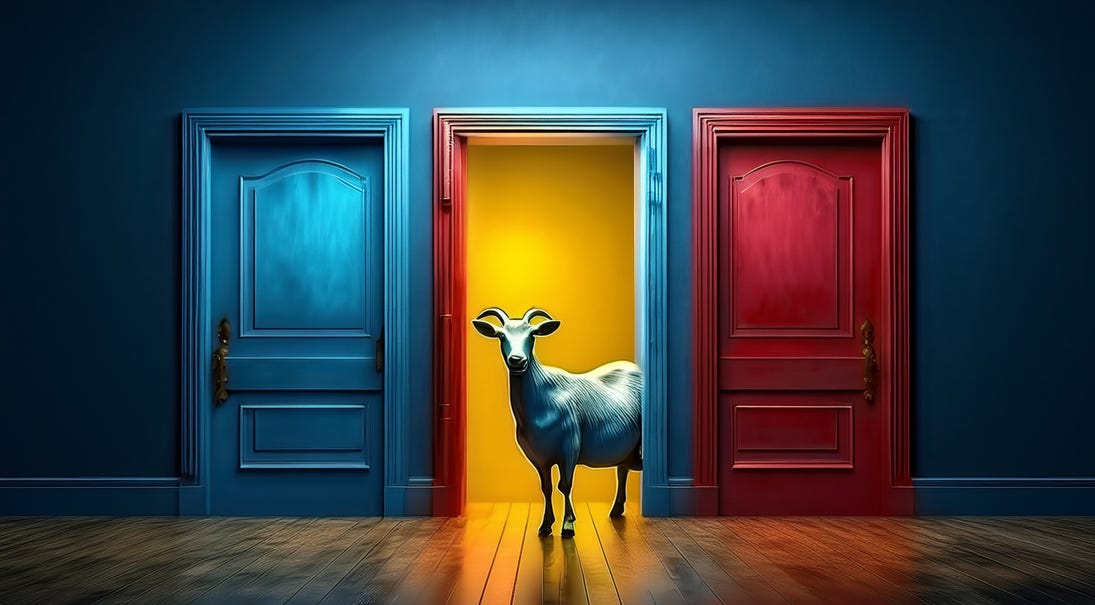
“The only way to make sense of change is to plunge into it, move with it, and join the dance.” Alan Watts
The Monty Hall problem goes like this:
You, the participant, stand in front of three doors. Behind one door is a grand prize; behind the other two are goats.
If you pick the door with the car, you get the car.
I don’t know what happens to the goats. Mutton, perhaps? No idea.
Anyway, the car is the prize; that’s the door you want to pick. You have no idea what is behind the doors, but you choose one. It may be the car, it may be a grazing beast.
Now, rather than reveal what’s behind the door you chose, Monty opens one of the other doors, revealing a goat.
Then you have the option of switching doors. Should you?
There is a definitive answer that at most 15% of people get right.
Which brings me to change.
Change is a funny thing. We can’t avoid it; if you think otherwise, try having kids, that’ll show you. Or try getting older. Or try boarding a plane with a flip phone…
We want things to stay the way they are.
We want this even though 53% of Americans are not “very satisfied” with their lives (according to Gallup). More than half of us feel that something is a bit off, yet we wake up and do what we did yesterday.
But, why, though?
There are legitimate reasons. A lot of dissatisfaction is work-related. Those who live in the US face powerful disincentives to take risks that severely punish professional mistakes. Leaving a job is extremely risky if you aren't well off.
It’s not just work, though. In a world where every datapoint is cataloged, tracked, and used to pass judgment, deviation from the norm faces scrutiny and potential backlash.
Those aren’t the real reasons we fight change. That reason is more profound, and it’s the same reason we get the Monty Hall problem wrong.
The change I’ve been fighting and what it means for you.
My resistance to change became clear when a friend sat me down, looked me in the eye, and told me I was doing it wrong.
Ehh?
“You want to inspire people to live more deliberately, but your writing doesn’t reflect that.”
Hmmm.
His point was that this content has attempted to straddle living deliberately and building a business. They may be related or not, and that friction makes the message unclear.
And he’s right. I’ve been holding on to the business stuff. It isn’t what I’m interested in at the moment, but what I’m good at.
It’s what I’m used to.
It’s why I haven’t been plunging in.
Hold on for dear life.
What’s really going on is the endowment effect.
The endowment effect is a cognitive bias that causes people to place a higher value on something they have than on an identical object they don’t have.
And it isn’t only objects. Another way to think of it is we fear losing something more than we appreciate gaining something.
You see this in the financial world all the time: people put money in a savings account that earns next to nothing rather than invest in stocks because they are more concerned about losing their money than they are interested in gaining more money.
It’s the reason I hold on to my business writing.
And it’s why everybody gets the Monty Hall problem wrong.
Back to the doors.
So there you are: You picked a door and don’t know what is behind it. Monty opens another door and shows you a goat behind it.
At this point, you can switch doors. Do you make the switch?
Some studies say 85% to 90% of people stick with the door they’ve chosen. They don’t know anything about what’s behind their door, and if the choice to switch or not switch were random, we’d expect people to switch about 50% of the time.
But they don’t. They fall in love with the door they already have.
They do this even though the correct answer is always to change doors.
In fact, there is a bias toward not changing doors even when people know the correct answer is to change doors.
That’s how strong the endowment effect is.
Why you should swap doors:
When you chose the first door, there was a 33% probability that you chose the car and a 66% probability that you didn’t choose the car. Monty reveals new information, but there is still a 66% probability that you didn’t choose the car. So, that means you double your chances of winning from 33% to 66% by switching.
(Yes, the math is correct, no, it isn’t a 50/50 choice after Monty leaves you with two doors. Really.)
What it means in real life
The irony is that the endowment effect often causes you to lose out, even to get what you fear.
You are more likely to lose if you hold on to your door.
If you keep your money in a savings account, there is a 100% chance that its value will diminish due to inflation; you will lose the principal you are trying to preserve.
If I keep confusing my writing by talking about business and life, I’ll end up watering down both messages, creating confusion, and not serving either of us.
So… from now on, SeekNorth will focus on living deliberately. Business may still come into the fold, but I won’t have regular business advice on Wednesdays.
That’s a change that makes me nervous.
So my question for you is: what are you holding on to that you should let go of…
Coming up: what embracing change makes possible.
Subscribe to SeekNorth
By Jeff Loehr · Launched 2 years ago
Writing on living a deliberate life, focused on building businesses rather than cabins by ponds. Content about strategy, life, and philosophy all building to being more deliberate and living a more amazing life.