Hatchery-raised salmon that started life in noisy environments are less likely to return for spawning, according to a new study published by Washington State University Vancouver.
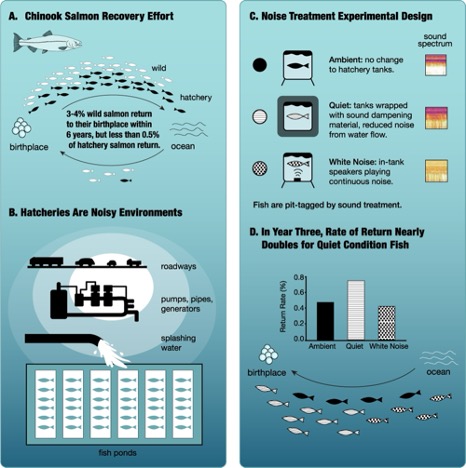
The study, which was published in the North American Journal of Fisheries Management, looked at Tule Fall Chinook salmon raised at the Spring Creek National Fish Hatchery on the Lower Columbia River. The hatchery is near a train track and a state highway that researchers identified with a relatively high amount of ambient noise.
Before first feeding, juveniles were reared in two different rearing habitats (Heath trays and Redd Boxes). After feeding began, fry were transferred to enclosures with one of three noise conditions: quiet (noise was dampened with padding and other methods), ambient hatchery noise, and continuous white noise treatment (150 dB [referenced to 1 μPa]).
During each month (February to April), researchers analyzed growth metrics, brain-to-body-weight ratios, lateral line neuromast number, and inner ear cell counts. In April (pre-release), they also analyzed swimming performance and then tagged and released fish to quantify adult return rates.
To their surprise, noise levels were not associated with significant differences in sensory development or swimming behaviour, though there were moderate differences in fish size. However, when they began tracking the return of adult salmon, they saw significant differences. Over the course of two years, fish raised in the quiet environment were slightly more likely to return than those raised in ambient noise, and nearly twice as likely as those reared with continuous white noise.
“That surprised me the most — when they started coming back, we saw differences in the return rates when we had seen very few differences as they were heading out to sea,” said one of the researchers, Allison Coffin.
Researchers said that more study is needed to pinpoint what causes that difference. Though the findings seem to suggest that noise-dampening techniques could improve return rates, there is a great variety among hatcheries and any such solutions would depend on each individual facility.