New STIM AS feed innovation could enhance smolt readiness for outmigration
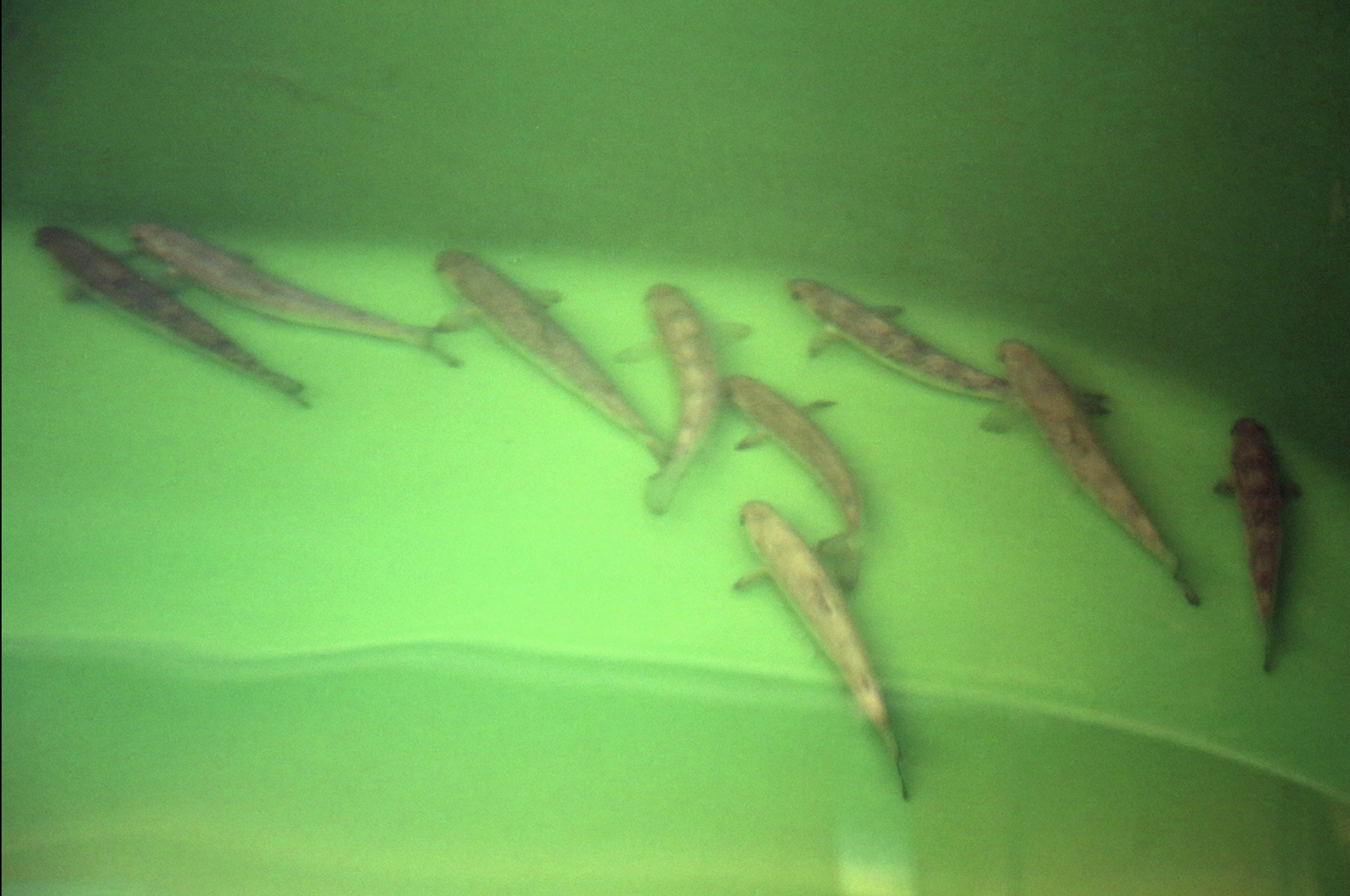
Smolts in the circular current tank, which have already recovered a few minutes after implanting transponders to track outmigration patterns. (Photo: Dietmar Firzlaff, Der Atlantisch Lachs)
Data suggests that low survival rates after release and during outmigration to the sea contribute to the poor smolt-to-adult return ratio. For over 20 years, significant efforts have been made to reintroduce Atlantic salmon into the Rhine River. However, the results have fallen short of expectations in recent years.
The Rhine River is the second-longest river in Central and Western Europe. River conditions vary from year to year, but there is often a mismatch between water temperatures, flows, and the natural timing of smolt outmigration in the highly modified Rhine River.
In short, when water flows are optimal for outmigration, it is too early in the year and water temperatures are too cold for most of the fish to smoltify and begin their journey to the sea. By the time water temperatures have increased and the fish are responding to natural cues to smoltify, river conditions are less favourable and fewer fish are able to make it to the sea.
Also, the longer the fish spend in freshwater waiting for the cue to smoltify, the more vulnerable they are to predators and other threats. The fundamental equation remains clear: fewer surviving smolts mean fewer returning spawners.
A new approach to smoltification
Our team of researchers at the Hasper Talsperre Salmon Centre in Hagan, Germany collaborated with Norwegian-based STIM AS to help solve this problem.
Instead of releasing fish as parr and waiting for them to smoltify naturally, inducing smoltification prior to release could revolutionize hatchery-based enhancement efforts. The result is the SuperSmolt® Feed Only (SSFO) which is designed for commercial salmon farming to induce smoltification before seawater transfer.
Unlike transfer diets or “salt feeds” that are used to support seawater transfers of fish that have already smoltified, it contains a proprietary blend of factors that induce smoltification without the need to change the photoperiod (e.g., no need for a “winter signal”) or otherwise manipulate the environment to smoltify salmon.
This feed innovation has sparked enthusiasm among salmon enhancement experts and industry professionals because successful smoltification is essential to improve survival rates of both Atlantic and Pacific salmon populations. SSFO could offer new possibilities for sustainable fisheries management and enhancement programs.
Initial observations
Hasper Talsperre Salmon Centre was first established in 2000 as part of the government’s “Return of Salmon” project. The research centre is a non-profit organisation located in Hagen, located on the southeastern edge of the Ruhr area. Although the city is not directly on the Rhine River, it is located within the Rhine-Ruhr metropolitan region. The Rhine River, a major waterway in Europe, flowing through Cologne and other cities in the Rhine-Ruhr area.
Hatcheries have been releasing salmon fry and, to a lesser extent, smolts into the Rhine River and its tributaries since 2000 but smolt survival and adult returns have contributed little to Atlantic salmon recovery due to poor outmigration success. Smolts released or produced in creeks between 2000 and 2024 appear to have had limited success migrating to the sea, and few—if any—returned to the Rhine as adults.
As part of my work as operations manager at the Salmon Centre, I started to think about the reasons for this. The climate change was an important factor (another reason is lack of government awereness/support). The Rhine River gets less and less water every year and gets much warmer, especially in early spring. This means the smolts start to migrate from the colder creeks relatively late April/May. They have to enter the Rhine River and will reach the Haringsvliet in the Netherland much later. This is a large lake and the current and the water temperature is not optimal and here is where we often lose smolts.
The Hasper Talsperre Salmon Centre first iniated trials in 2018 to determine whether SSFO could enhance smolt readiness for outmigration. Researchers noted that many of their smolts lingered near the release sites, and those that migrated downstream did so very slowly. Reasoning that a targeted smoltification signal might encourage downstream movement of the smolts, they began testing SSFO in 2018 as part of their hatchery operations.
Increased outmigration success
In April 2024, Hasper Talsperre Salmon Centre researchers conducted a controlled trial with SSFO-raised smolts equipped with transponders provided compelling evidence.
As part of a collaborative study between Rijkswaterstaat West-Nederland Zuid (Netherlands) and Landesamt für Nature, Umwelt und Verbraucherschutz Nordrhein-Westfalen (LANUV NRW, Germany), 89 SSFO-fed smolts were implanted with transponder tags to track their downstream movement.
After administering SSFO, researchers observed juvenile salmon thriving and displaying key smoltification behaviours, such as shifting swimming direction downstream in response to induced currents. The results were striking. Smolts fed with SSFO exhibited a drastically reduced dwelling time near release sites, even in varying water temperatures, indicating a fundamental shift in migratory behaviour.
It showed that twice as many smolts reached the sea in a short timeframe compared to traditional hatchery-raised cohorts (2018-2022). Additional monitoring studies in cooperation with Sportvisserij Nederland planned for the years ahead will fully document the effect of controlled smoltification with SSFO on migration of hatchery-reared smolts, but the Hasper Talsperre Salmon Centre is convinced they have found a tool to help rebuild Atlantic Salmon populations in the Rhine River system.
When we started the first releases in different creeks at different water temperatures, they started to move immediately and after five days, you could not find a single one. I was very happy with the results. This means that in the future, we will release the smolts in February when we have enough and cold water in the Rhine River and they can cross the Haringsvliet fast. I expect a water temperature of 5 C. (In nature, smolts start to migrate normally at 10 C.)
Anecdotal observations also indicated that 2025 releases were also improved by inducing smoltification with SSFO prior to release. Whereas unsmoltified fish would often linger at the release sites for a few days or weeks, SSFO-raised smolts began to move downstream within two days of release.
Encouraged by these findings, researchers have continued to use diet-based smoltification and plan to scale up in the coming years with significantly larger smolt groups. From next season, we will continue the transponder research in cooperation with the Sportvisserij Netherlands to get more scientific information.
Looking ahead
Currently, 2,500 kg of one-year smolts are raised annually at the Hasper Talsperre Salmon Centre using SSFO. The ongoing collaboration with STIM AS continues to drive progress in increasing smolt survival rates, ultimately benefiting wild salmon populations. Future research will explore whether the same positive effects observed in Atlantic salmon apply to Pacific salmon as well.
As this innovative strategy gains traction, it has the potential to redefine smolt rearing and release protocols worldwide, offering benefits for enhancement specialists, hatchery managers, and even commercial fisheries.
Dietmar Firzlaff is the operations manager at the Hasper Talsperre Salmon Centre where he helps conduct research and development, supported by STIM AS. He is also owner of AquaFUTURE, where he has earned more than 40 years of experience as an aquaculture equipment and operations consultant around the world, including East Europe, Russia and Australia. (firzlaff@aquafuture.de, www.lachszentrum.eu)
For additional information about SuperSmolt Feed Only, visit stim.uk or stim.no.