Aquaculture Information Exchange hosts first online networking event to connect job seekers and employers
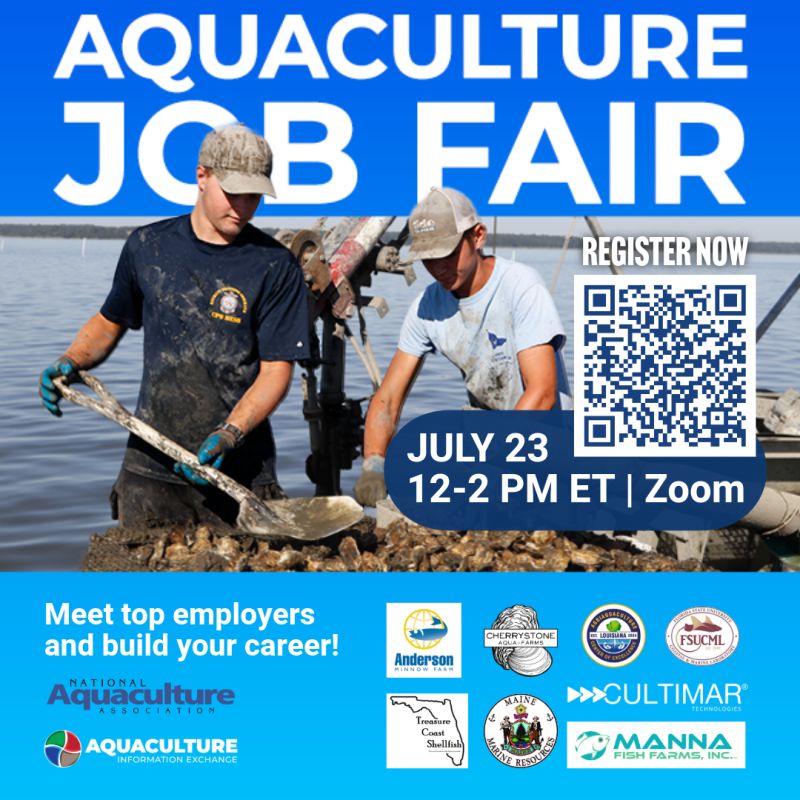
A good work ethic is top priority for today’s aquaculture employers. Experience can come later.
This is the main takeaway from Aquaculture Information Exchange’s (AIE) first virtual job fair on July 23. The event attracted 438 job seekers to connect with eight employers from across the United States. Event organizer and AIE digital experience manager, Joseph Caterine, said he was encouraged by the reception of the event and he hopes it will lead to more of this type of project.
“It was kind of a big swing as far as an experiment, where I didn’t really know if it was going to work,” he said. “We had a lot of people registered leading up to it, but you just still never know how a live event is going to go.”
The virtual event was organized into two employer categories, Research & Education, and Farmers & Industry. Each employer panellist presented about their company and multiple job opportunities that they are currently recruiting for.
“The virtual job fair went very well in my opinion,” said Paul Begue, program coordinator at the AgriAquaculture Center of Excellence in Harvey, La. “We are a multi-disciplinary facility, so we are seeking a diverse group of candidates to fill out our urban aquafarm team. The job fair brought a variety of candidates and put them in contact with an equally diverse group of employers.”
The ideal candidate
Many of the panellists agreed that their ideal candidate is passionate and has a strong work ethic. They said fundamental qualities, like punctuality, communication, and teamwork, are more important to them than specific aquaculture experience.
“We can teach you the aquaculture stuff that you need to know to further your career,” said Begue. “I’ve had a lot of these facilities that I’ve been a part of over the years and if you have a small team, you have to be able to work with that person, so the willingness to learn, positive attitude, showing up, these are big things.”
Charles McGuigan is co-founder and chief operating officer of Cultimar Technologies in San Juan, Puerto Rico. The company is looking to produce deep-water fish species at scale, starting with the first commercial American red snapper hatchery. He presented open positions for a broodstock manager and an aquaculture scientist, but he said he is also open to other entry-level applicants.
“We don’t have any specific requirements in terms of degree level, but experience in aquaculture is great, but practical experience in doing other things that’s associated with aquaculture goes a long way as well,” McGuigan said during the Q&A panel.
“If you have plumbing skills, or electrical skills, programming skills – a lot more of aquaculture is based on those things than on handling fish or other marine life, aquatic life than people might assume.”
Begue concurred and added that his number one tool in his career as a technician was his shovel. Other employer panellists on the video call nodded in agreement.
“For example, water quality. If you’ve kept an aquarium at home, if you’re a hobbyist, or you’ve worked at a public aquarium. I have employees after working with me, go on to work at wastewater treatment plants and become managers very, very quickly,” said Begue.
International applicants
Fourteen U.S. states and territories attended the virtual job fair, and there were also some international attendees from countries like, India, Norway, and the Czech Republic.
“I would definitely attend again. The event was informative and engaging,” said Shrijan Bajracharya, PhD candidate and graduate research assistant at Auburn University in Alabama. “As an international student, I especially appreciated that some presenters took the time to address visa sponsorship and the hiring landscape for international applicants and that’s not something every event covers, and it really made a difference.”
Employers at the virtual job fair like, Jamie Anderson at Anderson Minnows and Lexy McCarty at Cherrystone Aqua Farms, shared that their companies can employ international applicants under the H-2A visa program for temporary agricultural workers in the United States. They are open to finding ideal candidates for their open positions from outside the country, as well.
Many employers also offered that although they do not currently have postings for internships, they are open to receiving applications for these as well.
“My biggest challenge in recruiting is finding passionate potential employees with strong, basic communication skills,” said Donna Lanzetta, chief executive at Manna Fish Farms in Hampton Bays, N.Y. “I think the virtual job fair went great! I have connected with a number of potential employees.”
How it began
Caterine attributes the idea for the virtual job fair to initial conversations he had with Imani Black, founder of Minorities In Aquaculture. They discussed how it can be hard to find entry-level opportunities for aquaculture students and young professionals who are just starting out.
“We don’t necessarily have the infrastructure that other industries that are more developed like the American agriculture industry, have. And so, I think that’s why you see a lot of employers still relying on word of mouth,” he said.
Employers at the job fair said that they sometimes use online platforms like, LinkedIn and WaterJobs.com, to post open positions. But mostly, local job boards are their main recruitment tools.
In the past year, Caterine had been working on further developing the user interface for the AIE platform. Since then, the job board has featured more prominently on the main page, and that’s when he started to see more and more engagement with that section.
“So many people came up to me and said they really liked the job board, which wasn’t really something that I initially focused on. We were really focused on networking and education at that time,” he explained. “Since we’ve done that, (the job board is) now our most popular page. And so that was also part of what convinced me that there’s a real demand here for career support.”
AIE is an online project that is supported through the Virginia Sea Grant. The goal of AIE is to build community in the aquaculture industry. The online social networking platform has more than 2,100 members across North America and internationally.
Caterine manages and facilitates activity in the website. He has hosted a number of online webinars for the community in the past year. However, in order to execute the virtual job fair, he recruited support from the Virginia Sea Grant communications team, as well as the National Aquaculture Association, to bring the idea to life.
Caterine said he also received support from the Maine Aquaculture Innovation Center and the Maine Sea Grant.
The team received more than 20 employers who expressed interest in presenting at the event. Caterine worked to narrow down the selection to eight employers that could represent a diverse cross-section of disciplines and regions of operation.
“We wanted to really represent all the different regions in the U.S. and all the different types of entry level jobs,” he said.
Future opportunities
Following the success of this first experiment, Caterine has many aspirations for the future of this project.
“I think our greater mission with the AIE is to really strengthen the American aquaculture community, and I think there has to be, like, an in-person element to it,” he said.
“As far as future iterations of this, I’d be interested in having some sort of in-person component to it. We’ll probably still do virtual as well, but maybe there will be some sort of, smaller regional events or something like that. But, you know, that’s pie-in-the-sky imagining.”