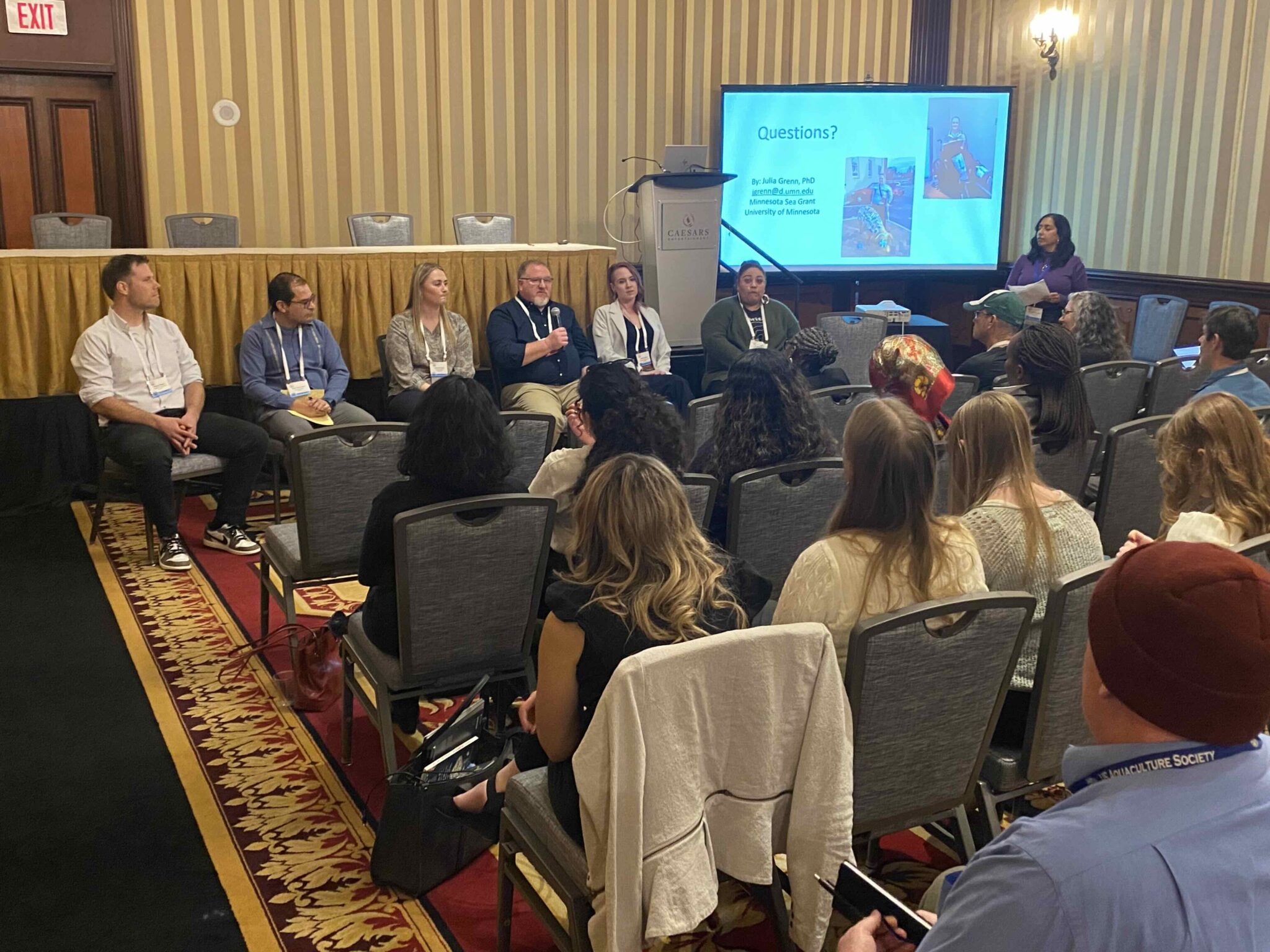
Take opportunities where you can, even if you feel like you are under-qualified.
This is the general advice that aquaculture mentors gave to a room full of young professionals at the “Building Pathways for Women’s Leadership in Aquaculture” on Feb. 17. The session was organized by Women of the Water, a networking community to encourage career development for women and other underrepresented groups in aquaculture. Aquaculture America 2026 took place on Feb. 16-20 in Las Vegas, Nev.
“The opportunities that scare you a little bit lead to the biggest growth,” Julia Grenn said to a room of aquaculture mentors and young professionals alike. “Never say no just because you don’t know what it’s fully about.”
Grenn is an almunus of the Virginia Institute of Marine Science (VIMS) Commercial Shellfish Aquaculture Lab & Team (C-SALT) and now works as a Fisheries and Aquaculture Extension Educator with the Minnesota Sea Grant. She said that networking opportunities, like in conferences, has been valuable experiences where a young professional can build a team of people that can help them in their professional growth. She encouraged young people to put their name out there and be a community connecter. For her, opportunities for grants and collaborations came out of a simple mentor-mentee breakfast check-in.
“It feels like a lot and your social battery might be drained, but you really get out what you put into it. The hustle today is future gains for tomorrow,” said Grenn.
“Don’t be afraid to apply to something, even if you feel like you need more training, because you miss all the shots you don’t take. And it’s like playing a lottery. If you don’t buy a lottery ticket, you’re never going to win,” said Taja Sims-Harper, graduate research assistant at University of New Hampshire.
Train yourself in other things
Dennis McIntosh said that in his more than 20 years of experience as professor and extension aquaculture specialist at Delaware State University, the students that thrive are the ones that are looking beyond their technical training.
“I think that there’s a big disconnect between the technical training you get as a graduate student and the job as an academician,” he said during the session’s panel discussion. “There’s a lot of things that go into budgeting, and politics, and just all of the day-to-day stuff that you don’t really think about. And there’s certainly no courses in grad school about that.”
McIntosh emphasized the importance of also giving young people the space to fail safely. A person can learn the most from their failures than from their success and a good mentor creates a space where students can test their own limits in a safe environment.
“It’s again, trying to be supportive, trying to have make sure they’ve got the research dollars they need, the tools in the lab, whatever, to make sure you’ve got the support around them… And it doesn’t always work, but to have the opportunity to create that relationship so that if they have a question or if they’re struggling with something, you can have a conversation, as opposed to it just being a very one-sided relationship,” he said.
Advocate for yourself
Michael Phelps, assistant professor in the Department of Animal Sciences at Washington State University, said when screening undergraduates to work with, he emphasizes the importance of curiosity and the desire to solve problems. He is looking for students who are passionate and engaged about the research that they are doing, not just about checking off a requirement for their grade.
“One of my first questions (to undergraduate students) is ‘Are they curious?’ ” said Phelps. “Can I see that they’re going to see a problem, and they’re going to want to find the answer to that problem, not just come to me and say, ‘Oh, my experiment didn’t work. I don’t know what happened. I’m going to go take my test.’ ”
Phelps added that he has an open door policy in which he wants students to have as much access to him as possible. He expressed that sometimes one of the most frustrating things for him is that he has a finite amount of time in a day as an individual mentor. But, he also wants to create a network of mentorship in which he can connect undergraduate students with graduate students, creating a near-peer support network.
“This is also a golden opportunity for my grad students and I know that they will benefit from it, and so I want to try to pass that mentoring down to them,” he said.
All the mentors on the panel agreed that the students who proactively ask questions and engage with them are the ones that stand out.
Ask your own questions
Grenn works with and hires a lot of undergraduate students through the Minnesota Sea Grant’s aquaculture lab. Some are hired on as technicians, while others come in for class credit. When asked about the qualities she looks for in her mentees, she sometimes looks out for those who want to learn more about her as a mentor.
“Some of the questions that I really look for and make sure that they’re asking is about my management style and making sure that I’m going to be a good fit for them,” she said. “Some people need way more hands-on than I might have time to give, so making sure that I have time to give it to them, but also laying out really clear expectations of like this is how I manage.”
Panelists agreed that students should also be screening their mentors and employers just as much. It is important for students to vocalize their expectations and ask for what they need in their leaders. Good mentors will welcome this conversation and help cultivate a working relationship that will help young people thrive, said the panelists.
“Them asking, ‘What kinds of skills am I going to get out of this internship?’ And asking what they need to do to get to their next step and how I can help them do it, is what I look for when I’m taking people on,” said Grenn.
Mentors want feedback, too
The last thing that these aquaculture mentors want their students to understand is that mentors don’t know everything. Rafael Cuevas Uribe, associate professor at California State Polytechnic University, Humboldt, shared his own experiences about becoming a mentor and advisor.
“I wish somebody taught me how to be a mentor or an advisor,” he said. “They just told me, ‘Okay, these are 20 students that are going to be the advisor.’ Okay, what do I do next?”
Other mentors agreed that they had a similar experiences. But, Cuevas Uribe said he learned open communication with the students is how he grew as a mentor himself. Being able to listen to what students need from him is the best way he can understand how to bring out the best in those he works with.