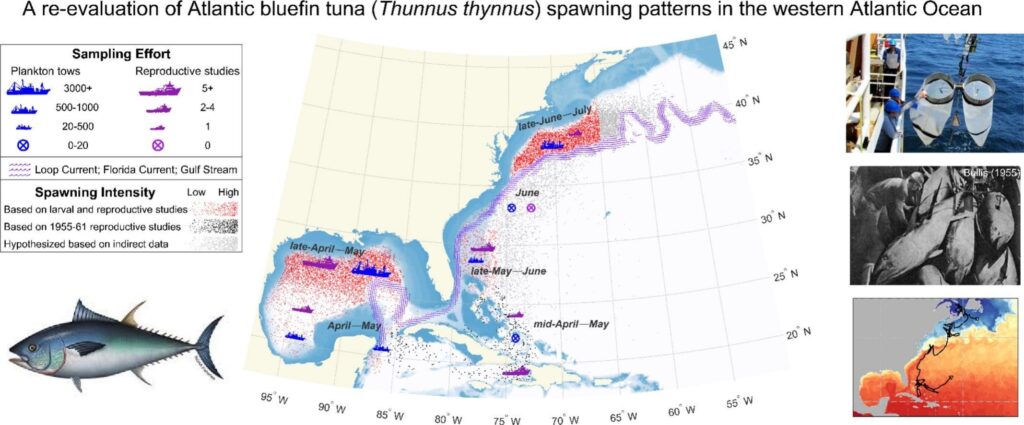
NOAA Fisheries scientists have published a new study that maps the distribution of Atlantic bluefin tuna (Thunnus thynnus) spawning in the western Atlantic Ocean.
The study, published in the Oceanography journal, showed persistent spawning in key areas despite changing temperatures over the decades. It identifies the Yucatán Channel, southern and northern Gulf, Blake Plateau, an area off the Carolinas shoreward of the Florida Current, and the western Slope Sea. Researchers said this indicates “a much broader spawning distribution than previously recognized.”
“Previous larval studies outside the Gulf of (Mexico) America were often based on a single year of sampling,” said lead author, Dave Richardson. “When we compiled data from many surveys, the consistency was remarkable… This confirmed the pattern we’ve seen in recent years has been going on for a long time. For example, bluefin larvae have been collected from the 1970s through the 2000s in both the Yucatan Channel in the south and the Slope Sea in the north.”
The study compiled ichthyoplankton and reproductive data that indicates that bluefin spawn in the Gulf of Mexico, northwest Caribbean Sea, north of the Bahamas, along the inshore edge of the Florida Current off the Carolinas and in the western Slope Sea. Researchers also used regional sea surface temperature cycles and the distribution of electronically tagged bluefin to identify potentially undocumented spawning areas and times.
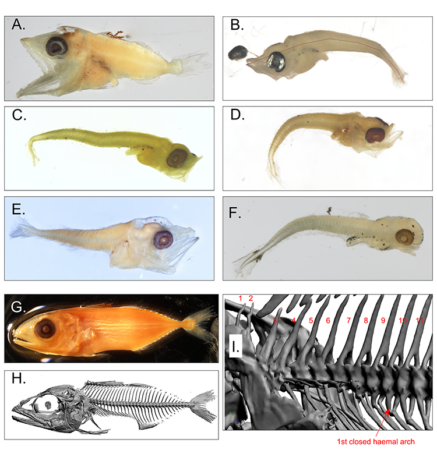
Of the areas outlined, the northern Gulf in the late spring and the western Slope Sea in the early summer seemed to produce the most larvae. Spawning starts in April in the southernmost areas—the northwest Caribbean and southern Gulf of America—and ends in early August in the northernmost spawning area, the Slope Sea.
“This study shows the value of ichthyoplankton data—data on fish in their egg and larval stages. It also demonstrates how archives and museums allow researchers to go back and reexamine samples and data from the past,” said Jon Hare, director of the Northeast Fisheries Science Center.