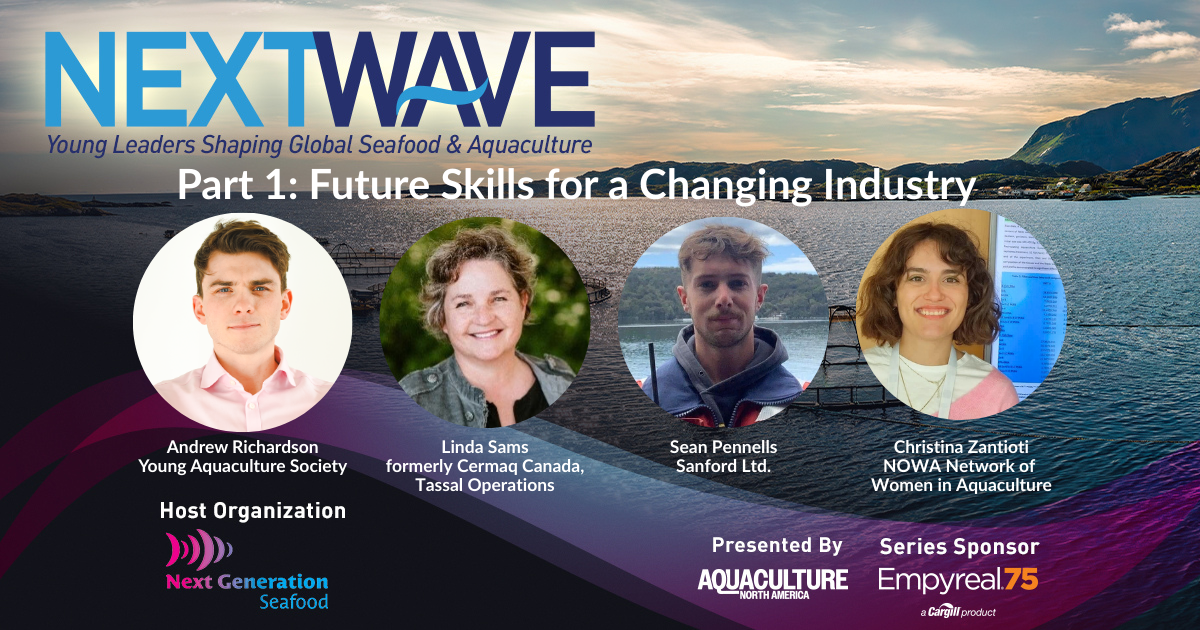
Experts reflect on fostering the next generation in Part 1 of the webinar series Next Wave: Young Leaders Shaping Global Seafood & Aquaculture
February 10, 2026 By Aquaculture North America staff
Aquaculture is among the world’s industries undergoing a technology shift, and with growing global demand for sustainable seafood, attracting talent is a pressing priority for the companies around the world.
The inaugural NextWave webinar on Feb. 5 welcomed experts in the U.K., U.S., Canada, and New Zealand to discuss future skills needed for a changing industry, and how aquaculture can attract, retain and develop young talent.
Hosted by Next Generation Seafood Alliance, the webinar was the first in a three-part series on young leaders shaping global seafood and aquaculture, presented by Aquaculture North America and sponsored by Cargill Empyreal75.
Andrew Richardson, founder and president of U.K.-based Young Aquaculture Society, moderated Part 1 of the series.
“We’re such a young sector that we’ve had to change and adapt and adopt new technologies really readily already. So we’re on our way already to leading in that food space through adoption of many of those technologies,” Richardson said in his opening remarks.
He went on to highlight common human resources (HR) feedback on changing skills in aquaculture, including information technology (IT) literacy across all areas of business, and potential for AI and automation to change administration roles.
Richardson noted that in aquaculture, while the skillsets and tools used might be shifting, employer priorities around fish health, welfare, and behaviour fundamentally remain the same. “I think it’s worth highlighting that HR professionals are still really thinking it is going to be stably focused on core priorities for farmers,” he said.
Richardson then welcomed panelists Sean Pennells, aquaculture technician for salmon producer Sanford based in New Zealand, Christina Zantioti, president and co-founder of NOWA Network of Women in Aquaculture in the U.S., and Linda Sams, former sustainable development director at Cermaq Canada.
Reflecting on what young people are looking for in an aquaculture job, Pennells said the biggest motivator he hears is values. “A sense of purpose; meaningful work; is what we are doing in our careers, is it contributing to making the world a better place? I definitely think that’s probably the biggest thing we all think about when picking a job or working in the aquaculture industry,” he said.
Career progression, work-life balance, and fair compensation are other notable priorities, Pennells said.
Sams, who has mentored upcoming talent in aquaculture throughout her career, said early career development opportunities are important pieces of attracting and retaining the next generation. Young employees should have opportunities to learn critical soft skills such as complex problem solving, she said.
Equally as important is fostering workplaces that are safe and inclusive of increasingly multicultural talent, Sams said. “Especially when people are working in remote or isolated places, and in British Columbia, in Canada, as I know it is in other areas, it’s a focus here with many of the First Nations partnerships, we have to have that cultural awareness and provide a workplace that is alive to that.”
Zantioti stressed the importance of mentorship when it comes to welcoming the new generation. “I think we should consider mentoring as a two-way exchange, where experience meets new ideas… both the mentor and the mentee are getting benefits,” she said.
“Organizations, when they create spaces that are safe to share knowledge or experiences, or when project meetings are mixed, things like that help the youth feel more safe in the working environment,” Zantioti said.
Ultimately, Sams said, every generation shares the human desire to be heard and valued. “The multigenerational meeting of minds is so critical for leadership teams and I applaud that approach,” she said.
Panelists went on to discuss the importance of raising the profile of aquaculture as a whole, pointing out the lack of awareness they regularly come across.
“We need to change the narrative,” Zantioti said. “We are working in the sector, we know it involves all of these aspects like data science, automisations, monitoring of the environment, etcetera. But people outside do not realize the fact that aquaculture is quite an interdisciplinary sector … a complex sector that has an impact on food security.”
Pennells suggested that when it comes to negative narratives around aquaculture and the environment, particularly misinformed negative narratives, the industry should proactively share their stories. “You’re always on your back foot when you’re reacting. And [environmental impact] is a huge topic of conversation that would help recruitment,” he said.
Tune into Part 2 on the series March 9 when Michelle Franze with the B.C. Salmon Farmers Association will welcome guests to speak about the next generation’s role in social license, tackling misinformation and building public confidence.