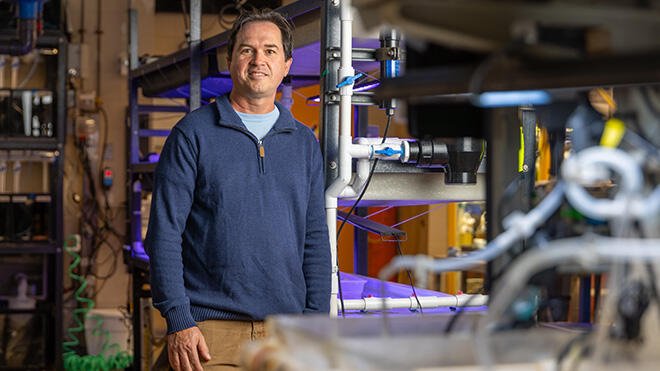
Researchers at Roger Williams University’s Center for Economic and Environmental Development (CEED) have created standardized methods for breeding and raising more than 20 marine fish species in human care.
The research project, called “Catalyzing Marine Finfish Aquaculture Through Public Aquariums,” represents a unique “distributed production model” that aims to move away from centralized rearing to build specialized capacity across a broad geographic network. Andrew Rhyne, Marine Biology professor at CEED, said this work will help develop techniques for breeding and raising fish for the initiative. He developed the Modular Larval Rearing Systems (MoLaRS), customizable aquaculture systems that allow aquariums and research partners with limited space to rear new marine fish species.
“Our partnership with the New England Aquarium provided the foundation for connecting undergraduate education, applied research, and the needs of the public aquarium profession,” said Rhyne. “This work gives our students hands-on experience while helping public aquariums develop more sustainable collections.”
Funded by NOAA Sea Grant, this multi-year collaborative is led by researchers at Roger Williams University, in collaboration with the University of Massachusetts, Boston, and the New England Aquarium, in collaboration with seven other partner institutions.
Last June, the collaborative also launched the “Breeding and Raising Fish for Aquariums” StoryMap. This website features an interactive digital experience that uses video, maps, and behind-the-scenes photography. The StoryMap offers the public a rare look at the science shaping the future of aquariums and the aquaculture industry and highlights the critical role sustainable aquaculture can play in reducing pressure on wild fish populations.
“Advancing aquaculture techniques is about more than raising fish, it’s about building a community,” said Barbara Bailey, vice-president of animal care at the New England Aquarium. “By sharing knowledge, expertise, and experience across public aquariums, we can strengthen sustainable collections, expand our collective impact, and accelerate innovation. As public aquariums, we have a unique opportunity to engage millions of guests each year, helping them understand the connection between aquaculture, sustainable collections, and ocean conservation.”