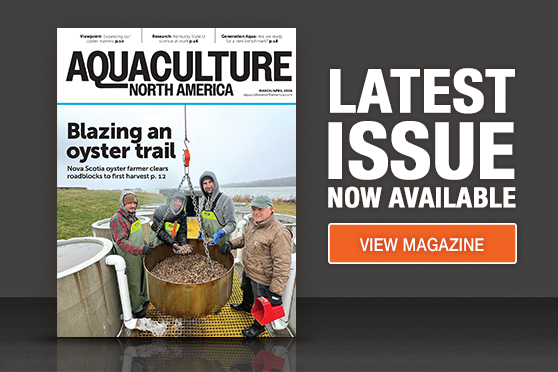
While we were in production for this magazine issue, I was attending the annual Aquaculture America conference in Las Vegas, Nev. Like in every year prior to this one, I’m coming back home from this event with a head full or ideas and a heart full of renewed passion for aquaculture.
Part of attending these conferences every year is to meet with friends and mentors that I’ve come to know over the years. Of course, I work hard all year to cultivate these relationships from a distance, either through email or video call. And yet, sitting down for 30 minutes allowed us to check-in with each other’s activities, come up with new ways that we can work together, and most importantly, connect on a human level.
There’s something that happens when you are surrounded by like-minded people that helps us amplify each other’s passions for the industry. I can’t quantify how important these conferences are in igniting that need for collaboration and cooperation, but it was certainly a running theme that many mentioned to me throughout that week.
And so, I think my biggest takeaway from Aquaculture America 2026 is that aquaculture’s diversity is its biggest strength, but it can also be its biggest weakness if we let it.
During one of the networking sessions, someone explained, for example, that in the poultry industry, there is only one major species of chicken, Gallus gallus domesticus (the domestic chicken), that is farmed for food production in the world. This can allow for a more universal knowledge transfer to solve common problems about nutrition efficiency, animal welfare, sustainability, and smart farming technology.
Comparatively, global aquaculture includes about 500 to 600 aquatic species, including finfish, mollusks, crustaceans, and aquatic plants. And so, lessons learned from a salmon net pen operation rarely overlap with those who might be farming geoducks in the same provincial waters.
I admit this may be an exaggerated example to support the point that I want to make about the challenge this industry faces in forming a united effort to solve problems together. However, I think it is also illustrative of how difficult it can be. Fortunately, one simple solution to address this could be to just gather in the same room and talk.
I think this industry is lucky to have so many conferences and events that give everyone an opportunity to meet in person. It could be Aquaculture America, or the Canadian Freshwater Aquaculture Conference, or it could even be our very own RAStech Conference & Trade Fair. There are others who are not as lucky to have a travel budget, and so, they take advantage of online opportunities like our Aquaculture Nexus virtual event or webinars like NextWave.
At the surface, these gatherings can feel superficial because you are not always returning to your farm with a tangible thing in your hand that will magically fix your problems. But then again, not all problems that appear in your farm stop where your driveway ends.
I heard once that it is easy to understand that “it takes a village,” but then, no one wants to be a villager and do their part to contribute. We’re missing the part where we align ourselves with a collective to solve the big problems.
I met many of you who read these pages during my week in Las Vegas and I hope you do take me up on my invitation to stay engaged. I hope you share your thoughts at jkodin@annexbusinessmedia.com.