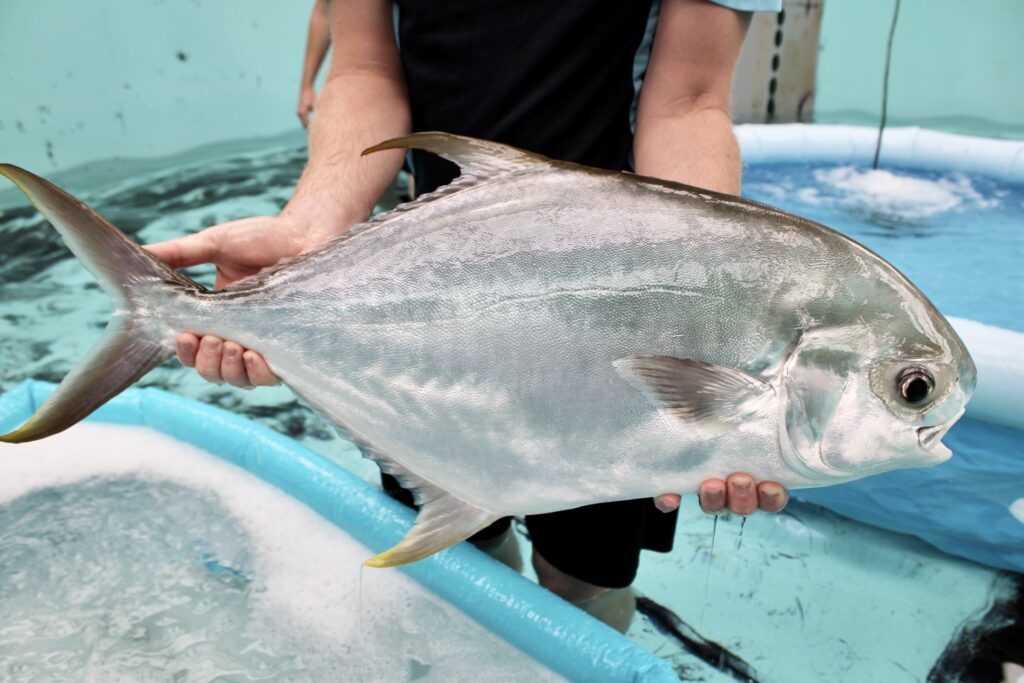
A new white-flesh fish variety could be swimming onto Australian plates in the coming year or two courtesy of a selective breeding project from the country’s national science agency, the Commonwealth Scientific and Industrial Research Organisation (CSIRO).
CSIRO has identified pompano (Trachinotus anak) as the ideal white-flesh fish for developing a sustainable aquaculture industry in Northern Australia’s tropical climate. The advocates at CSIRO, and elsewhere, say a pompano industry would help Australian aquaculture reduce the country’s reliance on white-flesh fish imports, while simultaneously helping to sustainably meet growing demand for seafood.
CSIRO’s project maintains both wild and first-generation broodstock, which will serve as the foundation for seedstock production and as the cornerstone broodstock for future applied breeding programs. The broodstock will provide the progeny needed to support the initial phase of industry commercialisation.
Working with industry
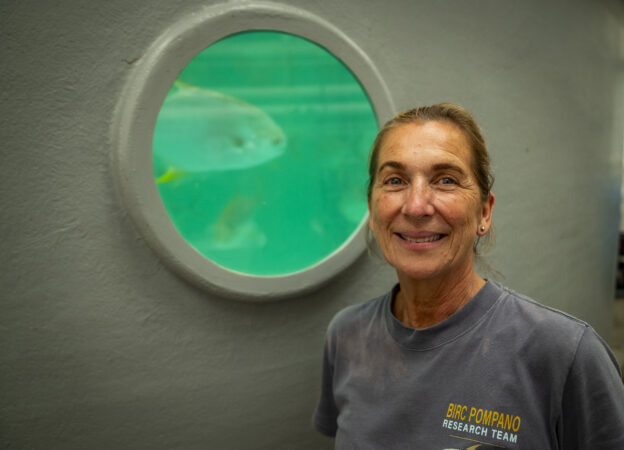
Pollyanna Hilder, aquaculture scientist with CSIRO’s Aquaculture Health and Production team, says the agency is working with a range of Australian aquaculture producers, hatcheries, and industry groups across multiple species.
“For emerging species such as Trachinotus anak, CSIRO’s work focuses on supporting industry interest by developing the foundational science needed for future commercialisation. This includes working with producers who are exploring diversification opportunities or assessing the feasibility of new species for northern Australian aquaculture,” Hilder says.
Hilder adds CSIRO’s aquaculture research and development (R&D) is designed to translate directly into industry outcomes with their research spanning breeding, animal nutrition, health, and production systems.
“A major part of CSIRO’s contribution is the early genetic and physiological work that underpins long-term industry development,” she says. “By characterising growth potential, environmental tolerance, and key heritable traits early on, CSIRO can help industry identify which broodstock lines are most suitable for domestication and future selective breeding. This reduces risk for farmers, shortens the time needed to achieve reliable performance in hatcheries and grow-out systems, and ensures that the first generation of farmed fish already has a clear pathway toward improvement.”
CSIRO’s multidisciplinary aquaculture research team includes more than 50 researchers and staff who work closely with the country’s aquaculture sector. Hilder says their goal is to use science to create impact.
“Many of our researchers have spent years working directly with industry, hatcheries, and regional communities, and they are passionate about helping Australian aquaculture grow in a way that is both economically viable and environmentally responsible. The team is excited by the chance, highly motivated to build the foundational knowledge needed to open new opportunities for Australia, diversify farmed seafood options, and contribute to long-term food security,” Hilder says.
Last year, CSIRO’s team organized a number of successful spawning events and larviculture runs. This led to advancements in three areas: reproductive development, monitoring, and broodstock management.
Throughout the year, the team advanced their understanding of T. anak larval physiology and cultural behaviour. The integration of improved feeding protocols, husbandry techniques, and environmental controls has yielded promising results in seed production. Continued refinement and targeted research will support the development of robust hatchery practices for industry-scale juvenile production.
CSIRO has engaged with a commercial company for on-growing trials. The fish has also been tested with a number of restaurants across Australia with chefs reporting positively on the versatility, yield, and flavour of the fish.
Untapped market
John Susman, founder of Fishtales, a leading seafood consultancy in Australia, says he sees enormous potential for this project to set a benchmark for how aquaculture species are developed – not just biologically, but commercially.
“By taking a market-led approach in the development of pompano quality markers, CSIRO is effectively ensuring that the science is anchored in consumer, culinary, and value-chain relevance,” he says.
Rather than starting from production capability and working outward, the project begins with understanding what attributes the market values most – flavour, texture, yield, colour, handling performance – and back-engineers those into the breeding and husbandry program, Susman says. The alignment between science and demand creates a far deeper level of intellectual property than simply developing broodstock or genetics in isolation.
That depth of IP – validated through the sensory, culinary, and distribution experience of early adopters, opinion leaders, and the trade — will be unique and transferable. It positions CSIRO not only to deliver a robust commercial broodstock line for domestic production but also to license the underlying knowledge framework and quality-marker algorithms globally, across multiple species and markets.
Josh Fielding, senior research portfolio manager at Australia’s Fisheries Research and Development Corporation, says whitefish is traditionally a favourite with Australian consumers and is an aquaculture opportunity.
“The difficulty in developing aquaculture opportunities in Australia is at least partly driven by high start-up costs (infrastructure etc.), the need to develop methods for production and need to hold broodstock, all contributing to a high cost of production,” Fielding says.
Fielding argues that novel methods for dealing with certain elements help to “break down some of the risk barriers for development of new aquaculture species. Previously, governments have on occasion run breeding programs and supplied industry with spat, eggs or juvenile animals, mostly linked with exotic species such as Pacific oysters and Atlantic salmon.”
Fielding points out that starting an industry with a selective breeding program is unusual, it’s typically the other way around. This could provide significant upsides for the development of a new industry or sector, and enable a new industry to be overcoming some of the initial challenges that would otherwise need to be overcome by a commercial operator.
“There is additional benefit in already having a research institution conducting work on this species; again, in other instances, it would fall to a commercial operator to try and attract funding and collaborators to conduct some of the work that CSIRO have already begun for this species,” Fielding says.
Lessons from tilapia
Australia is not the only government or institution focused on new and edible species. One of the longest-running global efforts to improve aquaculture species is the Genetically Improved Farmed Tilapia (GIFT) program, led by the international research organization, WorldFish.
GIFT began as a multi-country selective breeding project that combined diverse wild and farmed Nile tilapia strains to create lines with superior growth, robustness, and yield. Today, GIFT-derived strains make up an estimated 75 per cent of global tilapia production, and ongoing genomic research continues to refine traits such as disease resistance and feed efficiency by leveraging high-quality genome assemblies.
More recently, Brazilian Fish, in partnership with the Center for Aquaculture Technologies (CAT) in the U.S., announced a commercial-scale genetically edited tilapia project using precise genome editing (similar to CRISPR-based approaches) to accelerate beneficial traits. Unlike conventional selective breeding, these methods can introduce desirable genetic changes – such as improved growth rate, feed conversion, and resilience – in a single generation, potentially transforming how tilapia is farmed at scale.
The U.S. Department of Agriculture’s Agricultural Research Service (USDA-ARS) has teamed up with industry to develop disease-resistant tilapia strains through selective breeding programs. These efforts are aimed at reducing reliance on antibiotics and improving sustainability in commercial operations, as disease susceptibility has been one of the biggest limits on expansion of domestic tilapia aquaculture.
Across government labs, universities, industry R&D, and international collaborations, the aquaculture sciences are expanding beyond historical breeding toward genome editing, cell culture systems, and targeted selective genetics. These innovations aim not just to boost yields and sustainability for currently farmed fish like tilapia but to unlock new species and technologies that could help meet global seafood demand more resiliently and efficiently in the years ahead.