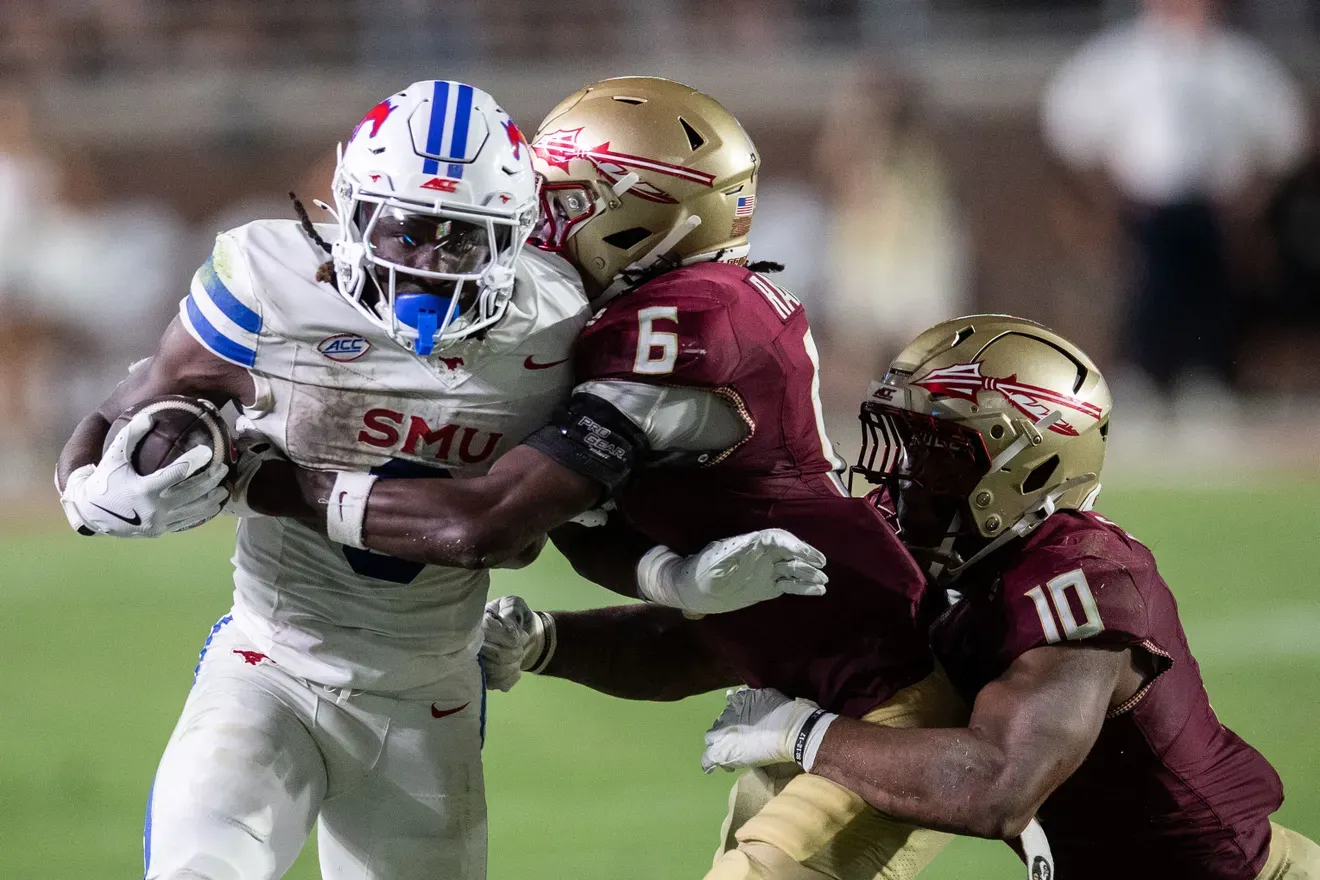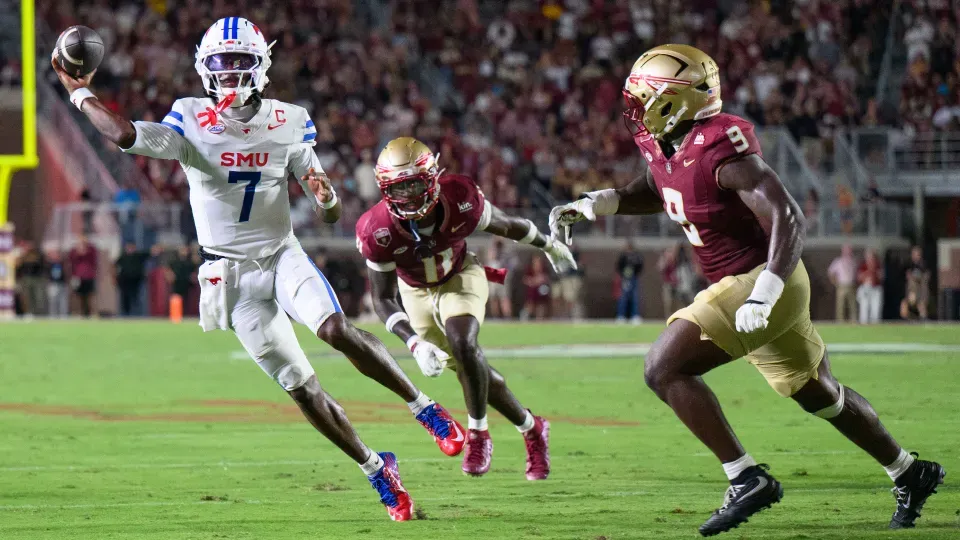
Mustangs overcome nearly two-hour power outage, explosive Seminoles rushing attack and their own mistakes to escape Tallahassee with a 27-24 victory
By Jasmine Jackson | Sports Journalist
Tallahassee, Fla. — September 8, 2026
Sometimes college football gives you a game that is difficult to explain with a simple box score.
Monday night's meeting between No. 19 SMU and Florida State was one of those games.
Before either team could officially begin its night, the lights at Bobby Bowden Field at Doak Campbell Stadium went out.
What was supposed to be a 7:30 p.m. Labor Day kickoff quickly became one of the strangest starts to a college football game this season. A power disruption involving the stadium's main transformer forced both teams back into their locker rooms and left thousands of fans waiting in an increasingly dark stadium.
Nearly two hours later, the lights came back well enough for football to finally take center stage.
And once the ball was kicked, neither team looked interested in waiting around.
SMU and Florida State went back and forth in a physical, high-energy ACC battle that ultimately came down to the final seconds. When the night was over, the Mustangs had escaped Tallahassee with a 27-24 victory, giving SMU a statement win on the road while leaving Florida State with another reminder that the margin for error in the ACC is razor thin.
A Night That Started in the Dark
The game was scheduled to begin shortly after 7:30 p.m., but minutes before kickoff, the stadium lost power.
The outage affected far more than the stadium lights.
The scoreboard was unavailable. The public-address system was down. Sideline tablets could not be used, and coach-to-player helmet communication was initially unavailable. At one point, officials were responsible for keeping the game clock on the field because the normal stadium systems were not fully operational.
The delay lasted approximately 1 hour and 45 minutes, with both teams eventually returning to the field for a short warmup before kickoff at approximately 9:15 p.m.
It was an unusual situation for everyone involved.
But perhaps the most impressive part of the night was what happened after the lights returned.
Neither team used the circumstances as an excuse.
SMU head coach Rhett Lashlee later described the challenge simply: the Mustangs had to remain calm in the chaos.
That mentality showed up almost immediately.
SMU came out attacking.
Florida State answered.
And before long, the bizarre beginning had given way to exactly what fans came to see — two teams willing to trade punches for four quarters.
Kevin Jennings Put on a Show
If there was one player who made sure SMU's offense didn't get lost in the chaos, it was quarterback Kevin Jennings.
Jennings delivered a career-best performance, completing 26 of 36 passes for 430 yards and three touchdowns.
He also added 33 rushing yards, proving that Florida State had to account for more than just his arm.
The first big strike came early.
Jennings connected with Jalen Cooper on a 50-yard touchdown pass, immediately giving SMU a 7-0 advantage and showing that the Mustangs were prepared to attack Florida State's secondary vertically.
Later, Jennings found Florida State transfer Randy Pittman Jr. for a 10-yard touchdown, adding another layer to what became a massive night for the SMU passing game.
Jennings wasn't perfect.
He threw two interceptions, including one that ended a promising scoring opportunity. But his ability to bounce back from those mistakes may have been the most important part of his performance.
When SMU needed a quarterback to make plays late, Jennings delivered.
The Mustangs ultimately finished with 585 total yards, including 430 through the air. Florida State's defense forced turnovers and repeatedly gave its offense opportunities to remain within striking distance, but SMU's passing attack continued to create problems.
That is what separates a good quarterback performance from a winning quarterback performance.
Jennings made mistakes.
Then he responded.
Florida State Refused to Go Away
For all the attention surrounding SMU's offensive explosion, Florida State deserves credit for the way it fought throughout the night.
The Seminoles could have folded after the unusual delay.
They could have allowed SMU to take control after the Mustangs jumped out early.
Instead, Florida State answered every time SMU appeared ready to create separation.
Quarterback Ashton Daniels helped establish the tone with his legs.
Daniels completed 12 of 23 passes for 125 yards and one touchdown, but his rushing production became an important part of Florida State's offense. He finished with 71 rushing yards and a touchdown, including an 8-yard touchdown run during a 14-play, 75-yard first-quarter drive.
That drive was significant because it showed Florida State wasn't intimidated.
SMU scored first.
Florida State answered.
And the Seminoles continued to battle despite struggling to consistently move the ball through the air.
Ousmane Kromah Gives Seminoles a Spark
The biggest offensive bright spot for Florida State was running back Ousmane Kromah.
Kromah was arguably the Seminoles' most consistent offensive weapon, rushing 22 times for 116 yards and a touchdown.
His 54-yard run was one of the biggest offensive plays of the evening, while his 7-yard touchdown helped keep Florida State within striking distance.
For Kromah, the performance marked his second consecutive 100-yard game to begin his sophomore season. An encouraging sign for a Florida State offense that will need a dependable rushing attack as the season progresses.
Florida State ultimately rushed for 211 yards, significantly more than SMU's 155.
That is an important takeaway moving forward.
Even in defeat, the Seminoles demonstrated that they can create explosive plays on the ground.
The problem was that they could not consistently complement that rushing success with enough production through the air.
Defense Kept Florida State Alive
Florida State's defense deserves its own share of the story.
The Seminoles intercepted Jennings twice in the second half, with Ashlynd Barker and Nehemiah Chandler coming away with picks.
Florida State also benefited from a muffed SMU punt that resulted in a third-quarter touchdown.
Those plays kept the Seminoles within one score and prevented SMU from turning its massive yardage advantage into a runaway victory.
For stretches, Florida State's defense gave its offense exactly what it needed.
But the challenge became sustaining that pressure.
SMU converted 8 of 14 third-down opportunities, allowing the Mustangs to repeatedly extend drives and keep the Seminoles' defense on the field.
That difference became increasingly important late.
Fourth Quarter: Where the Game Was Won
The game entered its final quarter with neither team willing to give ground.
SMU's offense had dominated statistically, but Florida State continued to hang around.
That is when the Mustangs showed perhaps their most important quality of the night, composure!
SMU produced two fourth-quarter scoring drives, and the game eventually reached a 24-24 tie before the Mustangs got the ball for one final opportunity.
The moment belonged to Jennings and the SMU offense.
Despite the earlier interceptions and the unusual conditions, Jennings guided the Mustangs down the field when the game mattered most.
That drive ended with kicker Nick Reed lining up for a 20-yard field goal with 21 seconds remaining.
Reed delivered.
SMU 27.
Florida State 24.
Ballgame.
The kick was more than the final three points. It represented the difference between a team that made enough plays to win and one that came within one possession of pulling off the upset.
The Numbers Tell Two Different Stories
The final statistics paint an interesting picture.
SMU dominated the total yardage battle, 585-336, and held a massive advantage through the air, throwing for 430 yards compared with Florida State's 125.
Florida State, however, controlled the rushing numbers, 211-155.
That contrast explains much of the game.
SMU consistently attacked through the passing game.
Florida State found its best success on the ground.
The Mustangs were also significantly more efficient on third down.
Florida State finished just 2-for-15 on third down, including an opening stretch in which the Seminoles failed to convert their first 10 third-down attempts.
Against a ranked opponent, those missed opportunities eventually become the difference.
What This Means for SMU
For SMU, this is the kind of victory that can shape a season.
The Mustangs weren't flawless.
They turned the ball over.
They made mistakes.
They endured a bizarre pregame delay.
They played in a stadium operating under unusual conditions.
And they still walked out of Tallahassee with an ACC road victory.
That matters.
SMU entered the night ranked No. 19, and this performance gives the Mustangs a legitimate argument to move upward in the next AP Poll.
More importantly, SMU showed that its offense can be explosive enough to overcome adversity.
Jennings' 430 passing yards immediately puts him on the national radar, while the emergence of multiple receiving options gives Lashlee plenty to work with moving forward.
But SMU cannot ignore the mistakes.
Two interceptions, a muffed punt and other miscues kept Florida State in a game the Mustangs statistically controlled.
Against stronger opponents later in the season, those mistakes could be much more costly.
The good news?
SMU now has proof that it can win an uncomfortable game.
And championship-caliber teams usually have to win games that aren't pretty.
The Mustangs will return home Saturday to host UC Davis, giving them an opportunity to build on the momentum from their ACC-opening victory.
What This Means for Florida State
For Florida State, the loss is disappointing — but it isn't the end of the story.
The Seminoles are now 1-1 overall and 0-1 in ACC play, but there were enough positive moments to suggest that this team can still compete.
Kromah's rushing performance is encouraging.
Daniels' ability to create plays with his legs gives the offense another dimension.
And the defense showed that it can create turnovers against a ranked opponent.
But the passing game must improve.
Florida State finished with only 125 passing yards, and the Seminoles' inability to sustain drives on third down repeatedly put pressure on the defense.
Against SMU, Florida State had opportunities.
The Seminoles simply didn't convert enough of them.
Head coach Mike Norvell acknowledged that the team has to make plays in the passing game and improve its protection and consistency.
The schedule doesn't get easier.
Florida State now gets a bye before traveling to Tuscaloosa to face No. 13 Alabama on September 19.
That gives the Seminoles time to regroup, correct mistakes and prepare for another major test.
More Than Just a Football Game
When people look back at SMU and Florida State on September 7, 2026, they won't remember only the final score.
They'll remember the darkness.
They'll remember the nearly two-hour wait.
They'll remember players walking back to the locker rooms.
They'll remember a stadium without its normal scoreboard, public-address system and sideline technology.
And they'll remember that once the lights came back on, both teams were ready to play football.
That may be the biggest takeaway from the night.
Neither team allowed the circumstances to determine its effort.
Both teams came prepared to go back and forth.
Florida State kept punching.
SMU kept answering.
And when the final possession arrived, the Mustangs had just enough left to make the winning play.
For SMU, the night ended with a 27-24 road victory, a career performance from Kevin Jennings and an early statement to the ACC.
For Florida State, the night ended in disappointment — but also with evidence that there is plenty to build on.
The season is only beginning.
SMU leaves Tallahassee undefeated and with momentum.
Florida State leaves with questions.
But both teams left the darkness knowing a little more about who they are.
And if Monday night's chaos was any indication, the road ahead for both programs could be anything but predictable.