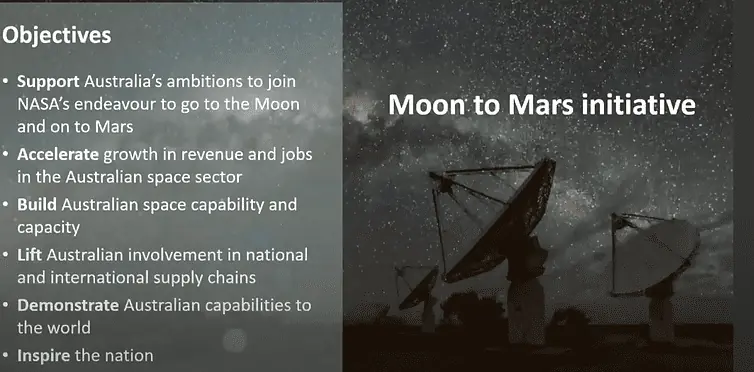
Ten Australian space companies have been awarded a share in almost $40 million of support funding under the Moon to Mars program, even as the fate of the entire project hangs in the balance.
A review of the $150 million Moon to Mars program will be completed by the end of this month. It comes after Industry Minister Ed Husic scrapped a $1.2 billion program to monitor Australian fires, floods, agriculture and the environment from orbit, and cut $77 million from other space-based projects, including investment in new spaceports and launch facilities.
The Australian Department of Industry Moon to Mars Demonstrator Feasibility Grants process has awarded up to $10 million each to 10 small and medium enterprises (SMEs) seeking to prove the viability of space-based technological systems. They were chosen based on their potential to participate in NASA’s mission to establish a foothold on the Moon and use it as a springboard to Mars.
“‘These space projects will make a big impact, including to NASA’s Artemis Program,” Australian Space Agency head Enrico Palermo said in a statement. “They will develop capability and experience in mission launch and space operation activities.”
Moon to Mars: what you need to know about Artemis
Building technology demonstrators is just one of three investment programs under the former Morrison Coalition government’s Moon to Mars initiative.
The $25.7 million Supply Chain Capability Improvement Grants program was established to assist Australian companies in developing components, improving production lines and securing positions in the international space industry. About $6 million has already been distributed since March last year.
And the $50 million Trailblazer Program is behind an agreement signed between the Australian Space Agency and NASA in March this year to design and build a semi-autonomous Lunar mining rover. Two consortia each received $4 million as part of stage one of this project.
But the existence of a Federal Labor Government contract seeking “professional advice on evaluation of Moon to Mars initiative” was announced to the public in the first week of May.

It revealed US consultancy group Deloitte has been commissioned for a three-month, $246,400 review into the 18-month-old space industry accelerator initiative, to be concluded on July 31.
However, the Moon to Mars Initiative Demonstrator Mission Grants appear to be going ahead.
The recipients include:
The Australian National University’s GRACE laser ranging technology project ($6.2 million) and Advanced Navigation’s Project LUNA Navigation and Guidance Technology ($5.2 million).
An ANU-led consortium will create Australia’s first ground station ($4.5 million) for laser-based communications with the Lunar surface and deep space orbits.
The University of Western Australia will establish an optical communications ground station network ($4.4 million), enabling laser-based links with low-Earth orbit satellites.
Fleet Space Technologies ($3.9 million) will send three miniature seismic stations to the Moon’s Schrodinger Crater – one of the favoured locations for any future Lunar Base.
QuantX Labs will design, test and verify a new design of a space-based atomic clock ($3.7 million) to assist with accurate navigation.
Lunaria One will design, build and test two self-contained horticultural testing units ($3.6 million) to test the viability of growing plants in space.
Raytracer Pty Ltd ($2.9 million) is working towards sending a robotic support vehicle to the Optus D3 satellite. This will attach itself in order to extend the satellite’s operational life by another six years.
Enable Aerospace ($2.8 million) is designing standardised payload racks for spacecraft.
And The University of Melbourne gets $2.7 million to support the operations of the Australian Space Agency’s demonstrator SpIRIT satellite.