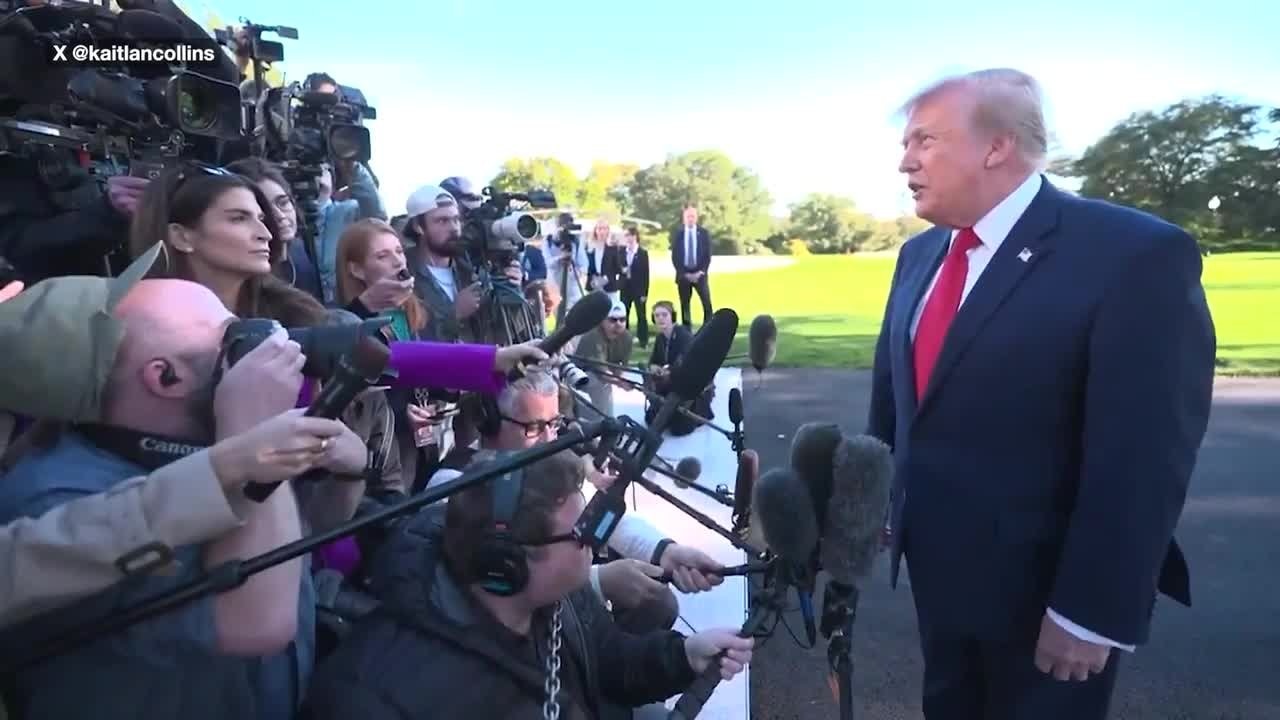
“I think I have the right to run again because they cheated.”
The 45th and 47th President of the United States, Donald Trump, keeps floating the idea of becoming the 48th.
He thinks the US Constitution won’t let him.
“I don’t know who’s going to be your next president. And I think the law says – I’m not 100 per cent sure – but I think the law says that I’m not allowed to run again.”
Speaking at a campaign rally in Iowa, Mr Trump said he may do so anyway.
“They cheated us on the second one because we won it three times, so I think I have the right to run again.”
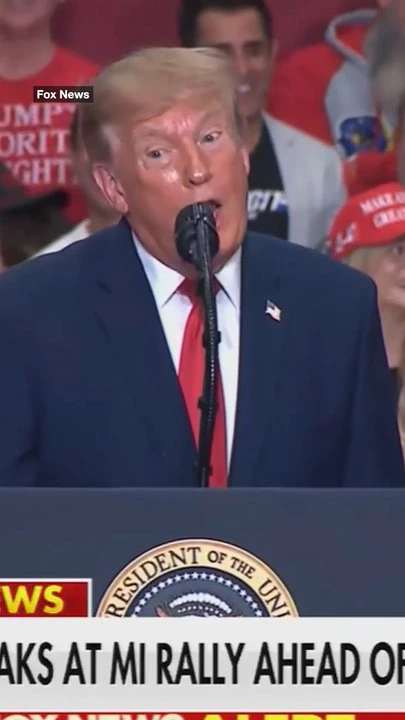
Mr Trump and his MAGA (Make America Great Again) movement continue to insist he lost the 2020 vote due to systematic voter fraud.
“They rigged the election. They rigged that,” he repeated at the Iowa rally on Friday, Australian time.
Six years later, no evidence of vote rigging has yet been presented.
On January 6, 2021, Mr Trump ordered his then-Vice President, Mike Pence, to refuse to certify the result at the traditional Capitol Hill hearing. His followers stormed the seat of government when Mr Pence did so anyway.
Upon taking up his second term last year, Mr Trump pardoned all the violent insurrectionists as “political prisoners”, “hostages” and “patriots”.
Some US political analysts fear the mercurial president will similarly refuse to accept defeat at next month’s midterm elections. And then again at the November 2028 presidential run-off.
United State of Denial
“I won three times. Now, I’m going to do it again.”
That was Mr Trump’s declaration at July’s rescheduled White House Correspondents’ Association dinner. An aspiring assassin disrupted the first attempt.
His extreme self-confidence is now being applied to his personal approval ratings, and Republican chances to retain their majorities in Capitol Hill’s Senate and House of Representatives.
Mr Trump was confronted with a record low approval rating of 38.8 per cent at the weekend.
“It’s fake,” Mr Trump retorted.
“I’m not at 38. I think I’d be in the 60s now. Now, in the Republican Party, I’m way up. Show him the 99 per cent. Have you seen it?”
He was referring to a poll of Republicans who identified as his MAGA supporters.
Much broader polls of all US voting blocs produce a significantly different number. An Ipsos poll conducted a week ago found 34 per cent approve of his presidency. A Pew Research result from earlier this month came up with 30 per cent. And a New York Times sample last week put the figure at 34 per cent.
“Those numbers have led some Republicans to fear a blowout like the 2006 midterms that gave Democrats both the House and Senate on the back of US President George W Bush’s deep unpopularity,” argues Foreign Policyanalyst Michael Hirsch.
The Democrats need only to win four extra seats in both the Senate and House to reverse the balance of power.
Mr Trump, however, does not believe this to be the case.
“I don’t believe I could be beaten by anybody,” he insisted at the weekend.
‘Love me’
“Voting in America is CORRUPT,” Mr Trump insists in a Truth Social post comparing the US system to that of Brazil.
And he’s dramatically raised the stakes of next month’s midterm vote.
This time, it’s personal.
“You have to pretend I’m on the ballot,” he has been telling Republican rallies across the country.
His Democrat opponents want voters to do just that.
They point to soaring inflation linked to Mr Trump’s war against Iran, his hostile tariff policies and prolific government spending.
Many Republican candidates agree.
So they’ve quietly tried to avoid their gregarious President’s personal endorsement.
But Mr Trump has already begun challenging the election results. Even before the votes are taken.
“TOTAL DEMOCRAT SCAM meant to confuse the Voter,” he posted in complaint over Alaska’s preferential voting system.
It’s a Republican Party innovation.
Mr Trump has ordered his Department of Justice to file a lawsuit demanding the Alaskan Senate election result not be certified – if Republican candidate Dan Sullivan does not win.
The Trump Administration’s new Attorney-General, Todd Blanche, insisted at the weekend that the move was not political.
“He’s the executive,” Mr Blanche said.
“He’s supposed to make sure that everything in this country is running right.”
But his Department of Justice has chosen a sensitive time to enforce its concerns over US electoral systems, candidates and processes.
By any means necessary
Accusations against long-term Trump Administration opponents, former CIA director John Brennan and former FBI director James Comey, have been revived.
A White House committee has been established to investigate alleged mortgage fraud by Federal Reserve governor Lisa Cook. She is refusing Mr Trump’s demands that a more amenable incumbent replace her.
FBI agents raided Minnesota Democrat Representative Ilhan Omar’s home, seizing documents and her mobile phone. They’re investigating alleged immigration fraud.
The Department of Justice has sued California to prevent 20,000 people from voting. It alleges they are not valid US citizens.
It has submitted charges against Virginia Democrat Senator Louise Lucas for alleged illegal marijuana production and distribution.
And it, at the weekend, arrested two senior FBI officers for allegedly lying to Congress about their role in “politically weaponising” a Hunter Biden investigation.
Meanwhile, Mr Trump has banned international observers from monitoring the elections. And he’s continued to refuse ruling out deploying the National Guard on polling day. Despite the Constitution expressly forbidding this.
The Ipsos poll last week found some 79 per cent of US voters were not confident the President would accept an unfavourable outcome. Just 28 per cent believed he would.
“If there’s a free and fair election and kind of a transfer of power, it can send a signal to Americans and people around the world that the United States is not destined for a January 6 at every contested election,” George Washington University political scientist Matthew Dallek told Foreign Policy.
“At the same time, there is no single election that can repair the damage to America’s image in the world as a defender of democracy and reliable ally or repair the lost faith of Americans in the ability of government to improve their lives.”
Constitutional ‘wiggle room’
The 22nd Amendment to the US Constitution states: “No person shall be elected to the office of the President more than twice”.
“I’ve studied that phrase forever,” the 80-year-old President told his Iowa supporters.
“Unfortunately, it’s quite concise. There’s not a lot of wiggle room.”
Mr Trump was elected the 45th President in 2016, and the 47th in 2024.
MAGA advocates have been attempting to argue the Constitution only applies to two consecutive terms. Not separated results.
Others have argued Mr Trump could run as Vice President, only for the winner to step down in his favour once in office.
“I’d love to run, but the law is very strong,” Mr Trump admitted in August.
“Everybody wants me to do it, but the law is very strong.”
Democrats, however, increasingly fear Mr Trump will make this move regardless.
“One of the things we’ve learned in the Trump era is that laws don’t enforce themselves,” Democrat campaign strategist and lawyer Dmitri Mehlhorn told US media.
“If Trump goes to the Republican Party and says … ‘my first term didn’t count because of the Russia hoax’, or whatever, and he says to the Republican Party, ‘make me your nominee’. I think there’s almost no chance the Republican Party would say anything other than ‘yes, sir’. So then he’s the nominee.”
It then becomes a matter for the Supreme Court.
“That would mean that the Supreme Court would need to declare that the next president is the Democrat,” Mr Mehlhorn adds.
“But my observation of this Supreme Court is there was no way they would do that. They would say it’s a political question. They would say it’s up to the voters … I don’t see anyone who could enforce it at that point.”