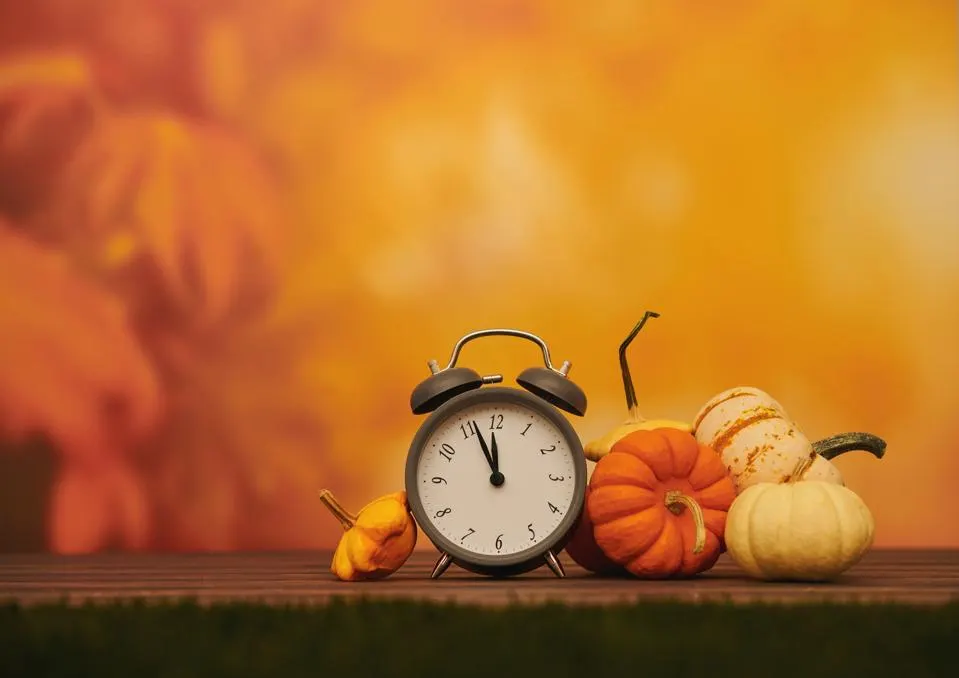
When do the clocks go back? Daylight saving time ends this weekend across most of the U.S. and Canada. At 2 a.m. local daylight time on Sunday, Nov. 1, clocks will “fall back” one hour to 1 a.m. as standard time returns, giving millions an extra hour overnight — but bringing sunset an hour earlier.
Key Facts
- Clocks go back one hour at 2 a.m. local daylight time on Sunday, Nov. 1, 2026, becoming 1 a.m. local standard time. Sunrise and sunset will subsequently occur about an hour earlier by the clock, bringing lighter mornings and darker evenings.
- Most smartphones, computers and connected devices should update automatically, but manual clocks and clocks in vehicles, ovens, microwaves and elsewhere may need changing.
- Two U.S. states — Arizona and Hawaii — don’t observe daylight saving time, though the Navajo Nation in Arizona does.
- Alberta in Canada will not turn its clocks back this year after adopting permanent Alberta Time, making 2026 different for some Canadians.
- Unless federal law changes, daylight saving time will return on Sunday, March 14, 2027, when clocks “spring forward” one hour.
BIG NUMBER
1 hour. That’s how far clocks go back Sunday morning. Sunday will effectively be a 25-hour day, with the hour between 1 a.m. and 2 a.m. occurring twice, giving most Americans and Canadians an extra hour overnight.
SURPRISING FACT
The U.S. House of Representatives voted this year to stop the twice-yearly clock changes. It passed the Sunshine Protection Act 308–117 in July, which would make daylight saving time permanent. However, the legislation has not become law, so most Americans still need to turn their clocks back this weekend.
KEY BACKGROUND
Daylight saving time begins on the second Sunday in March and ends on the first Sunday in November in the U.S. An easy way to remember the direction of the clock change is “spring forward, fall back.” The U.S. first adopted daylight saving time nationally in 1918 during World War I. It standardized the modern system with the Uniform Time Act of 1966, according to the Bureau of Transportation Statistics. The U.K. and most of Europe already turned their clocks back on Sunday, Oct. 25, one week before most of North America.
WHAT TO WATCH FOR
The Sunshine Protection Act now awaits further action in the Senate. Polling suggests most Americans want to stop changing their clocks twice each year, but they disagree over what should replace the current system. A Gallup survey in March 2025 found 48% favored permanent standard time, 24% permanent daylight saving time and 19% wanted to keep the existing system.