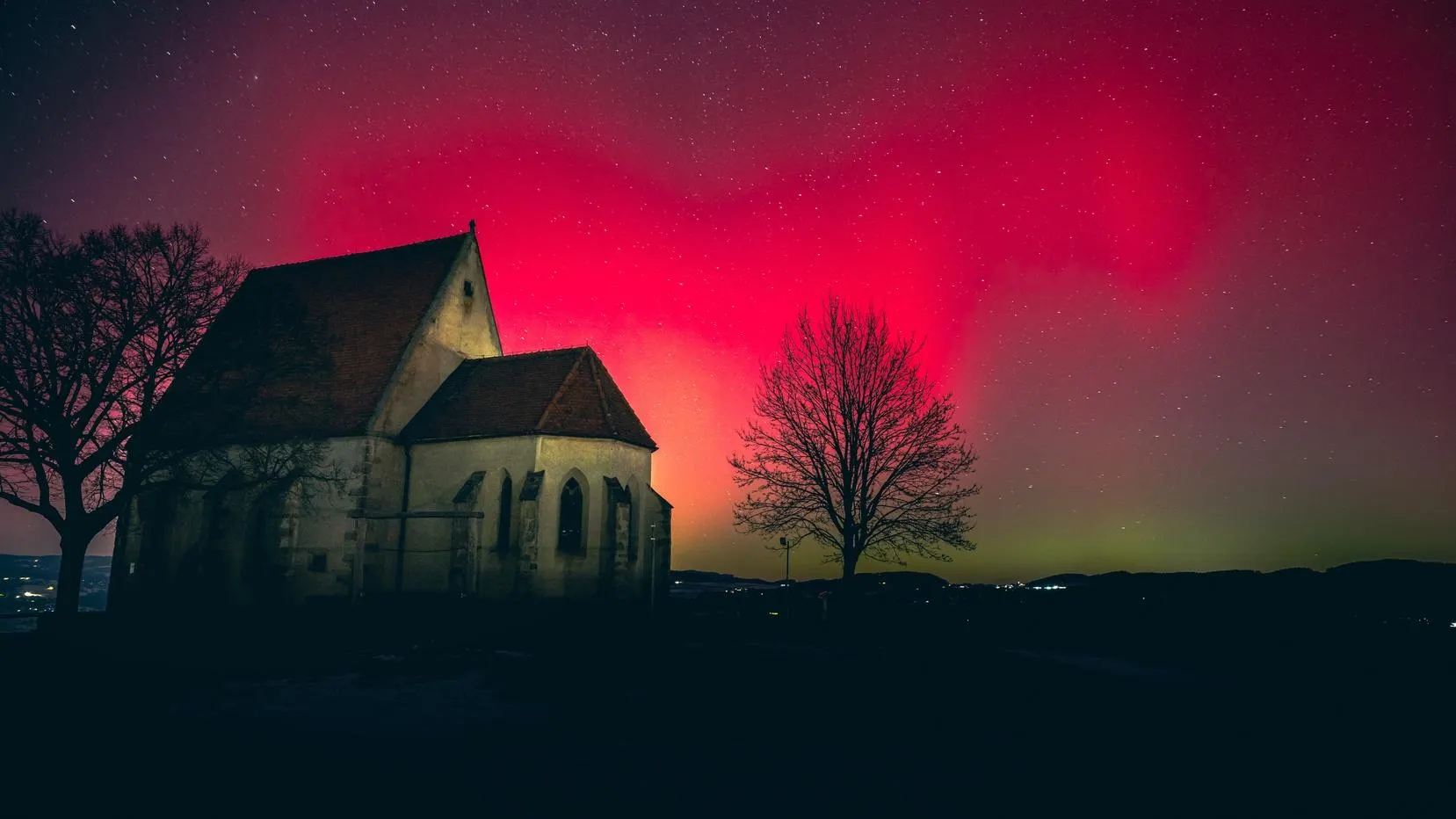
The northern lights might be visible in parts of the northern U.S. overnight on Monday, Nov. 16, and Tuesday, Nov. 17, as a strong stream of solar wind interacts with Earth’s magnetic field.
Space weather forecasters predict a G1-class geomagnetic storm, which could make the aurora visible from northern U.S. states near the Canadian border. If that happens and conditions are right, you can even photograph the northern lights with your phone.
The forecast comes in the wake of a coronal mass ejection — a huge expulsion of plasma and magnetic fields from the sun’s outer atmosphere, its corona — on Nov. 14. The potential displays will take place as the moon reaches its first-quarter phase, so it will shine brightly until around midnight. That will leave the rest of the night as dark as possible for sighting any faint aurora.
Will You See the Northern Lights Tonight?
According to a forecast by space weather experts at the National Oceanic and Atmospheric Administration, a G1-class geomagnetic storm could begin as darkness falls across North America on Monday, Nov. 16, with Kp 5 conditions forecast, and last into the early hours of Tuesday, Nov. 17.
“Mostly quiet conditions are expected early on 16 Nov, increasing to unsettled to isolated active periods late in the day,” states NOAA. “A further increase to active to isolated G1 (Minor) levels is likely on 17-18 Nov as the CH HSS moves into a geoeffective position along with the possible arrival of the 14 Nov CME late in the period. CH HSS refers to a coronal hole high-speed stream — a rush of charged particles escaping from a dark region of the sun’s atmosphere, sometimes moving faster than a million miles per hour. When this solar wind reaches Earth, it can disturb the magnetic field, trigger geomagnetic storms, and possibly bring the northern lights farther south than usual.
Where Will the Aurora Be Visible?
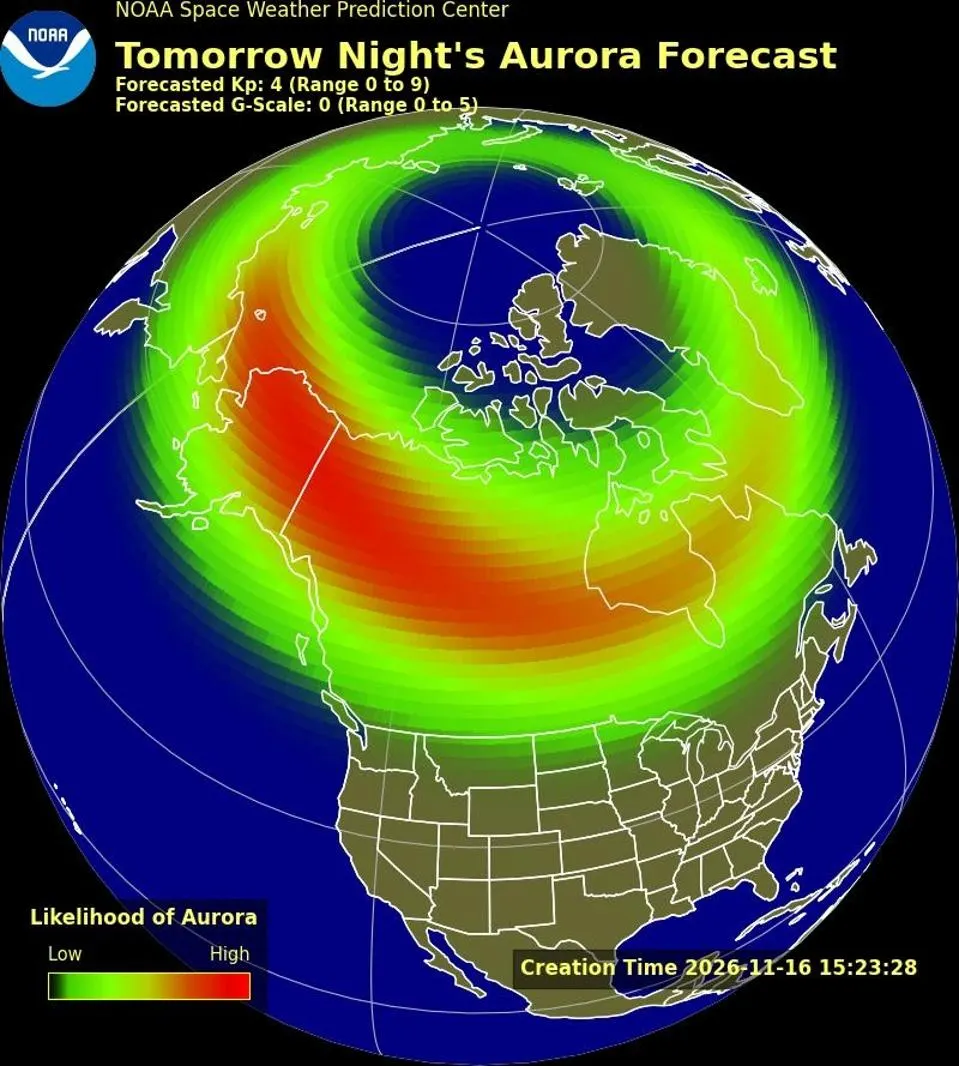
If a G1 geomagnetic storm happens, the aurora could be visible from dark spots in northern U.S. states near the Canadian border. You might see it in Alaska and parts of Washington, Idaho, Montana, North Dakota, South Dakota, Minnesota, Wisconsin, Michigan, Maine, Vermont, and New Hampshire, as long as the skies are clear.
The aurora-chasing website Cosmik gives live odds for all states and 552 cities in 10 languages, using NOAA’s data. You can check there to see if your area might see the aurora tonight.
How Can You Maximize Your Chances of Seeing the Aurora?
If you want to see the aurora, go to a dark place with a clear view of the northern horizon. Whether you see the aurora depends on the strength of the solar wind, cloud cover, light pollution, and the direction of the interplanetary magnetic field. This direction, called Bz, is important. When Bz points south, it connects more easily with Earth’s magnetic field, allowing energy and charged particles to enter the magnetosphere. If Bz stays south for a while, the aurora can get brighter and move farther south. If Bz points north, the display may be weak or only visible at higher latitudes.
Try apps like Aurora Now, My Aurora Forecast, or Glendale Aurora for real-time alerts and live solar wind data.
Wishing you clear skies and wide eyes.