
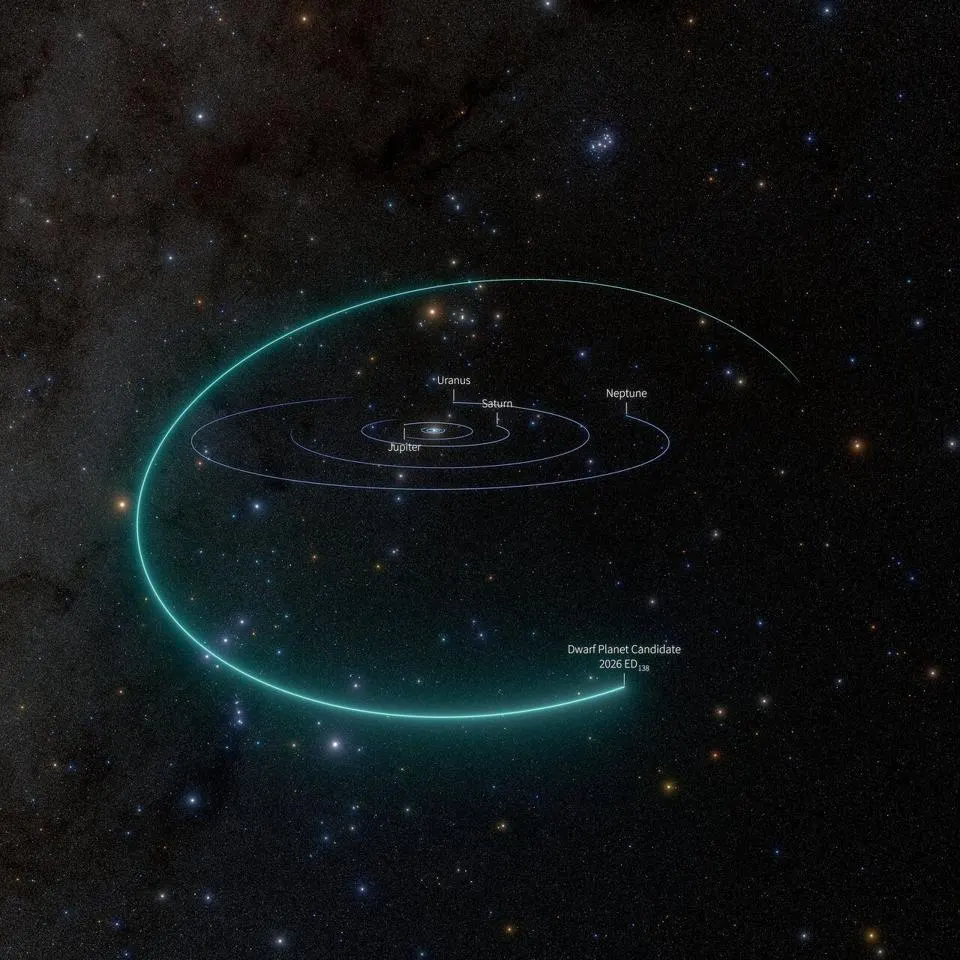
Scientists have announced the discovery of a massive new dwarf planet candidate in the outer reaches of the solar system. Thought to be about 370-930 miles (600-1,500 kilometers) in diameter, the object — initially called 2026 ED138 — would rank among the largest dwarf planets ever found beyond Pluto’s orbit, if it’s confirmed.
The newly identified object is among the largest and brightest trans-Neptunian objects detected in the outer solar system. Astronomers found it using the new Rubin Observatory in Chile.
A dwarf planet is a small planetary-mass object that is in direct orbit of the sun, smaller than any of the eight classical planets. ED138 could join an exclusive group of officially recognized dwarf planets beyond Neptune, including Pluto (the prototype dwarf planet), Eris, Haumea and Makemake.
New Dwarf Planet Candidate Discovered Beyond Pluto
The discovery was made by astronomer Matthew Holman of the Center for Astrophysics | Harvard & Smithsonian, who identified the object while analyzing observations collected by Rubin Observatory earlier this year. On Oct. 13, Holman used specialized software developed with colleague Kevin Napier to search billions of astronomical detections for previously unidentified moving objects. The algorithm revealed ED138, whose unusual brightness and distance immediately caught Holman’s attention.
“My first reaction was one of excited disbelief,” said Holman. “Objects like this are very rare, so I immediately started checking whether I or the code had done something wrong.” Further analysis confirmed the discovery, and researchers found ED138 in archival images captured by the Dark Energy Camera as far back as 2016.
2026 ED138: Key Facts at a Glance
| Feature | Details |
|---|---|
| Object name | 2026 ED138 |
| Classification | Dwarf planet candidate |
| Discovery announced | Oct. 27, 2026 |
| Discovered by | Matthew Holman, Harvard & Smithsonian |
| Observatory | NSF–DOE Vera C. Rubin Observatory, Chile |
| Location | Outer Solar System, beyond Neptune |
| Distance from sun | Approximately 46 AU (6.9 billion km) |
| Estimated diameter | 600-1,500 km |
| Orbital inclination | Approximately 25 degrees |
Source: NSF–DOE Vera C. Rubin Observatory, Oct. 27, 2026.
How Large Is Dwarf Planet Candidate 2026 ED138?
How big is 2026 ED138 compared to Pluto and other dwarf planets? Based on its brightness, distance and estimated surface reflectivity, scientists believe ED138 measures between 600 and 1,500 kilometers in diameter. It could become the fourth largest dwarf planet, larger than Pluto, Eris and Haumea, but smaller than Makemake, Gonggong, Quaoar and Sedna.
| Object | Estimated diameter | Distance from sun | Discovery year |
|---|---|---|---|
| Pluto | 2,377 km | 39.5 AU | 1930 |
| Eris | ~2,326 km | 67.7 AU | 2005 |
| Haumea | ~1,560 km | 43.1 AU | 2004 |
| 2026 ED138 | 600–1,500 km | 46 AU | 2026 |
| Makemake | ~1,430 km | 45.8 AU | 2005 |
| Gonggong | ~1,230 km | 67.5 AU | 2007 |
| Quaoar | ~1,090 km | 43.7 AU | 2002 |
| Sedna | ~995 km | ~500 AU | 2003 |
| Ceres | ~940 km | 2.77 AU | 1801 |
| Orcus | ~910 km | 39.2 AU | 2004 |
Note: Diameters are approximate. Objects are ordered by estimated size, with 2026 ED138 placed at the upper end of its estimated range. Distances represent average orbital distances, except for ED138, whose current distance is shown. Ceres orbits in the asteroid belt, not beyond Neptune.
Its size means ED138 is likely spherical — a key requirement for it to be classified as a dwarf planet rather than a trans-Neptunian object. However, additional infrared observations are needed to determine its precise dimensions and confirm whether it qualifies as a dwarf planet. ED138 currently lies approximately 46 astronomical units (AU) from the sun, compared with Pluto’s average orbital distance of roughly 40 AU. One astronomical unit represents the average distance between Earth and the sun. Its orbit is inclined about 25 degrees relative to the solar system’s orbital plane.
Rubin Observatory Could Discover More Dwarf Planets
The Rubin Observatory — home to a 3,200-megapixel camera, the world’s largest — began science operations in July. It has one of the most ambitious astronomy projects ever attempted — a 10-year time-lapse view of the southern sky comprising two million images and 30 trillion measurements of the properties of billions of galaxies, stars and asteroids. Its advanced detection algorithms can identify faint moving objects hidden among millions of background stars.
Earlier in 2026, Rubin researchers submitted observations of more than 11,000 newly discovered asteroids, including approximately 380 trans-Neptunian objects.
“Rubin will image the whole southern sky again and again for 10 years, so any others hiding in the places earlier surveys skipped are now within reach,” said Holman.
Astronomers worldwide will now conduct follow-up observations to investigate ED138’s physical properties and determine whether it deserves official dwarf planet status.
Wishing you clear skies and wide eyes.