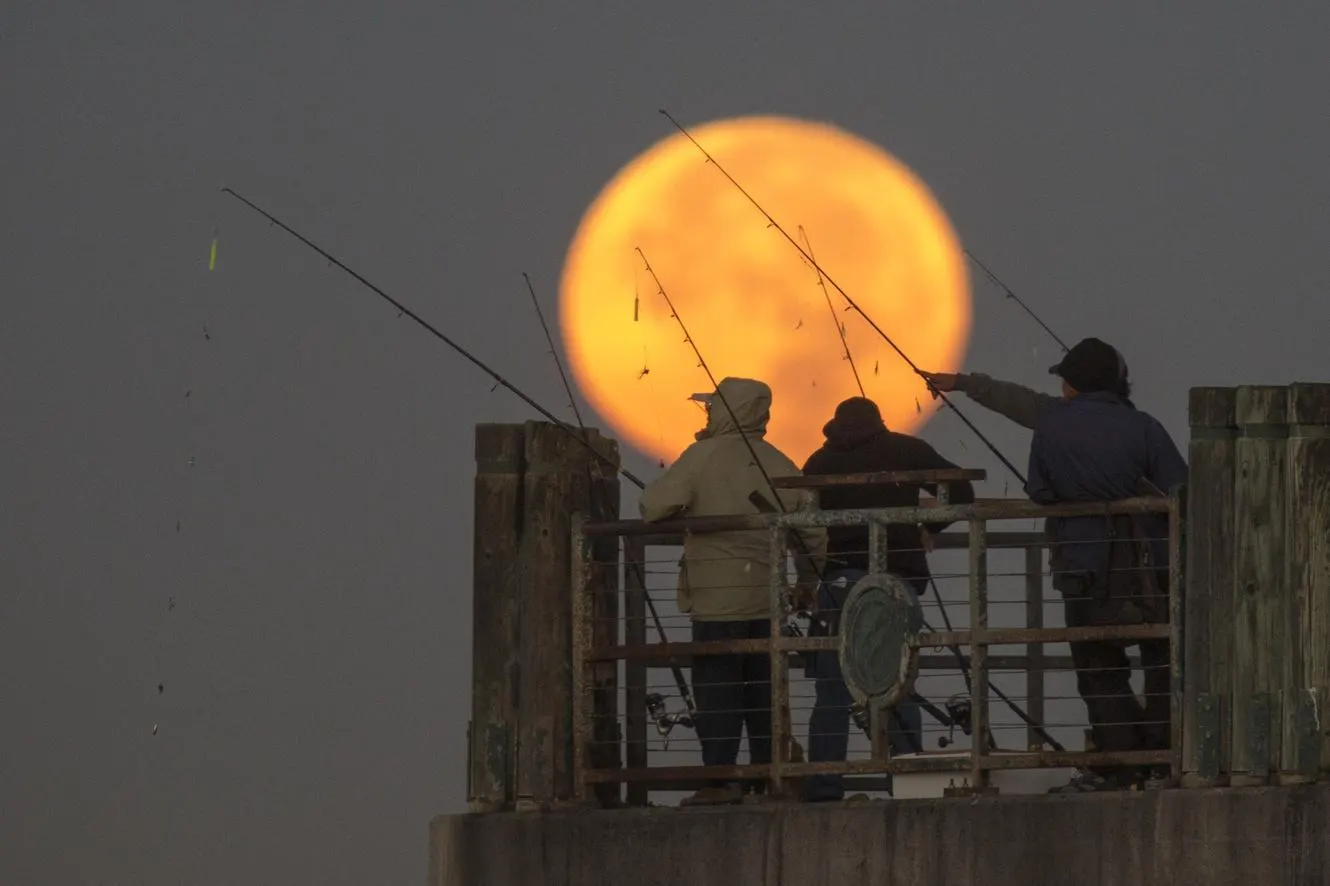
How close is tonight’s supermoon? Tonight’s full moon could have consequences far beyond finding the best time to watch from where you are. According to SpaceWeather.com, the Nov. 24 supermoon is helping generate exceptionally high tides along the U.S. Pacific Coast, raising fears of historic flooding during Thanksgiving week.
According to The Independent, tides could approach records set more than four decades ago, threatening coastal communities in California, Oregon and Washington. However, the supermoon itself is not solely responsible for the anticipated flooding. The extreme tides result from lunar and solar gravitational effects, while El Niño, storms and elevated sea levels can make their coastal impacts much worse.
What Is A Supermoon?
Supermoons are back in the news. The moon’s orbit around Earth is slightly elliptical, so each month there’s a point when it’s farthest away (apogee) and closest (perigee). If a full moon occurs near perigee, it appears slightly bigger and brighter in the night sky, making it a full supermoon.
According to astronomer Fred Espenak, a supermoon is defined as a full moon occurring when the moon is within 90% of its closest approach to Earth, based on the difference between perigee and apogee.
At 9:53 a.m. EST on Tuesday, the full moon will be just 224,171 miles (360,768 kilometers) from Earth — compared to the average distance of 238,900 miles (384,472 kilometers) — making it the second-closest supermoon of 2026.
Full supermoons can produce exceptionally high tides because the sun and moon are aligned on opposite sides of Earth. New supermoons have a similar effect, with both celestial bodies on the same side. These alignments produce spring tides, which can contribute to unusually high king tides, according to EarthSky.
Why Tonight’s Supermoon Could Trigger Monster King Tides
Tonight’s full moon occurs just 30 hours before perigee, giving it additional tide-raising power. SpaceWeather.com reports that the supermoon will appear 6.5% wider and 13.5% brighter than an average full moon.
The danger comes when the moon’s enhanced gravitational influence combines with elevated sea levels, strong winds and heavy rainfall.
California Faces Historic King Tides And Coastal Flooding
According to NBC News, tides in the San Francisco Bay Area could reach 2.6 feet above normal on Tuesday before peaking at 2.8 feet on Wednesday. That would come close to the record of 2.9 feet established on Jan. 27, 1983.
Tidal flooding had already surrounded vehicles in Mill Valley on Monday, while authorities in Humboldt County ordered evacuations after buildings flooded. San Francisco’s Embarcadero waterfront is also vulnerable, having experienced flooding during heavy rainfall last week.
According to The Independent, the ongoing super El Niño is amplifying the king tides by warming the Pacific Ocean and increasing the volume of seawater. SpaceWeather.com also warns that longer-term sea-level rise could compound the flooding threat and accelerate coastal erosion.
Dangerous Waves Threaten Thanksgiving Travel
According to NBC News, the National Weather Service has warned that breaking waves could reach 20 to 30 feet along the Bay Area coastline on Wednesday. San Francisco Mayor Daniel Lurie has urged residents to check conditions before traveling and avoid unnecessary journeys when roads are flooded.
Farther north, coastal flooding warnings extend into Oregon and Washington, where extreme tides have already disrupted ferry services. Approximately 300,000 people are expected to use Washington State Ferries over Thanksgiving weekend, raising concerns about further cancellations.
Florida Also Faces King Tide Flooding
South Florida could also experience significant coastal flooding from Palm Beach to Miami on Wednesday and Thursday, with water levels remaining elevated for several hours around high tide.
The threat follows severe rainfall that dumped more than 17 inches across parts of the region less than a week earlier. The St. Johns River near Cocoa has remained above flood stage since Nov. 2, recently surpassing a 1953 record. More rainfall could worsen flooding in communities still recovering from earlier storms.
When Will The Monster King Tides Peak?
The greatest flooding threat along the Pacific Coast is expected between Tuesday, Nov. 24, and Thanksgiving Day, Thursday, Nov. 26, although some coastal flood warnings extend into Friday. Residents should monitor local forecasts, avoid flooded roads and stay away from dangerous surf.
While supermoons are predictable astronomical events, their combination with elevated sea levels and severe weather can produce unusually destructive coastal flooding. According to Fred Espenak’s supermoon calculations, November 24 brings the second-closest full supermoon of 2026.
The year’s three supermoons rank as follows:
| Dec. 24 | 356,740 km | Closest |
| Nov. 24 | 360,768 km | Second |
| Jan. 3 | 362,312 km | Third |
December’s Christmas Eve supermoon, known as the “Cold Moon,” will be the closest of the year, passing approximately 4,028 kilometers (2,503 miles) nearer to Earth than November’s full moon. However, the closest supermoon doesn’t necessarily produce the most destructive tides. Coastal geography, weather conditions and existing sea levels also play crucial roles.
How Close Will Tonight’s Supermoon Get To You?
Tonight’s supermoon will actually be thousands of miles closer to some people than others. According to Timeanddate.com, Earth’s rotation means your distance from the moon changes dramatically throughout the night, with the closest approach occurring when the moon is high overhead.
During November’s supermoon, Londoners will get within just 219,050 miles (352,520 kilometers) of the lunar surface, compared with 219,670 miles (353,520 kilometers) in Los Angeles and 220,010 miles (354,070 kilometers) in New York.
That’s a difference of almost 1,000 miles between London and New York, even though everyone is looking at the same full moon. The difference comes down to Earth’s rotation, the moon’s constantly changing orbit and even time zones.
Wishing you clear skies and wide eyes.