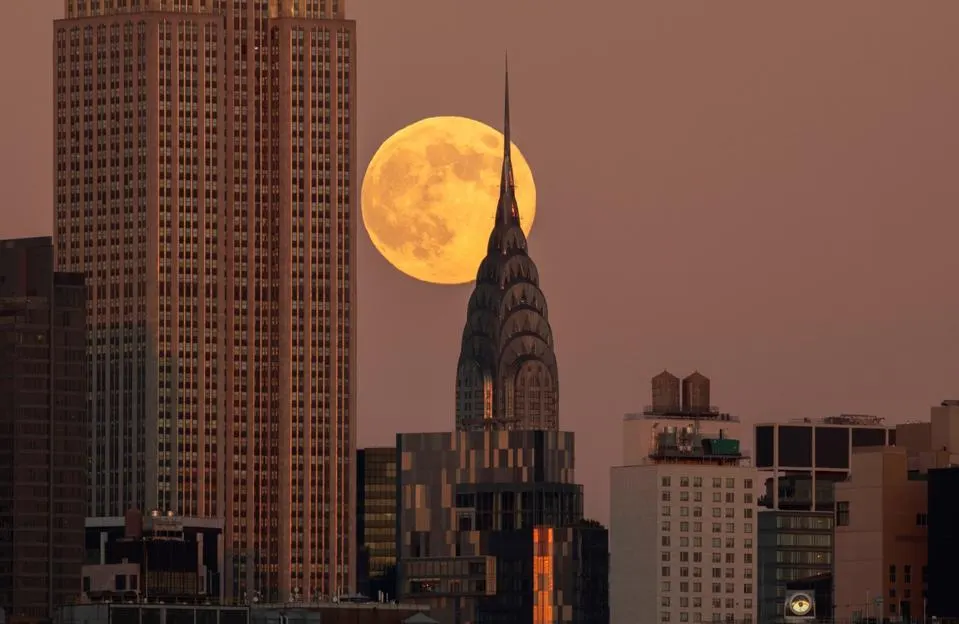
The full Beaver Moon — November’s traditional full moon — will turn full on Tuesday, Nov. 24. A North America-centric name that represents the time of year when beavers historically build dams before winter, this is the third and final full moon of fall in the Northern Hemisphere. It’s also the first of four consecutive supermoons, culminating in an exceptionally close “Christmas supermoon” in December. As with every full moon, the exact moment of peak illumination is not the best time to observe it. The most compelling views come at moonrise, when the moon appears low on the eastern horizon just after sunset.
Key Facts
- The Beaver Moon reaches its exact full phase during daylight on Nov. 24. The best time to see it will be at moonrise — just after sunset — on the evening of Nov. 24.
- November’s full moon is traditionally known as the Beaver Moon, with other Native American names including Frost Moon, Freezing Moon, Trading Moon, Oak Moon and Snow Moon, according to Timeandate.com. Celtic names include Mourning Moon and the Darkest Depths Moon.
- This Beaver Moon is also a supermoon, meaning it occurs near perigee, the point in the moon’s monthly orbit when it is closest to Earth. It will therefore appear slightly larger than average.
Best Time To See The Full ‘Beaver Moon’ Rise
Although the moon will appear near-full for about three nights in a row, it will rise in the east around sunset only on Tuesday, Nov. 24. Check the exact time of moonrise for your location.
- New York City: sunset at 4:32 p.m. EST, moonrise at 4:16 p.m. EST — 16 minutes before sunset.
- Los Angeles: sunset at 4:45 p.m. PST, moonrise at 4:43 p.m. PST — just two minutes before sunset.
The night after the full moon offers a darker sky, but the moon rises significantly later, reducing the dramatic effect of a full moon rising while the landscape is still lit.
What Is A Supermoon?
A supermoon occurs when a full moon coincides closely with perigee, the moon’s closest point to Earth in its slightly elliptical orbit. Because of that reduced distance, the moon appears slightly larger and brighter than an average full moon — typically by a few percent.
While the size difference is subtle, supermoons tend to look most impressive at moonrise, when the moon illusion makes a low full moon appear exaggerated in size against buildings, trees or landscapes.
THE MOON’S ELLIPTICAL ORBIT
Planets and moons don’t orbit in a perfect circle. German mathematician Johannes Kepler, working in the 17th century, first noticed that each planet’s orbit about the sun is an ellipse. According to NASA, Kepler’s First Law states that the planet-to-sun distance constantly changes as the planet moves along its orbit. This also applies to the moon as it orbits Earth. According to the Institute for Astronomy in Hawaii, the distance from the Earth to the moon varies by about 13% over the month.
Why December’s ‘Christmas Supermoon’ Will Be Even Bigger
November’s Beaver Moon is impressive, but it’s only the warm-up. In December, the full Cold Moon — often referred to as the Christmas supermoon — will be closer to Earth than at any point since 2018. That full moon occurs on Dec. 23, but will be best seen on the evening of Dec. 24, perfectly timed for viewing on Christmas Eve. It occurs even closer to perigee than November’s Beaver Moon and will be the closest, biggest and brightest full moon of 2026.