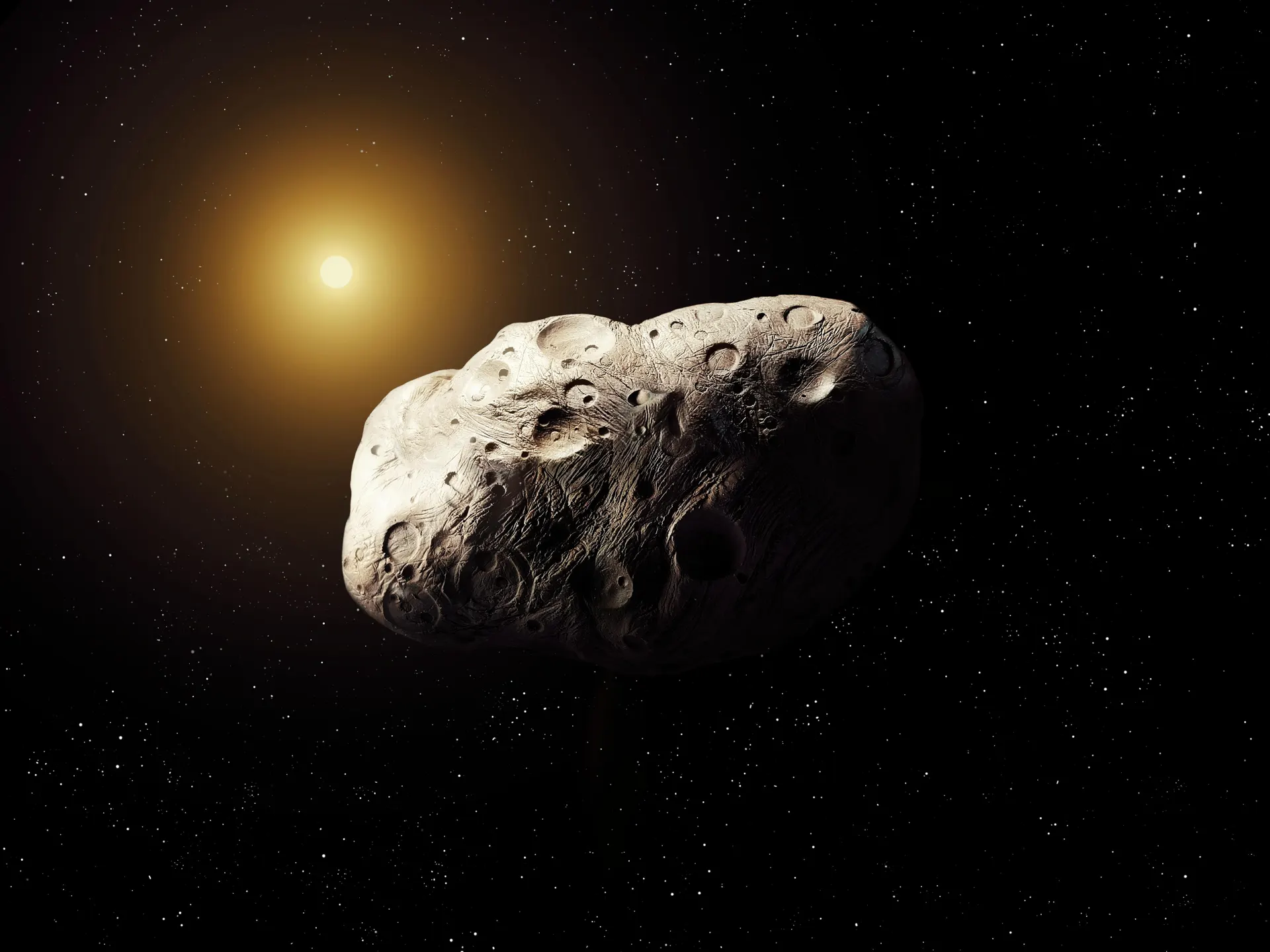
A mile-wide asteroid will make a remarkably close approach to Earth on Aug. 7, 2027, passing at approximately the same distance as the moon. Known as 1999 AN10, the enormous space rock measures an estimated 800 to 1,800 meters (0.5 to 1.1 miles) across and is classified by NASA as a potentially hazardous asteroid.
Despite its huge size and classification, astronomers have confirmed that 1999 AN10 poses no impact threat to Earth during its 2027 encounter. The close flyby will also provide skywatchers with an unusual opportunity to observe a large asteroid using binoculars.
How Close Will Asteroid 1999 AN10 Come to Earth?
Asteroid 1999 AN10 will reach its closest point to Earth on Aug. 7, 2027, at approximately 07:12 UTC. At that moment, the asteroid will be about 242,240 miles (389,855 kilometers) from Earth’s center, roughly the average distance between Earth and the moon.
Although that distance might sound large, it’s relatively close in astronomical terms, especially for an asteroid approaching a mile in diameter. However, the asteroid will travel safely past Earth without entering its atmosphere.
Will Asteroid 1999 AN10 Hit Earth or the Moon?
NASA classifies 1999 AN10 as potentially hazardous because of its substantial size and its orbit, which brings it relatively close to Earth. However, the designation does not mean a collision is imminent.
Potentially hazardous asteroids generally measure at least 460 feet (140 meters) across and have orbits that can bring them within 0.05 astronomical units of Earth’s orbit. Current calculations indicate that 1999 AN10 will not strike Earth in 2027 — and the moon is also safe. During the encounter, the asteroid will pass approximately 474,349 miles (763,391 kilometers) from the moon, nearly twice its closest distance to Earth.
How to See Asteroid 1999 AN10 in August 2027
One of the most exciting aspects of the encounter is that skywatchers will be able to see the asteroid. Astronomers predict that 1999 AN10 could reach an apparent magnitude of about 7.3, making it potentially visible in binoculars — and observers across North and South America are expected to have particularly good viewing opportunities.
Unlike stars, the asteroid will visibly change position against the background sky as it travels past Earth. During the night of Aug. 7, the asteroid will move through the constellations of Taurus, Aries, Pisces and Pegasus, according to EarthSky.
What Do Scientists Know About Asteroid 1999 AN10?
Astronomers at the Lincoln Laboratory Experimental Test Site in New Mexico discovered 1999 AN10 on Jan. 13, 1999. It belongs to the Apollo group of near-Earth asteroids, whose paths cross Earth’s orbit around the sun. The asteroid completes one orbit of the sun every 643 days, traveling along an elongated path that extends beyond Mars.
The close encounter next year will allow astronomers to refine its orbit, which matters because shortly after its original discovery, it was thought that 1999 AN10 could strike Earth in either 2044 or 2046. Tracking it in 2027 will help scientists improve predictions and potentially help with developing strategies for planetary defense.
What About Apophis, The ‘God of Chaos’ Asteroid?
Near-Earth asteroid 99942 Apophis makes an extraordinarily close flyby of Earth on April 13, 2029. The roughly 340-meter-wide asteroid Apophis will fly 19,400 miles above Earth — closer than geostationary satellites — but will safely miss Earth. Apophis should be visible to the naked eye from parts of Europe, Africa, Asia, Australia and South America. Spacecraft including the European Space Agency’s RAMSES mission and NASA’s OSIRIS-APEX will study the asteroid, while the LUMIO CubeSat could observe Apophis from beyond the moon.
Wishing you clear skies and wide eyes.