NASA has chosen a new mission to find out if a large pit on the moon leads to an underground cave that might one day provide shelter for astronauts on the lunar surface.
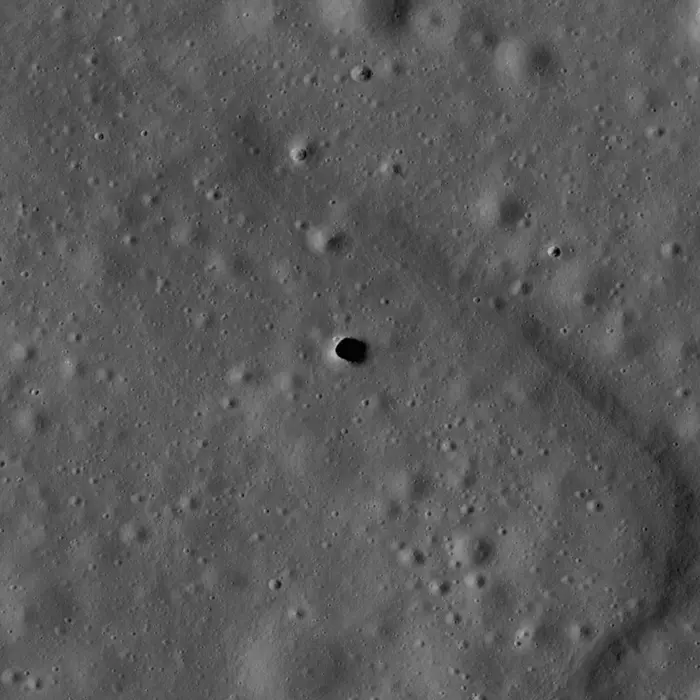
The now green-lit Geophysical Instruments for Marius Lunar pit Investigation (GIMLI) will study Marius Hills Pit, a big hole in one of the moon’s most volcanic areas, to see if it leads to a large underground lava tube.
Led by the Planetary Science Institute, GIMLI is one of three new science projects chosen by NASA’s PRISM program to help with plans for a permanent moon base.
Giant Hole On The Moon
Marius Hills Pit is in the Oceanus Procellarum region of the moon, which is on the left-hand side of the full moon as it’s viewed from Earth’s Northern Hemisphere. The pit was first seen in images from Japan’s Kaguya spacecraft and later studied by NASA’s Lunar Reconnaissance Orbiter. The pit is about 111 feet (34 meters) deep and roughly 213 by 295 feet (65 by 90 meters) wide.
Scientists think the pit might be a skylight, which is a hole that forms when part of a lava tube’s ceiling falls in. Lava tubes are the result of the top of flowing lava hardening while hot rock keeps moving underneath, leaving a hollow tunnel. GIMLI will use ground-penetrating radar, seismic sensors, and gravity measurements to find out if a cave stretches beyond the pit.
Natural Shelter For Astronauts
Lunar caves could eventually become valuable locations for moon bases. Astronauts living on the lunar surface face harmful radiation, micrometeorites and extreme temperature fluctuations. Temperatures in sunlit regions can reach 260 degrees Fahrenheit (127 degrees Celsius) and drop to minus 280 degrees Fahrenheit (minus 173 degrees Celsius) during the lunar night.
However, research using LRO data has shown that permanently shaded areas within some lunar pits maintain temperatures around 63 degrees Fahrenheit (17 degrees Celsius). Underground caves could therefore offer more stable environments for future astronauts, although their accessibility and safety need investigating.

NASA’s Moon Base Plans
GIMLI is one of three newly selected investigations designed to help NASA establish a sustained human presence on the moon. The Lunar Environment Monitoring Station=South Pole (LEMS-SP) will investigate environmental hazards, including micrometeoroids and seismic activity, while the Depth Imager with Spectral and Color Optics (DISCO) will study lunar ice and surface conditions.
Together, the investigations will help NASA identify potential shelters, assess hazards and understand resources that could support future astronauts. “These PRISM selections will directly help NASA minimize risks to our astronauts,” said Nicky Fox, associate administrator of NASA’s Science Mission Directorate. NASA’s planned Moon Base will be close to the lunar south pole, while Marius Hills Pit is in Oceanus Procellarum, much closer to the lunar equator.
Exploring The Moon’s Volcanic Past
GIMLI will be led by PSI Associate Director and Senior Scientist Than Putzig, with Honeybee Robotics, a Blue Origin company, building much of the instrumentation. The Norwegian Space Agency will provide ground-penetrating radar.
Even if no cave is found, scientists expect the measurements to reveal how Marius Hills Pit formed and provide new insights into the moon’s volcanic history. “Confirming a substantial lava tube would give us an insight into how volcanism operated on the moon,” said Gareth Morgan, PSI Senior Scientist and GIMLI’s Deputy Principal Investigator. The pit’s exposed walls could also reveal layers of ancient lava flows, helping researchers reconstruct volcanic eruptions that shaped the lunar surface billions of years ago.
Wishing you clear skies and wide eyes.