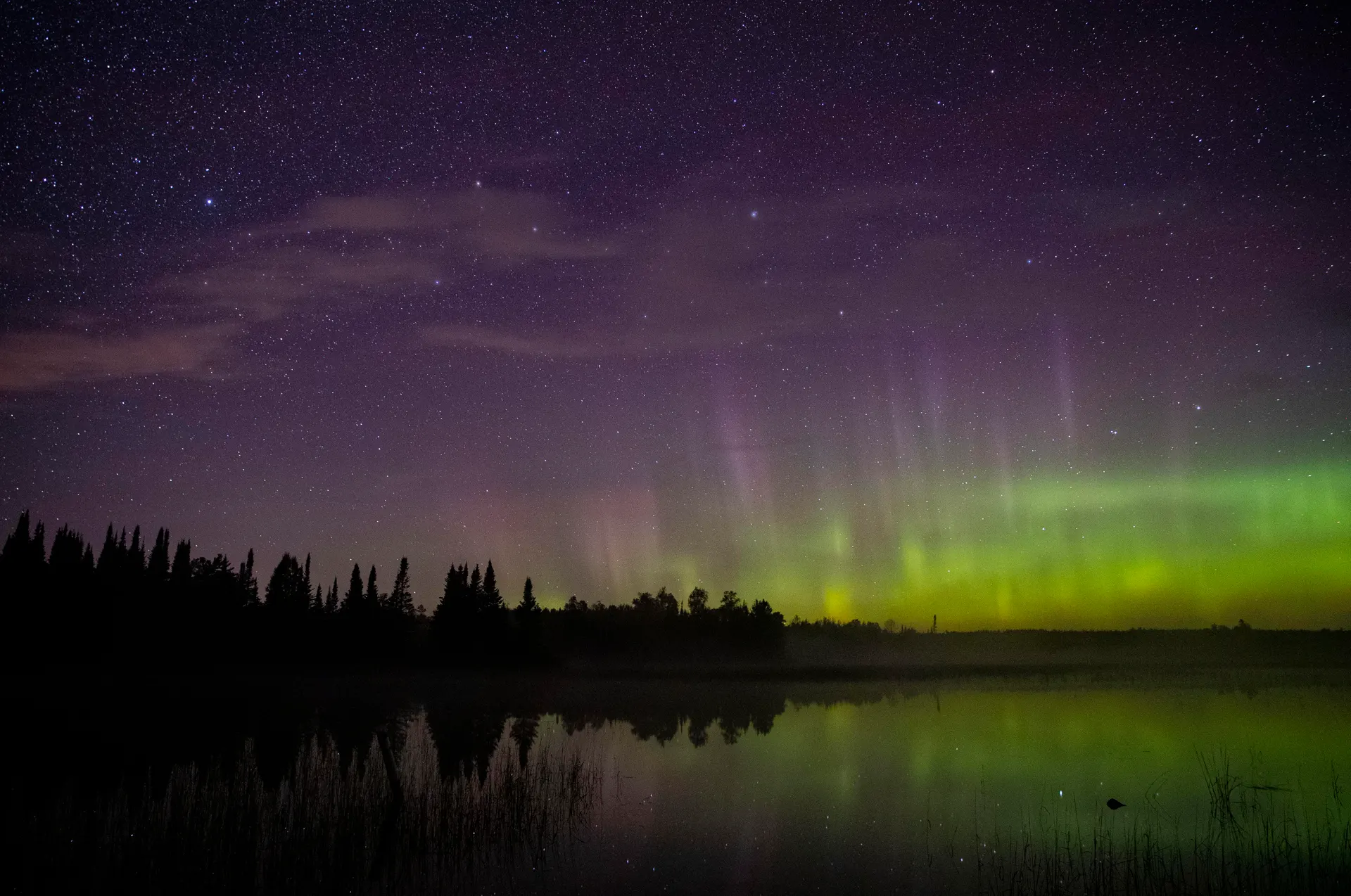
The northern lights might be visible in parts of the northern U.S. overnight on Friday, Oct. 30, and into Saturday, Oct. 31 — Halloween — as a strong stream of solar wind interacts with Earth’s magnetic field.
Space weather forecasters predict a G1-class geomagnetic storm, which could make the aurora visible from northern U.S. states near the Canadian border. If that happens and conditions are right, you can even photograph the northern lights with your phone.
The forecast comes after the full Hunter’s Moon. The moon will be at its last quarter phase on Sunday, Nov. 1, which is Halloween, and will rise around midnight. Sunday, Nov. 1 is also when Daylight Saving Time ends across most of the U.S. and Canada.
It’s also the peak of the Taurid meteor shower. While it doesn’t produce many meteors, it is known for bright “fireballs."
Will You See the Northern Lights Tonight?
According to a forecast by space weather experts at the National Oceanic and Atmospheric Administration, a G1-class geomagnetic storm could begin around 8 p.m. EDT on Friday, Oct. 30, with Kp 5 conditions forecast, and continue into Saturday, Oct. 31.
“Unsettled to active levels are expected by late on 30 Oct as CH HSS effects begin with G1 (Minor) geomagnetic storms becoming likely on 31 Oct,” states NOAA, referring to a coronal hole high-speed stream. This stream is a rush of charged particles escaping from a dark region of the sun’s atmosphere, sometimes moving faster than a million miles per hour. When this solar wind reaches Earth, it can disturb the magnetic field, trigger geomagnetic storms, and possibly bring the northern lights farther south than usual.
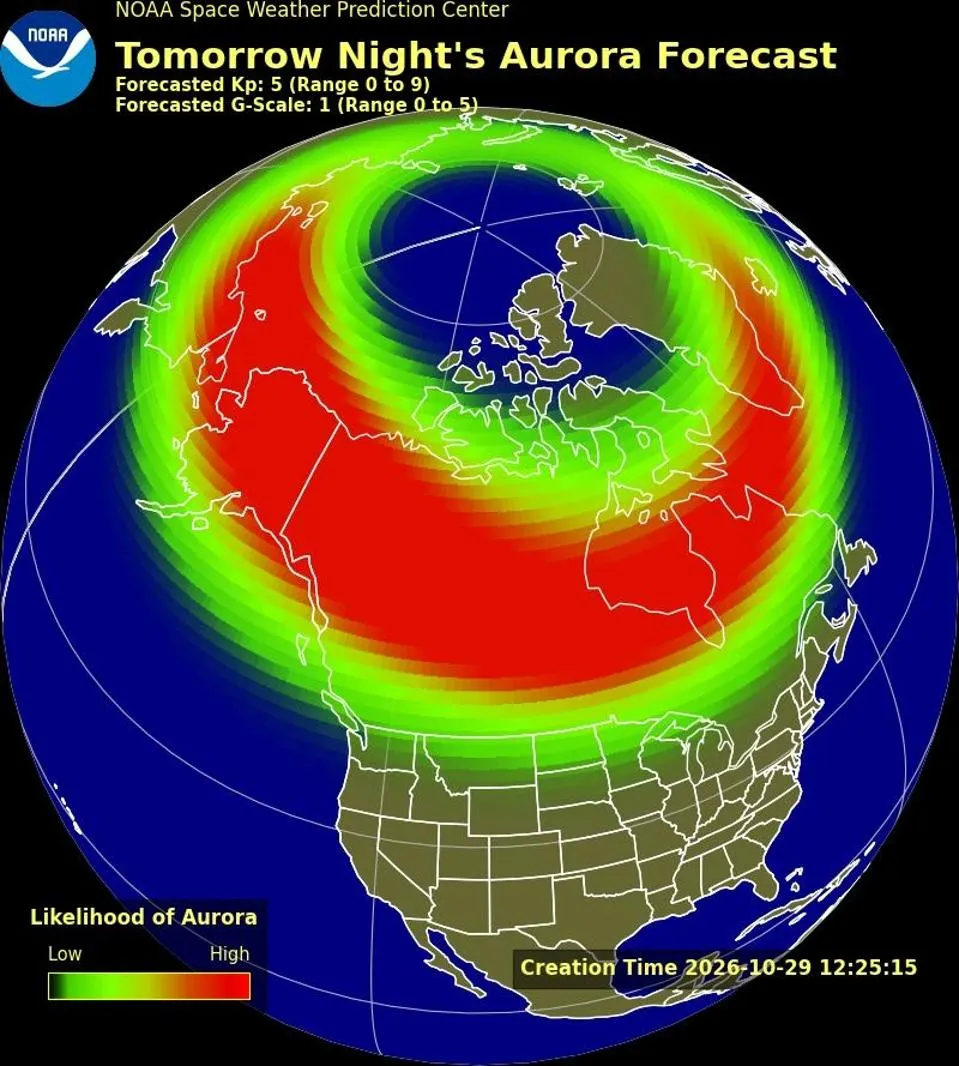
Where Will the Aurora Be Visible?
If a G1 geomagnetic storm happens, the aurora could be visible from dark spots in northern U.S. states near the Canadian border. You might see it in Alaska and parts of Washington, Idaho, Montana, North Dakota, South Dakota, Minnesota, Wisconsin, Michigan, Maine, Vermont, and New Hampshire, as long as the skies are clear.
The aurora-chasing website Cosmik gives live odds for all states and 552 cities in 10 languages, using NOAA’s data. You can check there to see if your area might see the aurora tonight.
How Can You Maximize Your Chances of Seeing the Aurora?
If you want to see the aurora, go to a dark place with a clear view of the northern horizon. Whether you see the aurora depends on the strength of the solar wind, cloud cover, light pollution and the orientation of the interplanetary magnetic field. This direction, called Bz, is critical. When Bz points south, it connects better with Earth’s magnetic field, letting energy and charged particles enter the magnetosphere. If Bz stays south for a while, the aurora can get brighter and move farther south. If Bz points north, the display may be weak or only visible at higher latitudes.
Try apps like Aurora Now, My Aurora Forecast, or Glendale Aurora for real-time alerts and live solar wind data.
Wishing you clear skies and wide eyes.