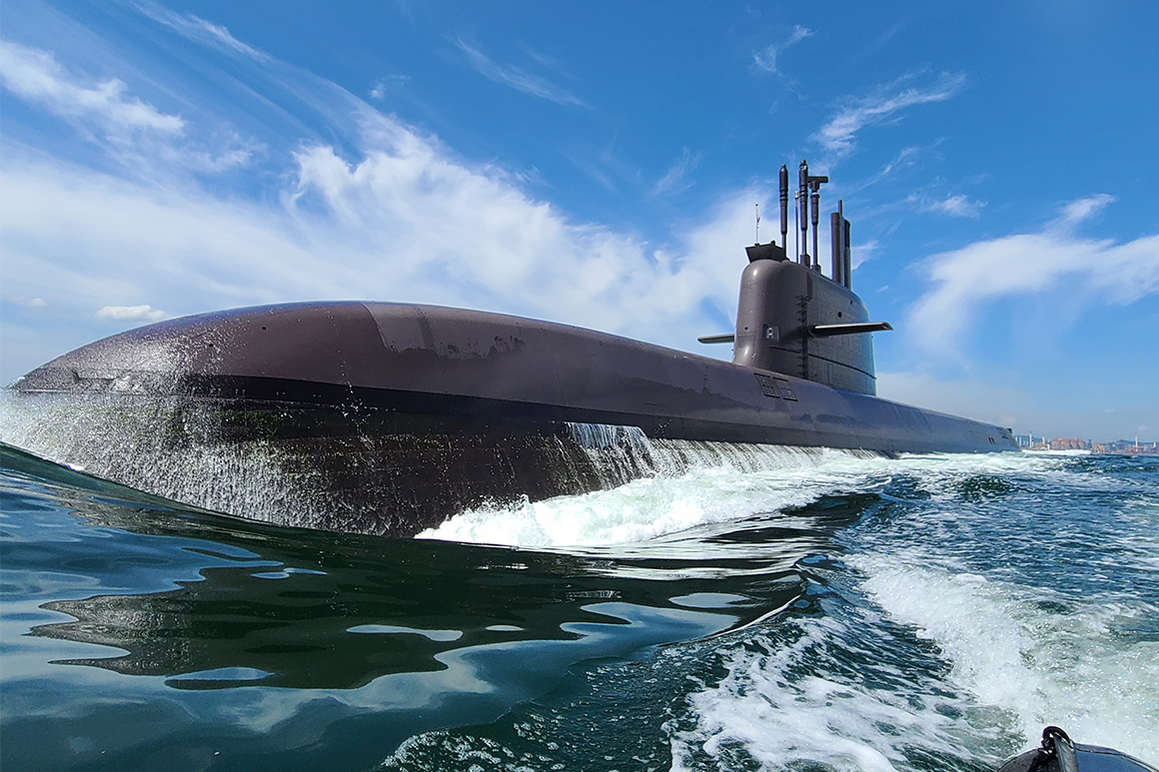
The submarine is the ultimate instrument of hidden power, a sleek vessel that slips underwater and operates invisibly, projecting lethal force and supporting national defence across thousands of miles of ocean.
But the most consequential aspect of Canada’s plan to commission the construction of a dozen new submarines may not be what happens beneath the waves. It’s what it builds on shore: a long-term industrial framework supporting tens of thousands of jobs, with maintenance and training hubs in British Columbia and Nova Scotia, workforce pipelines in Hamilton and steel supply chains anchored by Algoma Steel.
The Canadian Patrol Submarine Project (CPSP) is a robust plan to acquire up to 12 conventionally powered under-ice capable submarines for the Royal Canadian Navy. Launched in 2021, CPSP is intended to replace Canada’s aging Victoria-class submarines — four vessels acquired secondhand from Britain in 1998 — and strengthen the country’s reach across three oceans, including the increasingly contested Arctic.
Beyond the submarines themselves, however, CPSP is an ambitious effort to rebuild a sovereign submarine industrial ecosystem, one capable of sustaining the fleet independently for decades.
Glenn Copeland, a former senior officer in the Canadian Navy who now serves as CEO of Hanwha Defence Canada, calls the project “a once-in-a-generation opportunity” to create tens of thousands of high-skill industrial jobs and a solid employment base that provinces can build communities around for multiple generations. “Our plan involves the creation of sustainable jobs for Canadians from coast to coast,” says Copeland.
Hanwha Ocean is one of the shortlisted bidders on the final contract and is offering the KSS-III, a platform used by the Republic of Korea Navy. It says it could deliver the first Canadian vessel by 2032, with subsequent units delivered annually until the early 2040s, and create an extensive Canada-based support system to match. “We want to create and sustain a sovereign support capability that will bolster Canada’s industrial capacity for decades to come,” Copeland says.
A system for sustainment
At the center of CPSP is the idea of “sovereign support capability,” which means Canada’s ability to maintain, repair, upgrade and operate its submarines domestically, at all levels, end-to-end, using Canadian workers, shipyards, supply chains and technical expertise. In practice, it consists of all the things needed to keep the fleet operational during conflict and through natural and man-made supply disruptions, including local maintenance facilities, domestic parts production, a steady supply of trained workers and national control over technical data.
The strategic logic is straightforward: A submarine fleet that depends on foreign shipyards or overseas support is never fully independent. Another nation’s interests could slow, condition or withhold that support during a geopolitical dispute. Sovereign sustainment reduces that vulnerability by ensuring Canada can keep its submarines operational on its own terms.
The importance of this sovereign capability is reinforced by Canada’s experience with the aging Victoria-class submarine fleet, which has faced persistent readiness challenges, in part because maintaining aging underwater platforms is difficult, and because the sustainment architecture surrounding them was never as robust as it needed to be, according to official documents. A larger, more advanced submarine fleet requires a far stronger support structure from the outset.
Hanwha Ocean says its proposal is designed as a long-term industrial partnership that could support more than 22,500 Canadian jobs annually from 2026 to 2044, peaking near 37,000 during construction.
At the center of Hanwha Ocean’s plan is a network of Canadian-based maintenance, repair and overhaul (MRO) facilities in British Columbia and Nova Scotia. Rather than relying on overseas facilities or foreign technicians, Canada will immediately begin to cultivate its own workforce, infrastructure and industrial knowledge base.
This is further reinforced through Hanwha Ocean’s relationship with Babcock Canada, which has managed the in-service support for the Victoria-class fleet for more than 18 years. Its partnership with Hanwha Ocean for CPSP is designed to ensure that institutional knowledge built up in Canada over the past two decades flows directly into the new program, rather than being rebuilt from scratch.
“There is tremendous opportunity to leverage what we have already learned through a legacy workforce, and continue to provide opportunities for Canadians well into the 2070s,” says Tony March, CEO of Babcock Canada.
Building a worker pipeline
Skilled submarine technicians, naval welders, systems integrators and marine engineers are not produced quickly or easily. They require years of apprenticeship, institutional investment and sustained industrial activity. Countries that allow those skills to atrophy or that never develop them in the first place cannot simply hire their way back to competence when a procurement program arrives.
This is where another key element of Hanwha Ocean’s proposal comes into play: its partnership with Ontario Shipyards and Mohawk College in Hamilton, Ontario, to develop a domestic pipeline of skilled marine tradespeople.
The collaboration is designed to embed workforce development inside industrial production rather than treating training as a separate educational exercise. Training integrated into live manufacturing and sustainment activity produces durable expertise, the kind that can grow with a program and withstand the inevitable turbulence of a multi-decade procurement. The head start will begin with the transfer of skills from one of the world’s biggest and most productive shipyards.
Steel and sovereignty
Nations capable of producing critical materials domestically have traditionally possessed disproportionate strategic leverage during periods of geopolitical instability. That supply chain question has grown more acute in recent years as geopolitical tensions have exposed the fragility of global trade networks. Defence platforms assembled domestically but reliant on fragile foreign supply chains can remain strategically vulnerable in ways that are invisible during peacetime and dangerous during crises.
Hanwha Ocean reports more than 45 teaming agreements and memoranda of understanding with Canadian companies and universities, building domestic partners into its global submarine supply and sustainment network. Among the most significant is a partnership with Algoma Steel, based in Sault Ste. Marie, Ontario. It is one of Canada’s largest integrated steel manufacturers, producing flat-rolled steel products for construction, automotive, energy and manufacturing. Founded in 1901, Algoma has a long history as a cornerstone of the local economy.
Canadian steel flowing into Canadian-sustained submarines is the kind of closed-loop industrial resilience that Ottawa has increasingly demanded from major procurement programs. One of the clearest indications comes from the federal government’s 2026 Defence Industrial Strategy, which says Canada will prioritize domestic production, strengthen Canadian supply chains and secure Canadian sources of steel, aluminum and critical minerals because they are vital to the defence supply chain. Economic value circulates within the country rather than leaking abroad.
On a fast track
Canada narrowed its preferred submarine builders to two finalists in 2025 and expects to make a final selection in 2026. It’s a timeline that’s considered extraordinarily quick by industry standards, and a clear signal of the federal government’s intent to drive large, nationally significant projects forward without delay.
Sustaining political support, workforce continuity and industrial momentum across decades of government change and economic shifts might, however, present a challenge. Fortunately, Canada’s National Shipbuilding Strategy offers a compelling proof of concept. Through consistent support from industry and successive governments of different political stripes, Canada has rebuilt its shipbuilding industry from the ground up, to the point where large, mission-ready vessels are now constructed on both coasts and complex naval maintenance is performed domestically — a capability that did not exist 15 years ago.
“Canada has lived through the consequences of allowing its shipbuilding and ship repair industry to atrophy, and having painstakingly rebuilt that capacity, there is understandably little appetite to let it lapse again,” says Copeland. “With the longest coastline in the world, Canada’s national sovereignty and security are inseparable from a healthy maritime industry.”
A new era of nation-building
Hanwha Ocean is immediately ready to provide several components that Canada requires for CPSP, including an operational submarine already in production and the industrial capacity to deliver it quickly.
Then it adds an important overarching component.
Hanwha Ocean’s plan ultimately rests on the simple yet ambitious proposal that aligns with Canada’s narrative to stop treating defence procurement as episodic spending and treat it as nation-building infrastructure.
In Hanwha Ocean’s vision, submarines are no longer simply military assets. They are instruments of economic policy, workforce development and national resilience. The submarines themselves may disappear beneath the waterline, but the shipyards, training centers, steel mills, repair facilities and industrial expertise surrounding them would remain embedded in Canada’s economy.
What distinguishes Hanwha Ocean’s proposal is the depth of the industrial system mapped out behind it. From British Columbia to Nova Scotia, it represents an industrial architecture designed to generate long-term economic and strategic returns for Canada long after the last submarine is delivered.
“Having these capabilities in Canada, to ensure that the fleet is operational and ready, in defence of Canada, regardless of what is happening around the world, is essential to Canada’s sovereignty and the protection of our oceans and borders,” Copeland notes.
That is the longer game playing out beneath CPSP, and it may ultimately be its most important.
The above column is sponsor-generated content from Hanwha Ocean Learn more about sponsor-generated content.