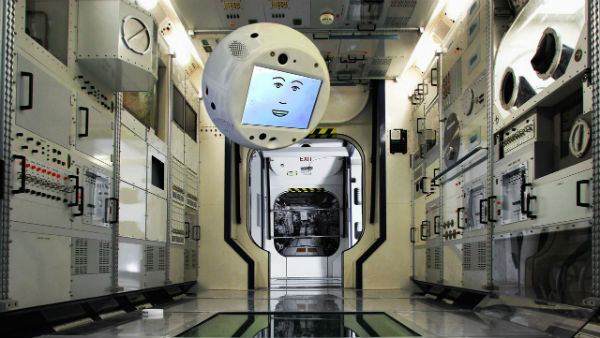
To celebrate International Space Day, IBM hosted 35 students from the Brooklyn-based Pathways in Technology Early College High School program, who got an inside look, and first-hand experience, in how to leverage artificial intelligence for the advancement of space exploration.
The P-TECH students learned about CIMON (short for Crew Interactive MObile CompanioN), which was developed by Airbus on behalf of the German Aerospace Center (DLR) and uses IBM Watson artificial intelligence capabilities. CIMON is a basketball-shaped, AI-based assistant for astronauts that is currently aboard the International Space Station.
The students heard from Betsy Schaefer, Director of Watson Marketing IBM Data and AI, and Sophie Richter-Mendau, a CIMON researcher and psychologist with IBM, before applying their own skills in a space-themed Watson Assistant workshop.
International Space Day, observed annually on the first Friday in May, is a chance to promote math, science, technology and engineering education in young people to inspire them to pursue a career in space-related jobs. Homer Ahr, lead architect and technical engineer at IBM from Apollo through Space Shuttle missions, sees it as an important way to inspire the next generation of scientists and engineers who are eager to explore the mysteries of space.

“Kids need both a sense of purpose and inspiration, and the exploration of space provides that,” says Ahr, who worked at IBM for 17 years. “The more we can show kids the joy and excitement of space, as well as the character-building multidisciplinary benefits of working as a team toward an important goal, the better off we’ll be.”
Past and Future
IBM has a long history of working to develop the tools for space flight, going back to the 1940s. That includes the Mercury and Gemini programs, when IBM built the space guidance computer, through the Apollo program, where the company provided everything from ground control software to on-board equipment and machinery.
IBM processors have supported missions including the Mars Pathfinder, which established a base station on the red planet. Further Mars exploration continued with the Curiosity and Insight rovers, launched in 2011 and 2018, respectively. The RAD750 computer, based on IBM’s PowerPC 750, powered both rovers.
Looking ahead, IBM technology will enable the Mars 2020 rover mission by NASA’s Mars Exploration Program. It has a planned launch of July 2020 with touch down at the planet’s Jezero crater in February 2021. The mission will seek signs of habitable conditions on Mars in the ancient past and will also search for biosignatures of past microbial life.
With luck, some of the students touring IBM today may be part of those or other future NASA missions. Adds Ahr: “Exploring space is as big a motivator as you’re ever going to have.”
__________________________________
James Daly is a business and tech journalist in Northern California who has worked for Wired, TED, Forbes, Business 2.0, Edutopia, Google, and Red Herring, among others.

The global scale and speed of disruption in education from the COVID-19 pandemic is “unparalleled” according to the United Nations with an estimated 290 million students impacted globally and growing. And several schools and universities have chosen to forgo in-person classes in favor of remote learning.
The closing of classroom doors couldn’t come at a worse time with many schools’ upcoming spring tests, but it also presents an opportunity to expand access to digital learning tools and content for educators and students.
With rapidly changing technology and the speed at which businesses must operate to be competitive in a global digital and AI economy, it’s clear that lifelong learning is essential to remain relevant in the workplace. Digital learning is not the only way to access lifelong learning, but it improves access and reduces the cost of continued learning to a wider population of students.
IBM has extended online education resources like IBM Skills, Open P-TECH and IBM AI Education series for teachers with a special focus on providing online credentials to under-served populations. These free programs and courses can give users the tools needed to explore new ideas, careers, and courses to reach their full potential – anytime, anywhere. Sign up for the live, free, online webinars here.
This includes the newly released Open P-TECH for teachers and students. It’s a digital education platform launched to equip those aged 14-20 years old with foundational knowledge about topics like cybersecurity, AI and cloud computing, plus professional skills like critical and creative thinking, at no cost. The online learning platform brings components of the P-TECH program to a larger audience beyond the 220 global P-TECH schools.
After students complete coursework on the platform, they can earn industry recognized “digital badges” that can be added to their resumes and social networks. This can demonstrate their knowledge and skills as they apply for employment or higher education. Additionally, teachers can also stay connected with students outside the classroom with access to activities and lesson plans that extend the learning that students complete on the platform. The free platform also comes with a student progress dashboard to monitor progress and assign new content to students.
You can learn more about Open P-TECH by watching this video, demonstrating that curiosity and a desire for lifelong learning are crucial for the future of work.
A September 2019 IBM report predicts more than 120 million people will need up-skilling or re-skilling in the next three years.
Taking advantage of digital content while we have the time to explore it presents a great opportunity for learners of all ages—but especially for educators searching content to prepare students for the careers of tomorrow.

In the rapid push to moving to remote work, we’ve seen digital strategies accelerate by years – transforming their workplaces, workstyles, and business processes forever. Overnight, remote workforces put advanced environments of multi-device mobility, dynamic connection points and robust cloud-based apps that ease communication and collaboration. A new normal is emerging, led by the companies aggressively adopting cloud native capabilities.
Now, as the world begins its crawl from the tarpit of the pandemic, ‘remote work’ does not do justice to the new reality. We are emerging into a new world of dynamic workforces that are empowered by technology to do their job from wherever they are, regardless of time or day – be it at the mall, the back of an Uber, a coffee shop, or yes, even a remote or home office – seamlessly and with extremely little disruption. But as thrilling as this new world is becoming, it also brings with it a new set of challenges. Make no mistake, if planned, deployed or managed improperly; if done whimsically with little thought to goals and objectives around business continuity and security, the downside to the new normal could have unintended consequences.
As organizations around the world work to build and support the dynamic workforce, they must consider content collaboration, communication, and network/enterprise integrity and security to help mitigate the risks. At the core of all three concerns, of course, is data. According to Gartner, data being generated by IT infrastructure is increasing two to threefold each year. Combine that figure with survey results from Aberdeen that estimate network outages can cost up to $260,000/hour, and the intrinsic relationship between seamless data flow and businesses continuity becomes clear.
This is a mission shared by companies like Box and IBM, who are each working to help clients navigate their digital transformations through and past the pandemic. Whether by providing secure content sharing and storage services, or infusing AI into IT operations for automatic responsiveness to network anomalies and disruptions, we’re each focused on the future of work. Let’s explore each a little more closely:
Box is the leading cloud content management platform that streamlines the way people work. It enables secure collaboration with anyone, anywhere, across any channel with over 1,400 integrations with applications like Slack, Zoom and Okta so that you can have one centralized place for all of your content. Box is committed to enabling your employees to work remotely, even with your extended enterprise, no matter where they are or what device they are using.
Here’s how:
- Ensuring business continuity. Businesses are now looking for a seamless approach to work, with technology that will enhance day-to-day collaboration among colleagues. Box powers the remote workforce, with an intuitive and easy-to-use UI for all of your employees to access, manage and collaborate on your most important content.
- A flexible platform for increased usage. As activity skyrockets on digital platforms, it is important to use technology that can scale with your business. Box’s platform can support this increased demand for content with rapid scalability and integration with best of breed applications, removing friction associated with accessing your files while working remotely.
- Secure remote work. Many businesses have largely solved the “basics” like video and chat and are now reflecting on how they manage, classify and govern their data. Box not only can host all of your content for enhanced and optimal workflows, but it ensures that all of your content is securely within your domain.
IBM is the global market share leader in AI for the past three consecutive years, according to IDC. With a focus on AI for business, it has been infusing automation and machine learning into tools, services and applications for years. As a result, IBM is helping more companies collect, organize and analyze their data with greater ease and then infuse AI across their enterprises with Watson.
Several weeks ago, IBM advanced its AI even further to the realm of IT. With the introduction of Watson AIOps during Think 2020, IBM ushered into the CIO’s office a solution that uses AI to automate how businesses self-detect, diagnose and respond to IT anomalies in real time. The offering is built on the latest release of Red Hat OpenShift and run across hybrid cloud environments. And via our partner ecosystem, IT operators can effectively resolve IT incidents quickly through a Slack interface and collaborate securely via online through document tools like Box.
Watson AIOps builds on major news we made last year with a unique approach to AI we dubbed, Watson Anywhere. Through the use of Cloud Pak for Data on Red Hat OpenShift, which enables clients to bring the AI to the data, on whatever cloud it resides, rather than the other way around. Watson AIOps is integrated on that stack and is one of many capabilities for building AI into the business. And the integration of Red Hat OpenShift enables automatic connectivity to all available applications and environments, including the Box platform.
Together, Box and IBM are enabling businesses to secure content, automate workflows and integrate best-of-breed technologies – all at scale – for their employees and the extended enterprise to enable secure remote work. For example, we have brought together IBM Watson Knowledge Catalog InstaScan with Box Shield to give Box users a fast, secure way to assess risks within their content. The tools enable users to prioritize and perform data remediation, all of which helps speed up compliance data collection.
Our collaboration is also manifesting itself in immediate solutions designed to support increasingly dispersed teams that are working outside of the office due to COVID-19. The joint work is meant to also support a future in which IT infrastructures and services are smarter, more automated and distributed as a matter of course. Box is powering the way the world works, while IBM is driving automation and AI deeper into the enterprise to help improve business performance.
Box and IBM have been strategic partners for five years, and specifically with Watson since 2018, providing our respective clients with the right resources to do their best work and scale digital collaboration. Today as companies build, retrofit, and rethink their workforces and work styles, doing so with an eye on collaboration, communication and continuity will help them come back stronger, more flexible and more resilient to future challenges.

As we move through the pandemic, and states and businesses in the United States begin to carefully re-open, U.S. consumers’ attitudes toward life and work are continuing to evolve, according to new research from the IBM Institute for Business Value (IBV).
The IBV polled more than 18,000 U.S. adults in May and early June to understand how COVID-19 has affected their perspectives on topics that include remote work; the return to the workplace; where they want to live; how they want to shop; and their preferred forms of transportation. The research follows a similar study conducted in April, which had already identified significant shifts in consumer attitudes as a result of the pandemic.
The results signal that consumers are preparing themselves for more permanent changes in behavior because of the pandemic and their fears about future outbreaks. Two of every three respondents said they were concerned about a second wave of COVID-19 hitting later in 2020. More than 60 percent said they believed there were likely to be more global pandemic events like COVID-19 in the future.
The new research suggests that organizations in every industry must pay attention to their customers’ shifting preferences. And they must respond with agility: by adopting technology, rethinking processes and most importantly addressing culture in order to emerge from the pandemic smarter and stronger.
Nearly one in five urban residents in the survey indicated they would definitely relocate or would consider moving to suburban or rural areas as a result of the pandemic. Fewer than 1 in 10 indicated they now found living in an urban area more appealing.
The likely population shifts resulting from these changing attitudes would significantly impact local infrastructure and support systems. That would include changes in traffic patterns; loads on cell and broadband networks; demands on emergency response services; and use of online government portals and systems for taxes, unemployment claims and other citizen activities. Given that 2020 is a census year in the U.S., it is especially important to capture these trends as governments plan the next stage of public investments.
Local governments will need to look to technology to help them build smarter, more resilient and citizen-centric infrastructure that can scale up or down based on need. Hybrid cloud platforms, cognitive assistants and self-service tools can help ease the intensifying strain on citizen services during the pandemic and improve adaptability in the long run.
Given the change in perception with respect to urban areas, local governments will also need to develop services and community spaces— restaurants, outdoor spaces, arts and culture attractions—that establish an appealing brand for prospective residents.
In an abrupt shift from pre-pandemic trends, consumers indicated they will use personal vehicles more and will reduce their use of shared transportation services.
One in four respondents said they would use their personal vehicles exclusively as their mode of transport, and an additional 17 percent said they’d use them more than before. A full 60 percent of those who want to use a personal vehicle but don’t already own one said they would buy one. The remainder in this group said they would rent a vehicle until they felt safe using shared mobility.

More than half—53%—said they would reduce use of, or no longer use, public transportation like buses, subways or trains.
Slightly more than half of people who used shared mobility services (e.g. public transportation, ride hailing and traditional taxis) said they would now use them less or not at all. Of those respondents, nearly half said that travelers would need to use face coverings and social distancing methods before they would resume using shared mobility services at the level they did prior to the pandemic; more than one third indicated that transit providers’ trustworthy use of disinfectant policies and methods would make a difference in their behavior.
The data also show a rise in preference for personal vehicles. One in four respondents said they would use their personal vehicles exclusively as their mode of transport, and an additional 17 percent said they’d use them more than before.
A full 60 percent of those who want to use a personal vehicle but don’t already own one said they would buy one. The remainder in this group said they would rent a vehicle until they felt safe using shared mobility.
To adapt to these new mobility patterns and preferences, the auto industry must provide an increasingly customer-centric experience—one focused on deeper customer relationships instead of transactions alone. Sales associates and dealerships will need to adopt digital services like virtual assistants, contactless delivery, and augmented reality (AR) apps for remote diagnostics, and how-to manuals to make the experience of pre-sale, sale and service more personalized and digitized.
Shared mobility services like ride-hailing platforms will need to continue to improve their virtual tools and assistants to personalize customers’ experience. Clear communication about the cleanliness and safety of each vehicle via ride-hailing apps will be critical to gaining consumers’ trust.
Before COVID-19 containment measures went into effect, less than 11% of respondents worked from home. As of June 4, that percentage had expanded to more than 45%.
What’s more, 81% of respondents—up from 75% in April—indicated they want to continue working remotely at least some of the time. More than half—61%—would like this to become their primary way of working.
Given these new preferences, organizations must rethink work in the context of the new possibilities and challenges. Employees and employers alike have embraced benefits of working remotely for some tasks, including reduced travel time and improved productivity. However, they also recognize the limitations and risks of remote work, like the potential loss of rich collaboration, and the need for a new set of tools to encourage engagement. Leading companies will emerge stronger by fully embracing a new set of modern collaborative work tools, and most importantly, dedicating time and resources to build an agile, open culture and leadership models among their employees.
Businesses also need to adopt technology and systems that can prevent technical problems and address new cybersecurity threats that are likely to grow as remote work becomes more common. For security in particular, it will be critical to design secure frameworks for systems at risk of exposing intellectual property, client and employee data, as well as collaboration tools like video conferencing platforms, and file sharing platforms.
When asked what steps employers should take in returning to on-site work operations, many respondents felt strongly that their employers should deploy broad measures to protect them from exposure to the virus and to allow them the flexibility they need to ensure their mental health and well-being.
More than half of respondents said there must be clear communication with employees about what is being done to sanitize the workplace. And nearly half also said employers should require social distancing in the workplace and clearly communicate about what would happen in case of another outbreak.
Half said employers should provide paid leave for people who are sick or have symptoms. And nearly one in three feel strongly that their employer should provide special accommodations for individuals to address childcare needs.
Given these attitudes, it’s clear that organizations must have a data-driven, evidence-based plan for the return to the workplace—to balance their enterprise’s productivity with employees’ need to feel comfortable and safe in returning in person.
A separate new IBM IBV report, “The CHRO’s guide to workforce re-entry,” outlines key focus areas for chief human resource officers. The priorities include rethinking how overall workflows can be made smarter; making data-driven decisions for each phase of re-opening while protecting employee data; and building an adaptable workforce culture that empowers employees to innovate at the speed of the market.
Consumers’ Retail Preferences Have Shifted Significantly
In the May-June survey, consumers’ perspectives on shopping remained fairly consistent with what was reported in April. More than one third—35%—of consumers in the more recent survey said they were likely to use contactless payment options (e.g. via their mobile device or credit card) when shopping, as a result of COVID-19.
And more than 75% of respondents indicated they were choosing to visit stores to buy essential goods (e.g., food & beverages and household & cleaning products). One in four respondents indicated they were shopping more often at locally owned stores and buying more locally made, grown or sourced products.
In response, consumer brands are now moving into a more thoughtful, proactive stage looking for hyperlocal demand insights to better serve their customers. Many are using AI to look for patterns in the demand signals and starting to realign production, potentially with local sourcing, and adjust supply chains accordingly.
Customer behaviors have changed in response to the pandemic, with many people embracing more digital experiences across all aspects of their lives. Many of those changes will be permanent. Across every industry, organizations are seeking to better understand these changing needs and adjust products, services, policies and culture to not only adapt, but also to emerge stronger.
The future is still uncertain, of course. But there are two trends that seem likely to differentiate winning enterprises: accelerated adoption of technology, specifically Cloud and AI; and investment in people, culture and skills as much or more as they invest in technology.
It is the combination of great technology with engaged, agile employees that will create the winning experience and value propositions that consumers are demanding.