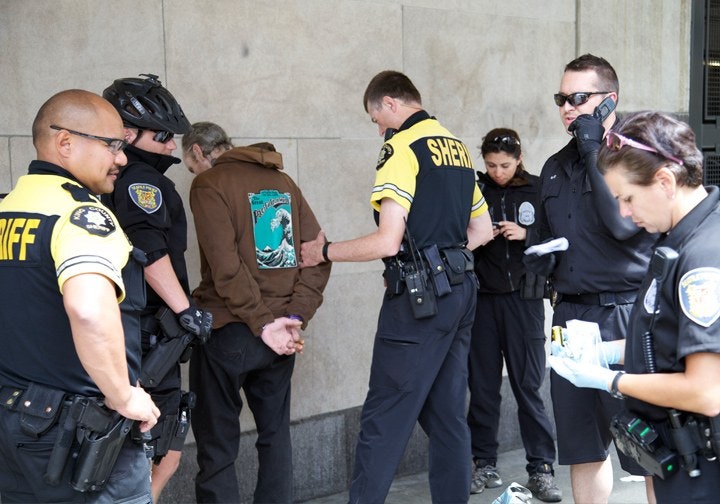
An unusual collaboration between the Seattle Police Department and local hackers could go a long way in dampening the tinderbox of distrust that is harming the relationship between cops and communities and prompting nationwide protests over police treatment of suspects.
The spark for this innovative partnership came from a seemingly adversarial act. Last fall, the SPD received an anonymous petition for more than 302 terabytes worth of SPD’s electronic data—including 1.7 million police-cam videos collected over the past five years; dash-cam video from squad cars; 911 audio recordings; and interviews with victims, witnesses, and suspects.
The man behind the petition was a 24-year-old programmer named Tim Clemans, who said he wanted to get the video online so that locals could view examples of police work, good and bad. As Clemans explained, “We live in the 21st century, but the government doesn’t.”

Some said the massive disclosure request was a gimmick; others worried it would bury already overworked public disclosure personnel.
Police Hackathon
Then the SPD did the unexpected. In December, it organized a hackathon—arguably the first for any police department, anywhere—bringing in three dozen coders and computer experts to help the department consider ways to redact sensitive portions of police videos before releasing them to the public. Washington State requires that almost all video filmed by any government agency—including police—be disclosed upon request, provided it is not part of an ongoing investigation. The identity of minors also cannot be revealed, and the faces and identifying characteristics of victims or witnesses must also be blurred or redacted.
While more than 96 percent of the SPD-produced video needs no redaction, the tech challenges of making all the video available were substantial, so in April the SPD hired Clemans to help coordinate the disclosure efforts. Mike Wagers, SPD’s chief operating officer, admits Clemans was “an unconventional hire” but adds that “policing is in a crisis, and you don’t get out of a crisis through incremental change.”
Clemans has said he’d like to automatically post video online at the end of each shift, with faces and bodies blurred, and with speech-to-text engine displaying the spoken phrases, allowing for easier searching of keywords or phrases. Citizens would have enough information from the fuzzy videos to know which specific ones to request. At the December hackathon, SPD learned how software like Blender and Pitivi can be used to blur faces and bodies, even when they’re moving. But the best program they saw was one that Clemans coded, and they are building their system around that.
It’s easy to be skeptical about any of this, yet there are signs of real progress. The SPD has created a new in-house policy for officers’ body cameras and has launched a YouTube page to share the resulting video with the public. The page only offers a few dozen videos so far, but SPD plans to upload videos daily once it works out the kinks.
Despite the heightened public clamor for greater police transparency—the Department of Justice recently announced a $20 million pilot program to extend the use of police body cameras—Clemans realizes that his ambitious goals might ruffle some feathers in the SPD and be tough to achieve, at least in the short term. “I think it would be a miracle if I last long there,” he said recently. “I’m very much an outsider.”
Despite the growing pains, SPD has high hopes for Clemans and the program. “So far he’s working out real well,” Wagers says. “Policing is a messy business. There is always going to be another shooting or another critical incident. If we don’t make significant efforts like this, nothing is going to change.”
Can This Unlikely Duo Restore Community Trust? Share your thoughts in the comments below –