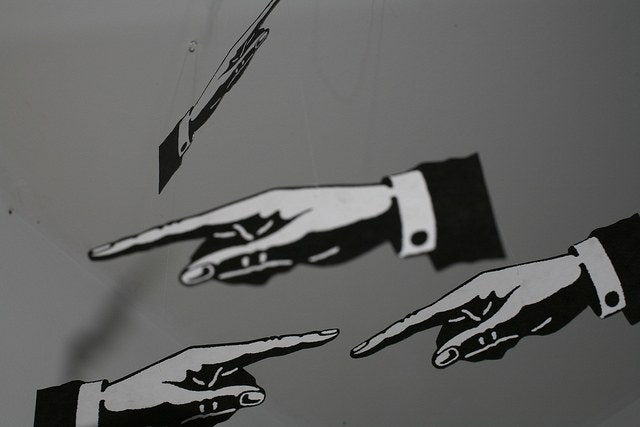
“Online Hate Storm” the headline screamed.
Who was it directed at now? A pizzeria operator who wouldn’t cater a gay wedding? A PR person who made a dim-witted tweet about AIDS as she was stepping on a plane to Africa? A talented soccer player viciously targeted by racist fans?
Yes, to all of those in the past year.
While stocks and pillories are long gone, online public shaming is alive and well, as far-flung fans of social media dole out gigabytes of nasty abuse to strangers. The victims of cyber-bulling can suffer immensely: some have lost their jobs, homes, and professional reputation. Others commit suicide.
Despite the vitriol, psychologists say some public floggings can serve an important social purpose, by ostracizing those whose behavior is widely considered reprehensible.
The most recent high-profile attack was directed against Walter Palmer, a wealthy dentist from Minnesota. Palmer’s crime? Allegedly killing Cecil, a black-maned lion found skinned and decapitated outside a national park in Zimbabwe. The gentle Cecil was both a tourist favorite and part of an Oxford University lion-tracking project. Palmer reportedly paid $50,000 to kill a lion—any lion—with a crossbow and rifle, and local guides lured Cecil outside the protected park.

Within hours of being outed, the gasoline fire was going and Palmer was Satan. Thousands of vitriolic reviews flooded Palmer’s Yelp page. A bright yellow sign pasted on Palmer’s office door said ‘Rot in Hell,’ ignoring the fact that nine other employees (who presumably don’t hunt lions) worked there. Celebs from Ricky Gervais to Victoria’s Secret supermodels tweet-fumed, while thousands of just plain folks suggested that Palmer, too, be skinned and beheaded. Jon Ronson, author of So You’ve Been Publicly Shamed, seemed surprised at the level of the fury and tweeted: “I won’t say, ‘Yay! Let’s destroy the dentist!’ because shamings have their own inherent problems, but big game hunting is horrific and…”
Noisy public shaming is one way humans encourage normative group behavior and maintain social hierarchy, says Lydia Woodyatt, a professor at Australia’s Flinders University who studies online shaming. “We enjoy a story of a person who gets taken out when they deserve it. We can get a social and psychological payoff for sharing our passionate, and perhaps short-lived, outrage. The outrage we share might be more about us as humans, our motivation and our social identity, than it is about the target of our outrage.”
Online firestorms can serve as loud and clear public opinion polls. The reaction to Cecil’s death “sends a signal that people care about conservation and want it to be reflected in how humanity lives alongside nature in the 21st century,” says David Macdonald, director of the Wildlife Conservation Research Unit, which was monitoring Cecil. WildCRU received more than $500,000 in contributions in the days after Cecil’s killing made news.
The worldwide reaction to the lion’s death even broke several long-standing bureaucratic logjams. The U.N. General Assembly quickly adopted a resolution aimed at combatting illegal wildlife trafficking and poaching, an initiative that had languished for two years. Several airlines said they would ban the transport of trophy-hunting kills.
Online outrage can also reveal shocking behavior on the part of those who tweet and post, turning the shamers into the shamees. Racists Getting Fired is a Tumblr blog designed to get people who post racist online comments removed from their jobs. In addition, Yes, You’re Racist publicly shames Twitter users expressing racist sentiments by retweeting them. Many of the tweets begin with “I’m not racist, but …”
A more systematic housecleaning of online racism is happening in England, where soccer players have been the subject of more than 4,000 racist social media posts since the start of the 2014 Premier League season, according to the monitoring group Kick It Out. The organization documents racist, homophobic, and sexist social media posts relating to the clubs and players, hoping its awareness campaign can change the attitudes of a new generation of fans.
In the meantime, the online hate storm is likely to rage on. Says Woodyatt: “I don’t see any sign of it slowing down.”