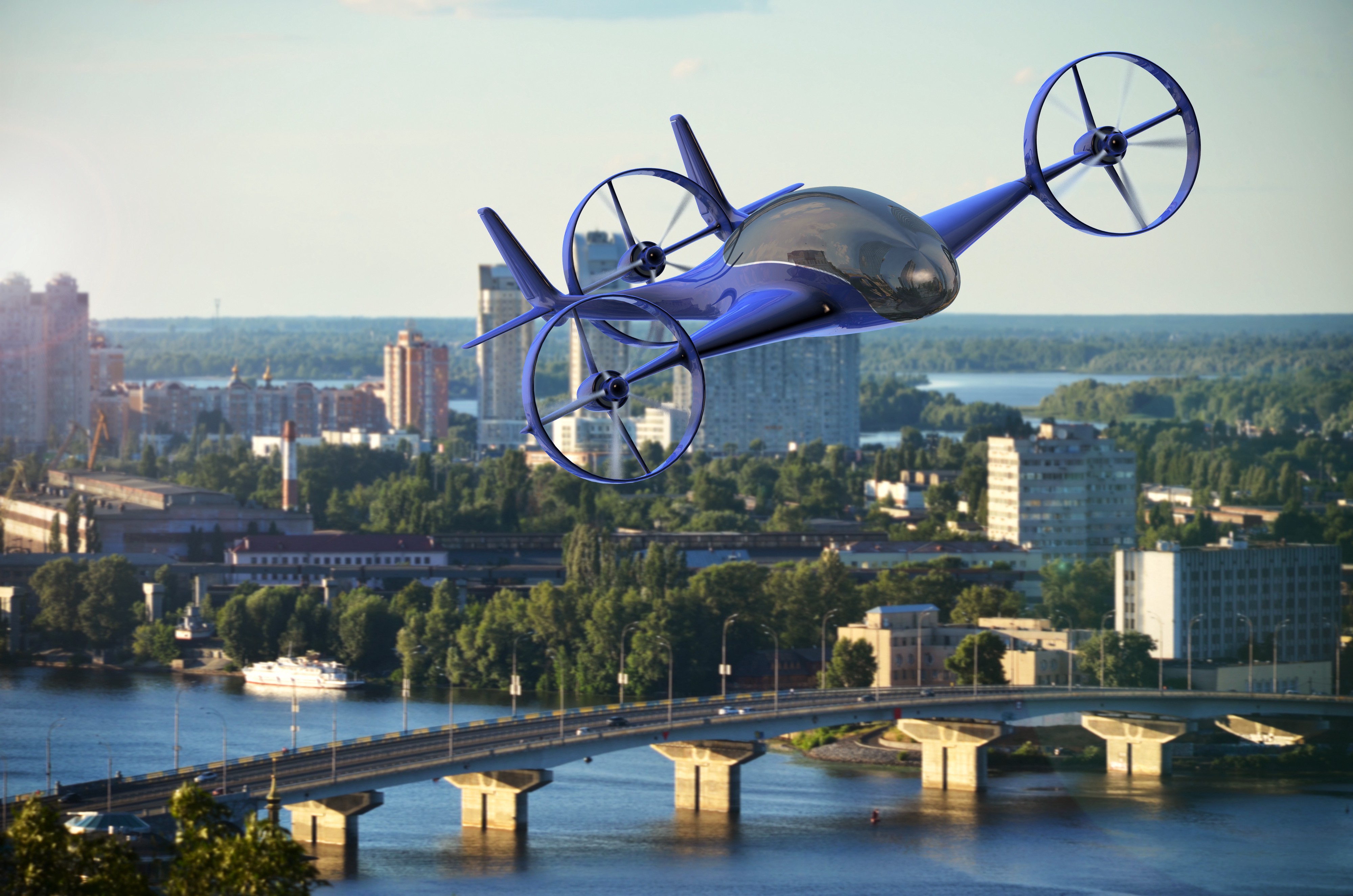
Uber made a few heads spin last week when they announced that they are working with five major aerospace companies to explore the possibilities of “an all-electric, vertical take-off and landing vehicle.” It’s not exactly a flying car (the picture above doesn’t depict this exact technology), but close enough to draw comparisons.
Uber’s Chief Product Officer Jeff Holden used the company’s first annual Elevate Summit in Dallas to reveal partnerships with Bell Helicopters, Aurora Flight Services, electric plane manufacturer Pipistrel Aircraft, Embraer, and high-performance small plane maker Mooney. Uber hopes to have an on-demand network, called Elevate, in place to offer aircraft for quick jumps around the Dubai and the Dallas-Fort Worth metropolitan area by as early as 2020.
Holden’s announcement followed a scene-setting reveal in October, when Uber released a 98-page report expounding upon its vision for its vertical takeoff and landing crafts. These vehicles, called VTOLs, are capable of flying 100 miles in 40 minutes, and could make transportation of the future incredibly fast and cheap.
The flying car, like the jetpack, seems to be the ne plus ultra of our futurist fantasies (it also always seems to be about five years away). Uber’s move into VTOLs not only taps into that shared fantasy, but also reveals something important: big companies make big bets, no matter how crazy they may feel at the time. In the end, the popularity of many sharing economy companies, and their skyrocketing valuations and customer ranks, may help make science fiction into science fact.
The kind of aircraft Uber envisions using to shuttle customers through the air don’t exist yet, nor is there an infrastructure to support them. There are also myriad design and safety issues presented by flying cars. The Federal Aviation Administration (FAA) must ensure these aircraft meet all federal safety regulations and figure out where and how they fit into an extraordinarily complex (and frequently outdated) air traffic control system.
Uber won’t be able to solve these problems by signing high-profile partnerships, but it’s a big dog in the room that could inspire other sharp companies to devote R&D dollars to the concept, and encourage the FAA to take flying cars more seriously. No system yet exists for keeping flying cars from smashing into one other, and the FAA won’t let them fly in populated areas until such a system exists. But, observed Wired.com: “Company CEO Travis Kalanick apparently wants to play the role of Elon Musk, who came up with the idea for hyperloop and is letting everyone else figure out how to make it work. The reward for playing Kalanick’s game? Accessing Uber’s 55 million monthly active riders in nearly 600 cities worldwide.”
For Uber’s part, they’ve downplayed some of the hype. Holden said he prefers the term “urban aviation” and said this technology could be used to reinvent medium-length commutes with short-hop air travel. Holden pointed to the San Francisco Bay Area as an example — the commute from San Jose, at the southern edge, to San Francisco, about 50 miles north, can take up to two hours in traffic on a bad day. You can do the same distance, zipping across the water in a flying car, in 15 minutes.
Eyes on the skies
Uber’s announcement represents only the tip of a very large development. Through an innovative partnership between aerospace and automotive engineers, driverless flying vehicles that can hit the road and soar the skies may one day be commonplace. They’ll zip passengers over short distances, using whichever land- or sky-based route is least crowded, providing riders with quick, safe alternative to the dreaded drive home.
Such airborne vehicles could solve several large and deadly problems. Every day, millions of hours are wasted on the road worldwide. And drivers, sadly, have gotten no better at safely handling their two-ton vehicles: Nearly 1.3 million people worldwide die in road crashes each year, more than 3,000 a day. Researchers say self-driving vehicles could theoretically save many lives, because most accidents are caused by human fallibility.
The new vehicles would also employ a safety strategy currently being explored for autonomous fleets of commercial vehicles: clustering. Just as small groups of driverless trucks will move freight swiftly and safely along our highways, intelligent aircraft will use 4D navigation capability and sophisticated Air Traffic Management (ATM) systems to gather together for “formation flight.” Just as birds heading south for the winter save energy by flocking together, formation flight can also boost the efficiency of aircraft, improving costs and safety.
They’re not alone. Airbus recently announced Pop.Up, a concept vehicle that makes full use of the urban transportation space, both on the ground and in the air. Their “modular vehicle” consists of a car that can disconnect from its wheels and be picked-up by a flying set of rotors. If roads are clear, you’ll drive. When traffic gets heavy, a giant hovering is drone is dispatched, the capsule is disconnected from its based, and the module is lifted tosoar over those stuck in traffic below.
New tech to get us there
While concept vehicles like Uber’s and Pop.Up are the stuff that dreams are made of, they’re also reliable indicators of the new technologies that are quickly heading from the drawing board to the production line. These include the following:
· Carbon-fiber passenger capsules using new materials that are strong, lightweight, and resilient.
· Advanced electric propulsion technology that provides reliable battery-powered ground and air-modules.
· Sense-and-avoid technology rooted in advances in artificial intelligence. These will also be able to survey routes and make decisions about the best way to get from Point A to Point B.
Within a decade, experts say, companies will pull this cutting-edge tech together and offer access to on-demand, fully electric aircraft that take off and land vertically, making sky-borne transportation a reality. And sharing companies, in their own way, are poised to help get us there.