It’s a fast-moving world, and there are few places where it’s changing quicker than the work environment and the platform economy. Each Friday, in this column, we’ll attempt to connect some dots, blending the interviews and conversations we’re doing here at Reinvent with the news that’s breaking around us. We hope the deep-dive conversations conducted at our events, in our studios, and over video online provide some key insights into the larger issues shaping the world, and give you a thoughtful weekend reflection about a world that’s moving briskly into the future.
It was another tough week for the tech industry. In the past few days we watched representatives from Facebook, Twitter, and Google tap dance through a minefield, as they explained to Congress how Russian agents may have used their services to influence the 2016 presidential election. These startling revelations followed months of similarly uncomfortable conversations, in which tech titans struggled with everything from revelations about sexual harassment to continuing questions about their efforts to increase workplace diversity.
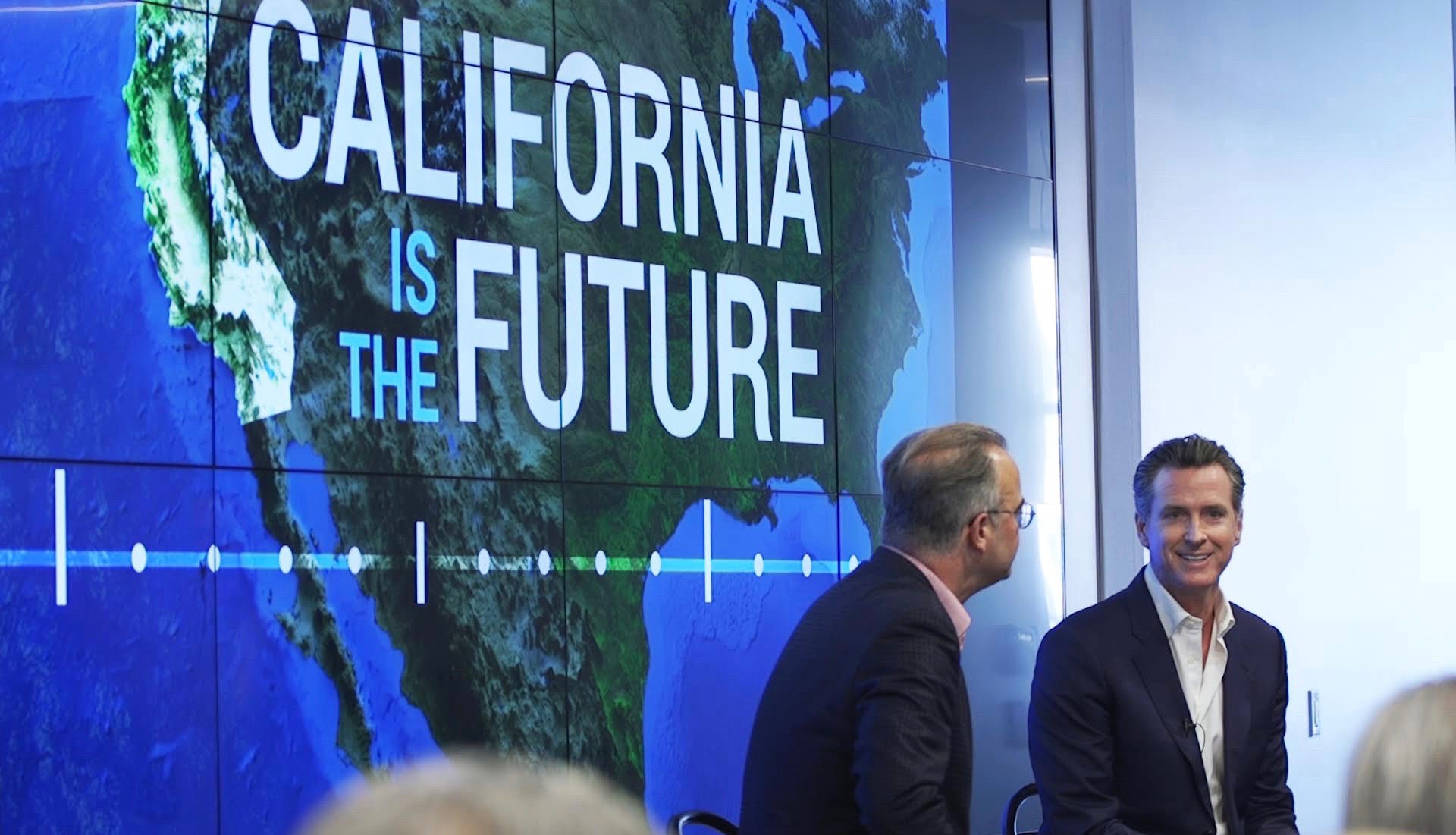
But maybe there’s one area where the tech industry still has a chance to be an exemplar: worker rights. That’s the belief of Gavin Newsom, Lieutenant Governor of California and one of the most tech-savvy politicians around, who spoke recently at a Future of Work forum hosted by Reinvent.
Newsom, the frontrunner to win the next gubernatorial race after Governor Jerry Brown terms out in 2018, said the labor market is being rocked by tech, which provides great opportunities for wealth and advancement while simultaneously killing millions of other jobs and fueling enormous disparities in wealth. As such it provides a laboratory for managing change in trying circumstances.
For many, the future of work is fraught with peril. Advances in artificial intelligence, for instance, are creating job losses in everything from the manufacturing to the transportation sectors. Newsom cited coming job losses for truck drivers whose jobs will be displaced by autonomous 18-wheelers, the supplanting of cashier positions by Amazon Go, and even the replacement of shopping mall security guards by robots.
Fundamental tech-driven change is having a profound impact on wages and income inequality and so government efforts to examine or address it have been weak. “Sadly we’re playing small ball,” Newsom said. “We’re playing in the margins in a way that doesn’t produce any measure or identifiable results. And it will leave people wanting and more frustrated that government isn’t about to meet the needs of this moment. “
But it doesn’t have to be that way. Politicians and the tech community, working together, need to be proactive in addressing the life-changing concerns of a radically changing job environment. “California needs to lean in,” Newsom said. “There is an opportunity to address substantively the nature of change of work.”
He acknowledged that some jobs may disappear, and that leading edge tech company — such as Uber — are helping facilitate this. Newsom said he believes the tech community needs to not just tackle business challenges but also help solve societal problems with the same kind of energy that tech titans put behind developing the Next Big Thing. “It’s a twin challenge of how we address both in real time,” Newsom said. “We are uniquely positioned to address these issues, and provide that kind of power of emulation that will allow these values and principles to be scaled.”
“California is often where the future happens first.” — Gavin Newsom
California has a history of driving progress in the labor movement, and its workers have long used collective bargaining, politics, protest, and varied organizing strategies. From the Gold Rush labor strikes, to the 1934 longshoreman actions that led to the unionization of West Coast ports, to the 1962 founding of the National Farm Workers Association by Cesar Chavez and Dolores Huerta, the Golden State has long been at the forefront of widespread change in the workplace.
“California is often where the future happens first,” Newson said. “Again, we’re going from something old to something new….and the California labor community is uniquely positioned to set an example.”
Meeting the needs of a changing workforce
California is regularly among the top 10 states boasting the highest rates of job growth, with a strong base in blue collar jobs like construction, transportation, utilities, and warehousing—many of the jobs that are directly threatened by advances in high tech. Given this, Newsom said California has all the elements necessary to craft a populist movement around economic fairness and social justice.“We’re a labor state, just like Michigan,” Newsom noted, adding that the job of government is to “create the conditions where great things can take place.”
Newsom looks to other countries as examples of “creating the conditions” for doing things right. When it comes to those just entering the workforce, Newsom is a fan of the kind of the kind of apprenticeship programs that are common overseas. Switzerland, for instance, has a widely admired program that could serve as a role model for the United States. There, students as young as 15 and 16 sign 3- or 4-year contracts with an employer’s apprenticeship program, which pays them as they learn skills for high-demand, high-skilled jobs. More than 70 percent of students go into these apprenticeship programs, which offer hundreds of career options. The U.S. Department of Labor has expressed interest in establishing an apprenticeship program based on the Swiss vocational education model.
For older workers whose jobs may be disappearing, Newsom also wants to offer “nano-degrees” for job retraining for all Californians, similar to Singapore’s system. These undergraduate-level courses typically lasting six to nine months, and are aimed at training older workers for in-demand careers like machine learning.
Newsom also proposed examining new ideas about how jobs are structured, and not just “paving over the old proverbial cowpath. We’re talking about disruption the likes of which we haven’t seen in a generation.”
For instance, in the past, most workers relied on employers to provide them with things like health insurance, retirement, and short-term disability insurance. Many experts believe that as the number of contingent and gig workers in the United States rise — they now make up more than one-third of the workforce — the current labor laws and policies need to shift to provide a stable safety net. That includes instituting things like portable benefits, provided outside of the traditional employment relationship, which workers can take with them from job to job or project to project.
In addition, Newsom expressed interest in a universal basic income, an idea popular among Silicon Valley utopians, which would see all citizens receive some kind of regular and unconditional payment. In the past, Newsom has also expressed interest in a proposal from Bill Gates to tax companies when they replace humans with robots.
Battle-scarred, but undaunted
Newsom is no newcomer to engaging new ideas and working with the disruptive power of the future. And it was no surprise that his remarks were delivered in San Francisco, where he rose to prominence as a two-term mayor (2004–2011) known for his tech prowess. In 2008, for instance, Newsom was the first U.S. mayor to deliver his “state of the city” address on social media.
San Francisco, then as now, serves as petri dish for both technological advances and their social consequences, and Newsom knows the challenges inherent in his call to action. He hit several roadblocks, for instance, as the mayor of San Francisco. In 2004, he proposed a plan to establish free wi-fi throughout his city. The plan eventually died after the San Francisco Board of Supervisors stalled the project over accessibility and privacy concerns, and the company responsible for the rollout faced financial issues. In 2009, inspired by a trip to Paris, he proposed a bike-sharing program in the city. It consisted of just 50 bikes that would have cost $1 million to implement. In the end, the program didn’t materialize because its corporate sponsor pulled out.
The trick, Newsom says, is getting politicos to break out of their short-term thinking and engage critical meta-issues that will play out long after their political careers are over. “You’ve got a institutional structure that doesn’t reward this kind of disruption,” he noted. “They’re holding onto their trophies. They can ride it out, but we can’t afford them riding it out.”
Still, he believes that government can be part of the solution, and help pave the way to improvement. In his 2013 book Citizenville: How to Take the Town Square Digital and Reinvent Government, Newsom showed how government has fallen short on understanding and embracing new technologies. He hopes that no longer is the case. We have a unique moment to act, Newsom says, noting that government “is situational.” If California companies step up and show exemplary practices, it could serve as a positive model for social progress.
If Newsom becomes the next governor of California, as many believe he will, he could help pave the way for a new golden age of the worker. “I don’t want to spend 10 years with everyone going at each other’s throat, and nothing substantively gets done,” he said. “There are real opportunities here, and many kinds of partnerships can begin to address these issues. So let’s just get ahead of the curve. Unequivocally, absolutely, the best has yet to come for California.”