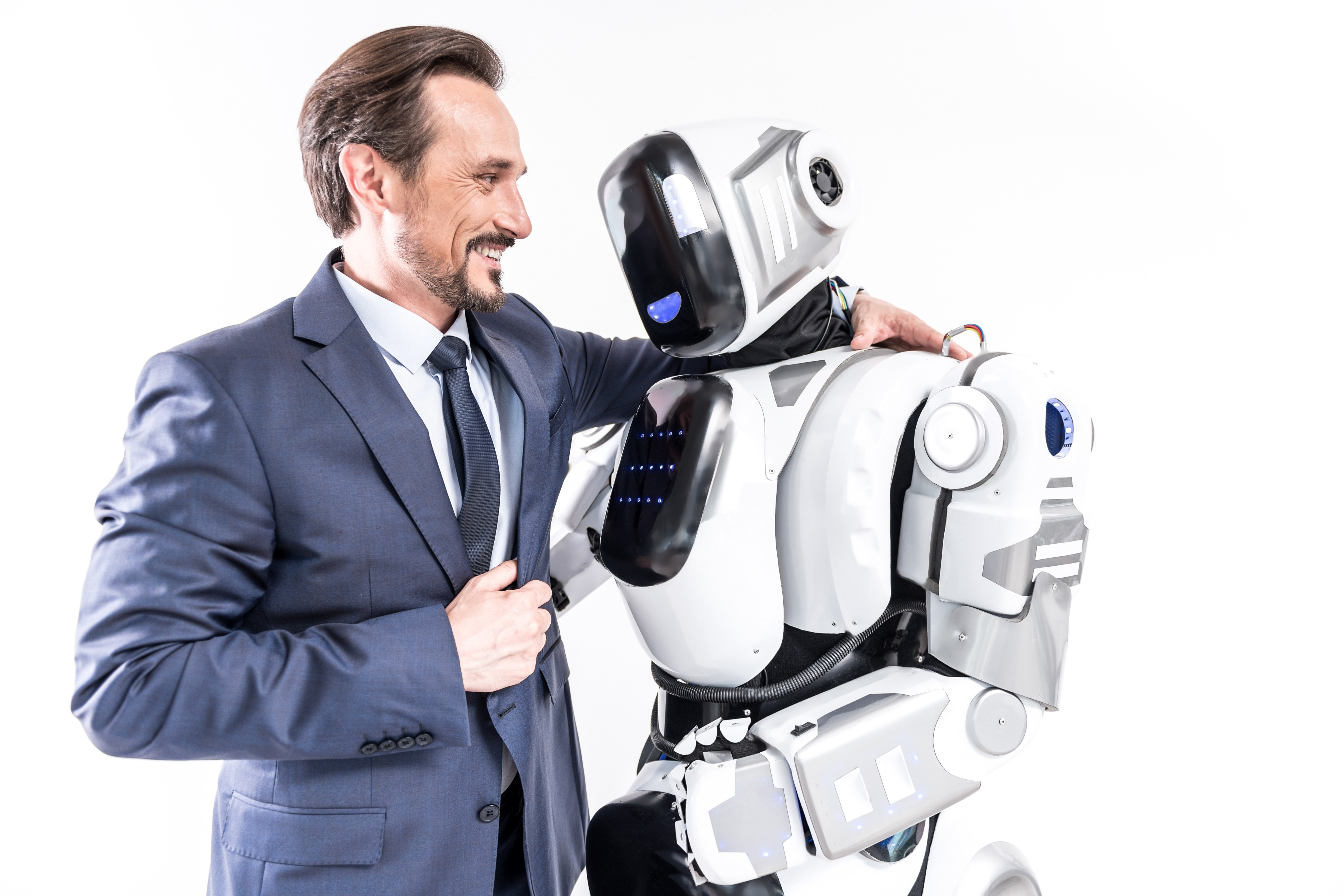
It’s a fast-moving world, and few places are changing more quickly than the work environment and the platform economy. Each Friday, in this column, we’ll attempt to connect some dots, blending the interviews and conversations we’re doing here at Reinvent with the news that’s breaking around us. We hope the deep-dive conversations conducted at our events, in our studios, and over video online provide some key insights into the larger issues shaping the world, and give you a thoughtful weekend reflection about a world that’s moving briskly into the future.
One question pops up in every discussion about the future of work: will a robot take my job?
The short answer, with some exceptions (and we’ll get to those), is no. Still, public anxiety about robot-led job displacement has never been higher. A recent Pew Research Center study found that 77 percent of respondents believed robots could eventually replicate most human work tasks, even while only 30 percent thought that robots could capably do their job.
Maybe robots won’t replace one-third of the American workforce by 2030, as a dire McKinsey study predicts, but that’s cold comfort on sleepless nights when you’ve got bills to pay and mouths to feed. There’s no question that robots and the artificial intelligence software which drives them will have some impact on what’s next in the workplace. “A few occupations will disappear, but many occupations will be transformed and many will shrink,” said UC Berkeley Economics Professor Brad DeLong , during a recent interview with Reinvent.
The componentry for change is already in place. AI is pervasive in our world, although it’s not inherently scary. AI is a simply a set of algorithms, machine learning, and natural language processing tools that are already a key part of many technologies we use every day, from personalized ads to voice recognition apps. This is not the AI you’ve seen in sci-fi movies, with nervous scientists clacking away on keyboards and attempting to halt machines from destroying the world.
Your smartphone, house, bank, and car already use AI on a daily basis. Sometimes it’s obvious, like when you ask Siri to get you directions to the nearest In-N-Out Burger joint, or Facebook suggests a friend for you to tag in a picture you posted online. Sometimes it’s less so, like when you use your Amazon Echo to make an unusual purchase on your credit card (like that goofy holiday sweater) and don’t get a fraud alert from your bank.
AI is already bringing about major shifts in society through developments like self-driving cars and better medical diagnosis, and it will certainly be the backbone of many of the most innovative apps and services of tomorrow. But, for now, a clear picture of how it will impact the workplace is uncertain.
Man-machine collaboration
Ken Goldberg, a professor of engineering at UC Berkeley, says that we shouldn’t worry about robots replacing workers, but instead should seek ways in which robots can complement our work. Together, carbon-based life forms (that’s us) and highly programmed bits of hardware and software (that’s the AI-based bots), will each work on what we do best. Computers are very good at rapid calculation, finding patterns in mountains of data, and doing repetitive tasks. We humans excel at creativity, non-linear thinking, understanding, purpose, and passion. An AI program has none of these. Instead, it should be seen as a supplement to our creative brain.
Goldberg believes these complementary abilities portend a future replete with AI-driven intelligence amplification. He calls this idea the multiplicity. “Rather than a monolithic AI that’s coming to take over and surpass humans, multiplicity is about robots and humans working together,” Goldberg said during a recent presentation on the future of work for Reinvent’s What’s Now:San Francisco series.
“It’s not a matter of us versus the machines. That’s the old way of thinking. It’s really about us working with the machines … to provide a new way of thinking.”
This man-machine neurodiversity will lead us into new areas of collaboration and insight. “It’s not a matter of us versus the machines,” Goldberg said. “That’s the old way of thinking. It’s really about us working with the machines…How can we combine groups of machines with diverse groups of humans in appropriate ways to get them each to perform most effectively? The machines will have a seat at the table, to provide another level of thinking, and it’s a matter of understanding what they can do and use it, rather than fear it.”
Some jobs are going away
To keep up with these changes, people will need to be nimble and flexible in their career choices. It won’t be enough to simply say “I want to be a doctor,” or, “I want to be a teacher.” Instead, the doctors and teachers of the future will also be skilled in data analytics and using AI tools to innovate, communicate, and do their jobs better. AI apps are designed to get smarter over time, so they’re a very powerful tool. But they need a smart human to guide them.
Nonetheless, repetitive low-skilled jobs may be replaced. Said DeLong: “In the next 50 years an awful lot of paper-shuffling tasks are going to be taken over by software bots, and a lot of blue-collar traditionally male jobs are going to be taken over by robots…Not just blue-collar manufacturing workers, but also blue-collar construction, and blue-collar transportation and distribution warehouse workers are going to be hit by the coming of technology. Also what used to be white-collar work is going to start disappearing as expert systems and software bots take it over.”
Just this week (Jan. 22), Amazon open the doors on it’s new AI-powered grocery store. Customers at the Seattle-based Amazon Go shop can walk around the store tossing food in their basket, then skip the cashier and walk out with their purchases. The hungry shopper quickly scans a code on the Amazon Go app as they walk in, and then is tracked around the shop with AI-monitored video. Any product they leave with is charged to their Amazon account. No cashier is involved unless you’re buying beer or wine, when an ID must be checked.
How widespread will be the impact of AI be on low-skilled jobs? Some predictions are quite dire. Up to 5 million Australian jobs, or 40 percent of their workforce, will disappear in the next 10 to 15 years, according to the Committee for Economic Development of Australia. In regional areas, as many as 60 percent of jobs will be affected. Robotics will replace many of them, the report notes, largely in the sectors of manufacturing, agriculture and manual labor.
Forward-thinking politicos are hoping to channel money gained by firms that employ job-stealing robots back toward those whose work will disappear. San Francisco city supervisor Jane Kim, for instance, told Wired that she would support a Jobs of the Future Fund to study a statewide tax on machines that eliminate human jobs. Proceeds would fund job retraining initiatives as well community college classes or even a universal basic income. Bill Gates has said he would support a similar idea.
The result of what DeLong calls “the rise of the machines” will be a foundational economic disruption and the income and wealth distribution will be be substantial, he notes. But it’s not the first time tech has caused tectonic shifts in the workforce. “We have already eliminated all jobs several times in human history,” futurist Ray Kurzweil told Fortune, “How many jobs circa 1900 exist today? If I were a prescient futurist in 1900, I would say, ‘Okay, 38% of you work on farms; 25% of you work in factories. That’s two-thirds of the population. I predict that by 2015, that will be 2% on farms and 9% in factories.’” And everybody would go, ‘Oh, my God, we’re going to be out of work.’ “
Despite the panic, the tech shift could create more jobs than it destroys. “For every job we eliminate, we’re going to create more jobs at the top of the skill ladder,” said Kurzweil. Such as? “Well, I don’t know. We haven’t invented them yet.”
The robot revolution is coming, no question, and it’s causing great angst and uncertainty. Pew found that 64 percent of Americans believe that those who lose their job to a robot will be at a loss for what to do with their lives. That’s a depressingly large number. In the workplace, we’ve put so much value on increasing productivity that we’ve forgotten the value of helping others live a decent life. Ultimately, we must manage how beneficial (or devastating) the rise of the robots will be in our collective desire to create a dignified human future.