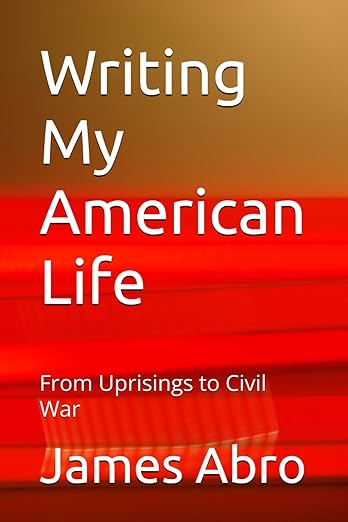
In August, Ivy House Studio hosted a book launch for my just published memoir. Writing My American Life: From Uprisings to Civil War.
When asked, I tell people that I believe we are now on the verge of another Civil War in America because we didn’t address the causes and reasons for the first Civil War, nor have we as a society come to terms with why Black Americans rose up in rebellion not that long ago in cities across America during the late 1960s.
I do not think you can understand the first Civil War, or prevent another one from taking place, if you refuse to acknowledge what Slavery was like in America. Both of my parents were first generation Americans, so there was no one from my family who was around then to pass down the knowledge. Like most Americans, I studied history in high school and college. So, I knew the dates and places of the Civil War, but not why it took place. Books and movies made it seem like slavery was a benign and even quaint part of southern plantation life.
It wasn’t until I was an adult, when I read Toni Morrison’s novel Beloved, that I began to understand what it was like to be enslaved. The novel is based on a true story about a Black woman who, when she finds out that her only child, her daughter. is about to be interned in slavery, kills the child.
All of us who have experienced motherlove knows how strong that bond is and probably cannot comprehend how any mother in her right mind could kill her daughter. Yet it happened. Why?
There is a reason Toni Morrison is one of only a dozen American writers who earned a Nobel Prize for Literature. Morrison provides a harrowingly detailed narrative about what it was like to be a slave. It was essentially to live under the yoke of a systematic brutalization of a race of people to dehumanize them so much that they’d allow themselves and their children to be bought and sold as property, to be done with as their owners pleased.
When the woman is arrested and charged with murder, her defense attorney eloquently argues for an acquittal of the murder charge on the grounds that under the circumstances the homicide was justified. You will find yourself going against every human instinct there is to protect children, like I did, and then agree that given the choice between slavery and death, killing the child was the more humane option. That’s how horrific slavery was administered in America.
Slavery has been a part of the human story throughout history. When one nation state conquered another, it was standard operating procedure for the vanquished country to provide slaves to the conqueror. But, and this a big but, the enslavement lasted only for one generation and the offspring of slaves could then assimilate into society or return to their home country if they wanted. Not so in America where slavery lasted for four hundred years and enslaved eighteen generations of Black Americans. That also meant that eighteen generations of white Americans were indoctrinated into believing in white supremacy and black inferiority, enshrined in legal segregation and Jim Crow laws while being enforced by wanton racial violence that included public whipping and lynching.
The question is not whether America should provide Black American with reparations for the unpaid labor that made America an economic superpower. The question should be how much and how soon.
I also do not think you can understand why Black Americans rose up in rebellion – in Detroit, Watts, Chicago, Atlanta, Birmingham, Los Angeles Chicago, and New York, and Newark, and New Jersey where I grew up -- if you are not familiar with ghettoes. In every city that when up in flames, its Black residents were forced live in ghettoes, densely populated urban environs cut off socially and financially from the rest of America.
In 1963, Martin Luther King delivered a speech that provided the intellectual reasoning and moral justification for the Uprisings that took place less than a decade later.
The same mainstream American media that attempted to redefine the Uprisings as 'race riots', also attempted to defang King's speech by mislabeling it as his I Have a Dream Speech. This is what he actually said that day.
“One hundred years after slavery, the Black American lives on a lonely island of poverty in the midst of a vast ocean of material prosperity, languishing in the corners of American society, an exile in his own land. It would be fatal for the nation to overlook the urgency of the moment.’
Well, America did ignore the urgency and forewarning given at that moment. As a consequence, American cities went up in flames. followed by the assassination of King by a deranged loner and white supremacist.
I have family in Newark where one of the largest Uprisings took place. Newark at the time was tribal. You had your Italian sections of the city, Irish and Jewish ones. To get to any one neighborhood, you had to pass through one of more of the others.
The Black section of the city was like none of the others. If you saw it for the first time you would probably think it had been ravaged by war and this is what was left standing, barely. Many of the downtown commercial buildings were abandoned or in disrepair, and the people you saw there looked beyond weary from the everyday grind of trying to survive while being intentionally sequestered in poverty. These ghettoes were completely cut off from the outside resources – jobs, infrastructure funding, financial investment, etcetera - that made the rest of America one of the wealthiest countries in the world. When you passed through the ghettoized section of the city you could feel how the atmosphere was charged with despair, desperation, anger and rage.
I was the youngest in my family, a toddler at the time of The Uprisings, so I sat in the front seat of our car between my parents while my older brother and sister played in the back.
Whenever we came up on the ghetto, I would feel myself become anxious and short of breath. Then I’d bury my head in my mother’s coat until we passed through. I would not have the words to express what I was feeling at that time until years later when I heard people chanting ‘I Can’t Breathe!’’ If I felt that way just by passing through the neighborhood, I could only imagine how the people living there felt.
So, I was not surprised when The Uprisings fired up Newark. If anything, my younger self was not able to understand why the rebellion didn't happen sooner.
Not that long ago, many of us were feeling that America was finally moving past its history and practice of white supremacy and racism. There was the two-term presidency of Barack Obama and then the solidarity and outpouring of empathy by so many Americans in the aftermath of the killing of George Floyd.
But here we are again, finding ourselves facing another racist backlash, led by a demagogue opportunist. Thus, we find ourselves on the precipice of another Civil War.
So where do we go from here? What are we gonna do?
The shit is going to hit the fan in 2024 no matter what happens in the election. I feel we need to start preparing ourselves for that now by fortifying our communities, so we have safe places to go to and network.
My family may not have been here for the first American Civil War. But I am here now because they knew how to survive and overcome autocrats and dictators. We can do this!
Peace.
Writing My American Life: From Uprisings to Civil War on Amazon.