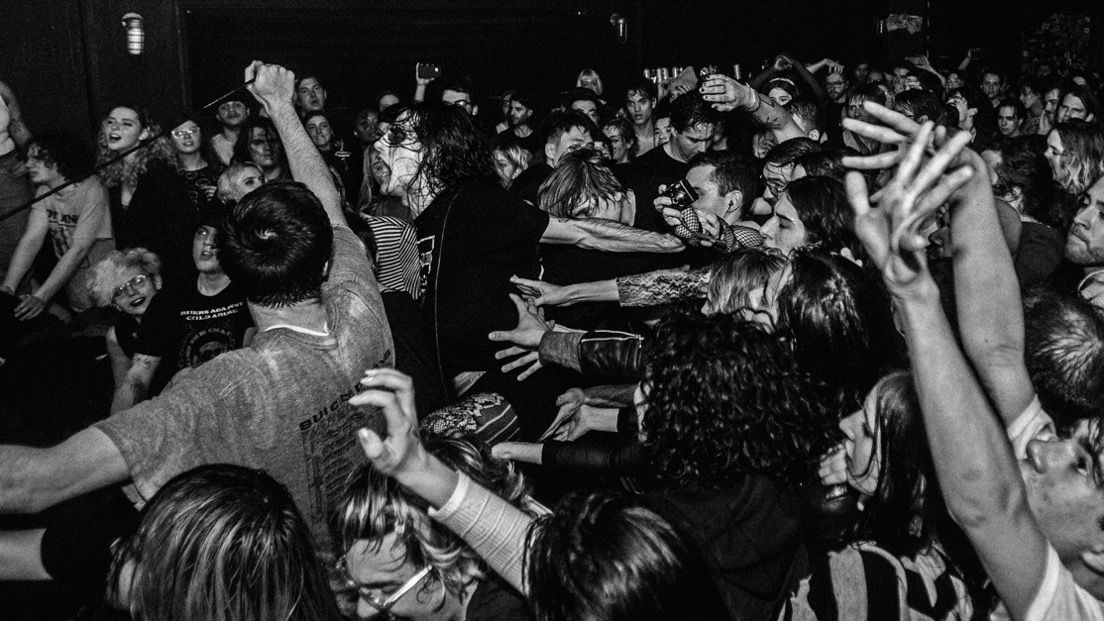
The world is becoming angrier and more isolated, and punk has been digitally reborn to fight crypto scams, digital hellscapes and Elon Musk. New York based band Machine Girl has been virtually fighting ‘the man’ for the better part of a decade, declaring in the title of their 2017 album: ‘Because I’m Young, Arrogant, and Hate Everything You Stand For’. The group’s popularity has skyrocketed in the following years and has tapped into a growing discontent in a disillusioned youth. It’s vulgarity weaponised as left-wing political expression and it’s deeply popular, with their most successful song garnering 44 million plays on Spotify alone.
Bandleader Matt Stephenson snarls imperatives and judgement to an audience clutching outdated Nintendo consoles and vapes with LCD screens. Statements like ‘The voice in the mushroom cloud says, ‘It’s time to make your father proud’’ and ‘What's the antidote to global psychosis? Another world war, or the children of COVID?’ are deeply provocative. They speak to an abandonment that young adults feel even from left-wing politics, rejecting liberalism as ‘a tool of corporate interest and a failure of imagination’. The stealthy rise of the radical right has been discussed for years at this point, with Gen Z Maga warriors now being household names. The rise of an equally potent left-wing sect is almost inevitable, and music like Machine Girl’s indicates we might be hitting a tipping point: ‘You got your truth and I got mine. You can make it up if you can't find it online’

Asked about this growing resentment, Stephenson says: ‘I think that the pessimism is something that everyone feels, even slightly older generations. But why we're feeling that pessimism, and what people believe are the culprits of why things feel like they're getting worse, are obviously different between generations and political ideologies. But I think for most young people it's just weird and f***** up, growing up in a world where everything is just getting worse and there's no sign of it getting better.’
They’re caught between writing rallying cries and warnings to their generation of younger fans. The sheer amount of ‘brainrot’ that the average person is exposed to online is enough to sterilize any critical thought, and the rending, static feedback that Machine Girl tames almost uses the enemy against itself. Their songs change tempos and electronic genres wildly, with glitched lyrics that one couldn’t hope to catch without a google search. It’s hypnotic, almost reminiscent of the sound of a dial up modem connecting.
“It's just like, every turn has been this horrible, historical moment that is definitely making a downward turn. And so that's just always been reflected in my music. Had I maybe been born 20/30 years earlier, the music I would have made probably wouldn't be so angsty and negative.”
Movements like the one that Machine Girl represents have obviously been around far longer than their post covid boom. One only needs to look at this band’s decade of momentum to see this, but something is shifting to catch millions up with them. Cultural moments like ‘#DarkWoke’ and ‘the dirtbag left’, both from this year alone, are a crystallisation of the kind of rebellion these artists represent. The former hashtag, garnering 100,000s of likes, is best understood by one its first tweets: ‘My Grandma voted for Trump so I made sure she fell down the stairs.’. There has later been a resurgence in its usage following the assassination of Charlie Kirk. The latter refers to a brash sect of left-wing figures who are unconcerned with politeness politics in favour of radical change. There’s mostly sardonic humour at the core of these that rarely reaches the outside world, but they do represent something nascent and powerful. Fringe right-wing murmurings 10 years ago were discussed with a similar flippancy. For these new punks and dirtbags, why take the high road if no one else is? This version of the left is no longer overly polite, non-committal and pathetic. It’s a bitter, righteous fury built from moshing and mainlining hatred.
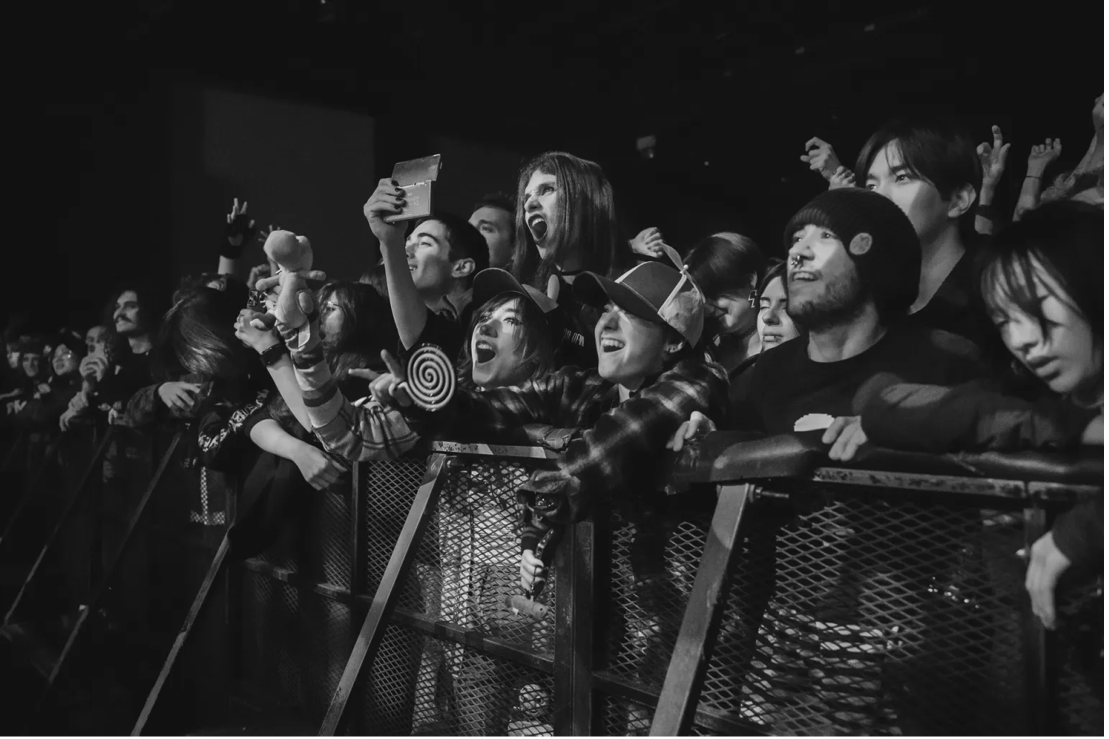
As Stephenson themselves said, musical like this is fundamentally reactive. Punk sentiments have always been a response to institutional failing. Inconceivably high inflation and unemployment rates were rampant around the time of God Save The Queen’s 1977 release. Faith in the government’s capacity to actually solve the UK’s problems had been almost completely lost and Johnny Rotten was here to command us not to be told what we need. History is repeating itself and the targets of punk’s ire seem broadly the same. CEO’s, landlords and tech entrepreneurs all take punches. The main difference now being that they’re digitised and seemingly less reachable or concrete. The subjects of Machine Girl and similar artists’ music is less specific than these historical hit pieces, instead directed at the institutional problems themselves. Reticent to namedrop, Machine Girl opening act LustSickPuppy’s song titled American Healthcare pleads to an unspecific medical authority ‘I am not your enemy, I am begging for empathy, but they want the death of me’. There is a deep disfranchisement that is often mischaracterised as an apathy in Gen Z. A sense of being utterly powerless to influence the powers-that-be permeates, and that frustration has to go somewhere. Artists like these are crystalising that for more and more people as technocrats and CEOs are closer digitally yet harder to humanise than ever before. Machine Girl’s outrage isn’t as specific as The Sex Pistols’, but it’s a wrath that’s once again gone from being fringe to centre stage.
“Punk as an ethos, as a rebellious counterculture thing, is something that isn't genre specific. There's aspects of so many other genres of music that are arguably more quote, unquote punk than punk music. Like early hip hop, early electronic and dance music.”.
While absolutely identifying Machine Girl as a punk outfit, Stephenson is reticent to link it to any historical punk movement. It more functions as a one-size-fits-all misnomer to flag the bucking of cultural trends.
"Even punk itself, is this weird genre where there's not really a super clear lineage, narrative to the genre as a whole. It's not like this lineage you could simply plot out.”
The question is whether this new movement will have as much of an impact as punk sincerely did. Punk was impactful and stunt driven, disrupting jubilees and fashion cycles. Part of this was down to their shock factor, with God Save The Queen being banned from radio and punks being mired in most major publications. Focus often lingers on their lyrics, but part of this was also down to just how unintelligible that sound and aesthetic was to most people. ‘It sounded truly dreadful, but it felt like I was witnessing the second coming!’ a student stated in 1977 in regard to The Sex Pistols. Machine Girl and other such artists clearly use a similar “dread” as inspiration, with Stephenson stating that boundary-pushing provocation has always been compelling to them. The difference is while their rebellion is absolutely felt virtually, we rarely see this translate into spotting cyberpunks on the street. There is nowhere near as definitive a visual style to this new wave of data moshers. But this is primarily intentional, with Stephenson rejecting any form of homogeneity: “Especially if your rebellion has an aesthetic, it will be co-opted and marketed”. But punks were in some capacity powerful because of their immediately recognisable visual identity. Ketamine chic, a style characterised by sardonic overconsumption may have some zealots, but we could actually see the DIY punks amongst us before their inevitable commercialisation. Where are the hundreds of thousands of neo-punk dirtbags? Dr Simon Sleight, professor of urban history and historical youth cultures puts this partly down to the isolation and loneliness that explains why this movement has moved online in the first place.
“As bombs fall and seas rise, so too a rightful indignation at the failure of always-older politicians to listen and act. What's different now is the bedroom rebellion part of this, with music being conveyed and consumed virtually, without any need to journey to gig venues in the first instance. A generation used to digitally mediated conversations is also roaring to life through punk once more, albeit sometimes at the remove of a monitor or phone screen. There's a fascinating mix of shyness and outré expression here as well. Musical artists have always possessed alter egos, and now that can happen virtually too. Will there be a popular punk icon like Hatsune Miku, one wonders? Or will Hannibal Niccals (the punk older brother of Gorillaz's Murdoc) form his own digital band?”
Machine Girl seems to be the exact answer to this question. Even if we can’t see the cyberpunks now, they don’t seem far on the horizon.