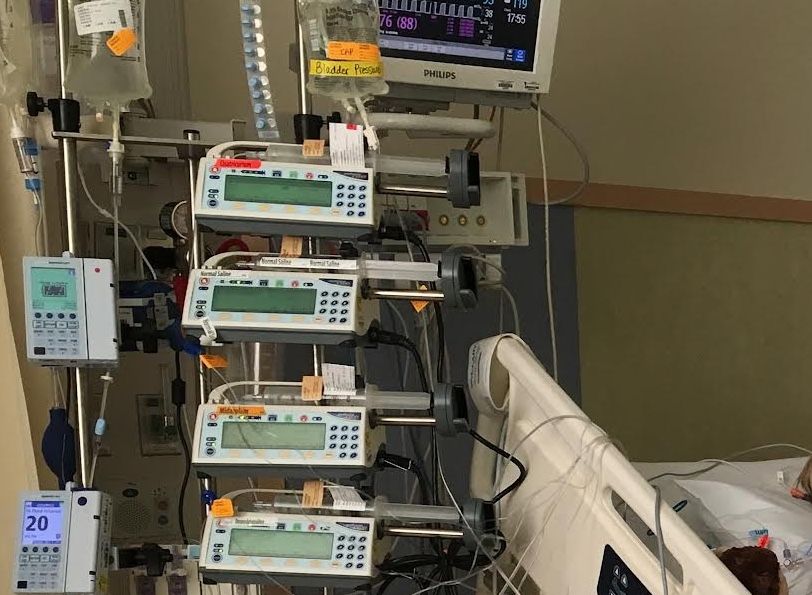
If you dig deep enough in my sent emails (for your own peace, please don’t) you’ll find an email I sent to my family and close friends on April 30, 2017, from our 8-year-old son’s ICU bedside in Children’s Hospital, Denver. I didn’t even do the “Dear”:
I know everyone has had sleepless fragments from me, and then long silences. I'll try to fill in a tiny fraction of what's happened.
Reed's diagnosis is
Influenza B
Varicella tracheitis
Methicillin-susceptible staphylococcus aureus
Septic shock
Acute renal failure
Acute hypoxemic respiratory failure
Fluid overload
Thrombocytopenia
They took off the paralytic on Friday afternoon. Friday night he opened his eyes a few times and yesterday he moved his legs. He needs to stay calm so they sedated him some more. He's still intubated.
This has all happened before. On Tuesday they took off the paralytic; after a disturbingly long time (on Wednesday) he opened his eyes from time to time, squeezed hands, moved his feet, and by the next morning he had gone downhill so fast he had to be transported by flight team to Denver.
We had thought for sure when he started moving he was on the way up — but not only was he still in renal failure, his respiration was dramatically worse and they thought he could have pneumonia. His kidneys couldn't clear the fluid overload even with lasix so he needed dialysis he could only get in Denver. He was completely sedated again and put back on 100% oxygen.
He had a top-shelf flight team for the transfer to Children's and thank God, because he needed so much intervention on the way up to keep breathing. He has now had a bilateral thoracentesis (tubes between the ribs into the chest cavity) which drained 480ml of fluid from around his right lung and 150ml from his left in the first couple of hours and has been draining since. He had his first dialysis Friday, which we were very anxious about. Seeing the intrajugular catheter they placed in his neck for dialysis is one of the few things that's actually made me blanch and need to sit down quickly. It's hard to look at. Dialysis was definitely the right thing to do and it made the world of difference. His body is almost not swollen anymore and his breathing is so much better without the massive fluid overload.
He is still intubated and will have dialysis again today. He has been opening his eyes and moving, but after they did the initial testing of his responses we have just let him stay as sedated as possible. He has so much to heal from. The biggest worry remains his kidneys. He passed his oxygen/breathing trial in the early hours of this morning so we hope he might be extubated tonight. That would be huge.
Four times I have heard quite bluntly from different doctors how close he was to not being with us anymore. I never asked. But they said we had less than an hour to spare.
The terrifying thing is how quickly it happened and how no one saw it coming — including his doctors. Kids really can get catastrophically ill that fast. Google 'systemic inflammatory cascade in sepsis' for an inadequate idea of part of what went wrong.
We are far from out of the woods. And when we are, he is going to have a long road to recovery, no matter how quickly he climbs right now. I'm collecting and focusing on every prayer. Thank you for praying and for all your kindness and love. I'm convinced it makes the difference. Please pray for Reed to keep fighting and not to be traumatized by this long ordeal. Please also pray for Reed's doctors, and pray for us to save our nervous breakdowns for later in the year.
We love you all.
Last month was Sepsis Awareness Month, but if you give me a minute or a soapbox I’ll never think there’s a wrong time to tell you about sepsis — what to look for, what to ask about, how quickly it can kill. Sepsis is the body’s overwhelming and life-threatening response to infection, which can lead to tissue damage, organ failure and death. Septic shock (severe sepsis) is what nearly killed Reed. It kills 270,000 Americans each year. Many more lose limbs, and suffer chronic pain and lifelong organ dysfunction, as well as PTSD. In the United States, more than 75,000 children develop severe sepsis each year. Almost 7,000 of these children die. That’s more than those who die of pediatric cancers.
It can start in so many ways — an infected cut, a hangnail, strep, a post-operative infection — and it’s fast. Like a stroke or heart attack, sepsis is a medical emergency. If you don’t get the right treatment in a very small window of time, it can be deadly.
To drive this home, the Sepsis Alliance has launched the “It’s About T.I.M.E.” campaign, emphasizing the symptoms to look for:
T: Temperature higher or lower than normal
I: May have signs and symptoms of an infection
M: Mental decline — confused, sleepy, difficult to rouse
E: Extremely ill — severe pain, discomfort, shortness of breath
“If you experience a combination of these symptoms,” the Sepsis Alliance says, “call 9-1-1 or go to the hospital with an advocate. Ask, ‘Could it be sepsis?’”
Doctors and nurses at Evans Army Community Hospital on Fort Carson, Memorial Central in the Springs, and Children’s Hospital in Denver saved Reed — along with a thousand prayers, along with one question I asked the ER doctor the first time we were sent home from the hospital with what they thought was croup: “If this was your child, what would make you bring him back?” I didn’t ask “Could it be sepsis?” because it didn’t cross my mind. It’s astonishing, really, because I was so aware of sepsis. It nearly killed my dad almost nine years earlier, the month before Reed was born. But Dad’s septic shock started with a catastrophic post-operative infection; years later, I just didn’t make the connection. It didn’t cross my mind that Reed’s sore throat could turn sinister so fast.
Reed and my dad are among the very, very lucky ones, but they both still deal with fallout and increased risk from their battles with septic shock. If I can save anyone that anguish by getting preachy about this, I always will. Take infections seriously. Don’t dismiss symptoms in yourself or others. Look for T.I.M.E. Get help early. Ask “Could it be sepsis?” You can save a life.